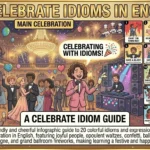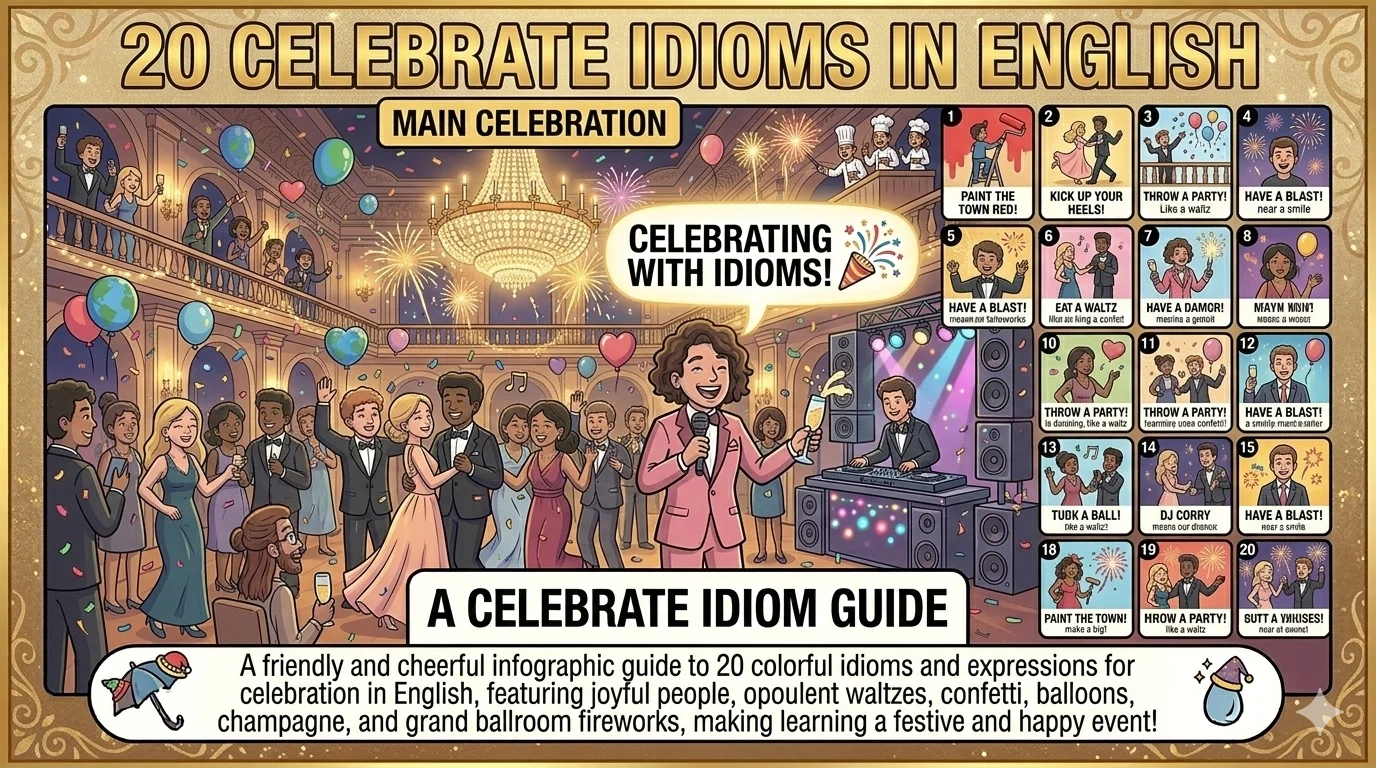
Celebrate idioms are fun expressions used when people talk about success, happiness, or special moments. Instead of simply saying “we celebrated,” English speakers often use colorful idioms that make conversations more lively.
For example, when your friend gets a new job, you might say “Let’s paint the town red!” These expressions make language exciting and memorable. In this guide, you’ll learn 20 popular celebrate idioms, their meanings, examples, and common mistakes so you can use them confidently.
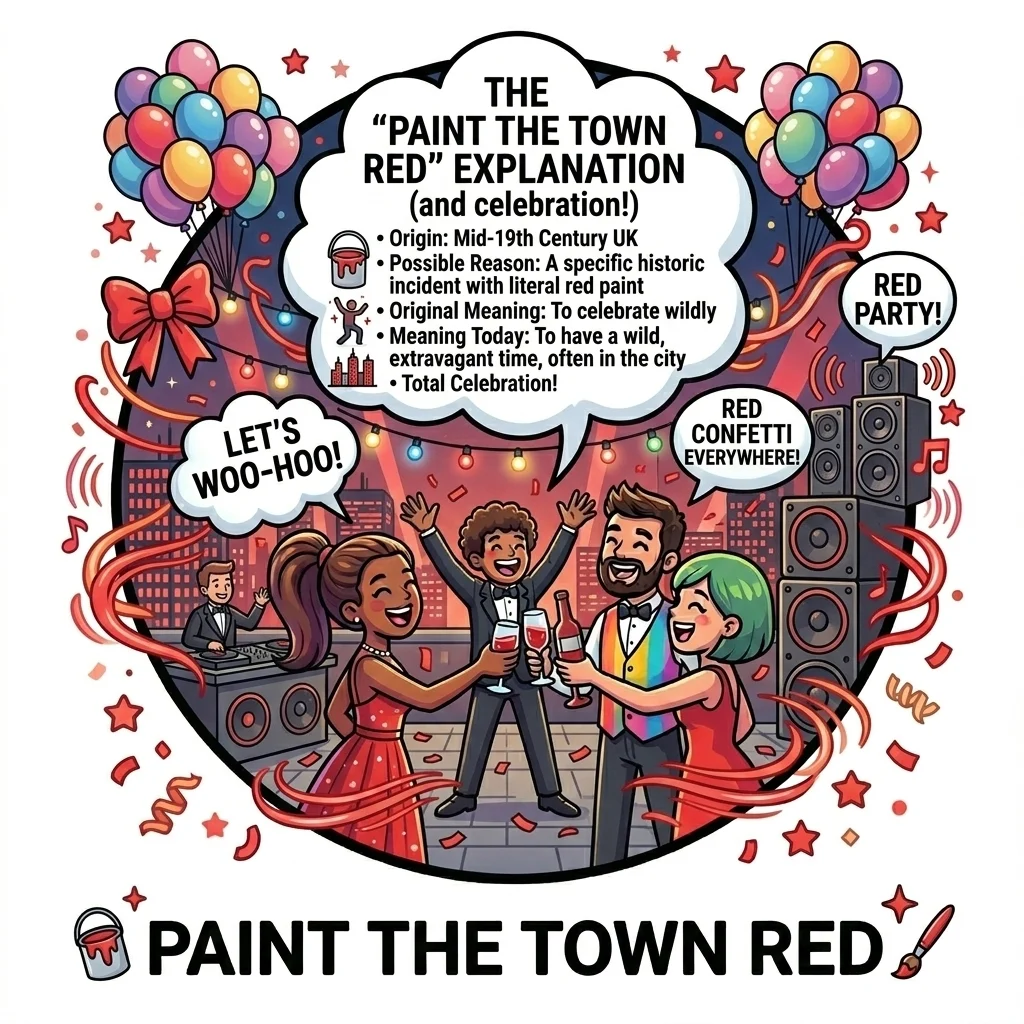
Paint the Town Red
Word-by-word meaning
- Paint – to color something
- Town – city or place
- Red – a bright color
Idiomatic meaning
To celebrate wildly by going out and having fun.
Example sentences
- After passing the exam, we painted the town red.
- They went out to paint the town red after the wedding.
Common error
❌ Paint the city red tonight.
✔ Use town, not city.
Usage note
Often used when celebrating a big achievement.
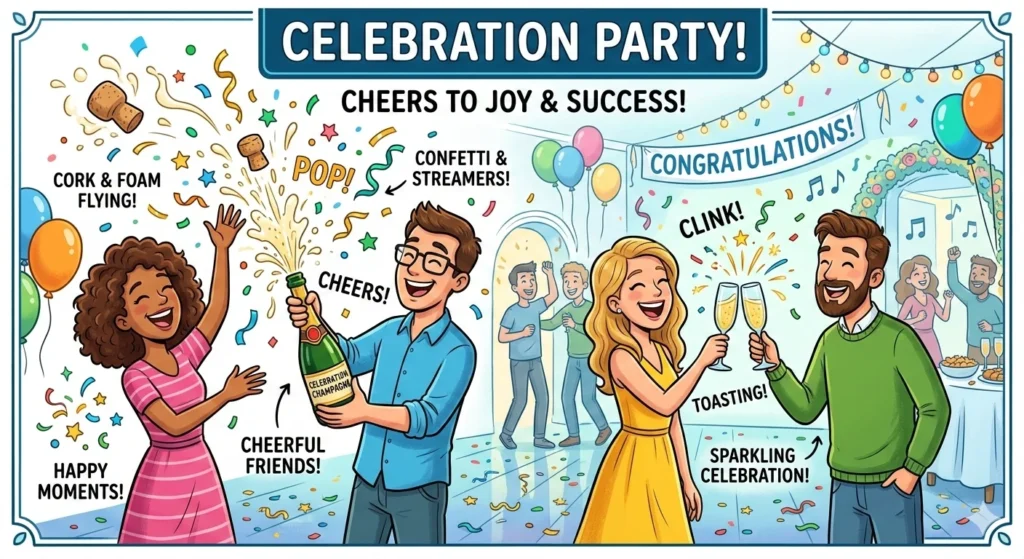
Pop the Champagne
Word-by-word meaning
- Pop – open suddenly
- Champagne – sparkling celebration drink
Idiomatic meaning
To celebrate an achievement or success.
Example sentences
- The team popped the champagne after winning the championship.
- Let’s pop the champagne for your promotion!
Common error
❌ Pop champagne for sad news.
✔ Used only for happy celebrations.
Usage note
Common in professional achievements and big events.
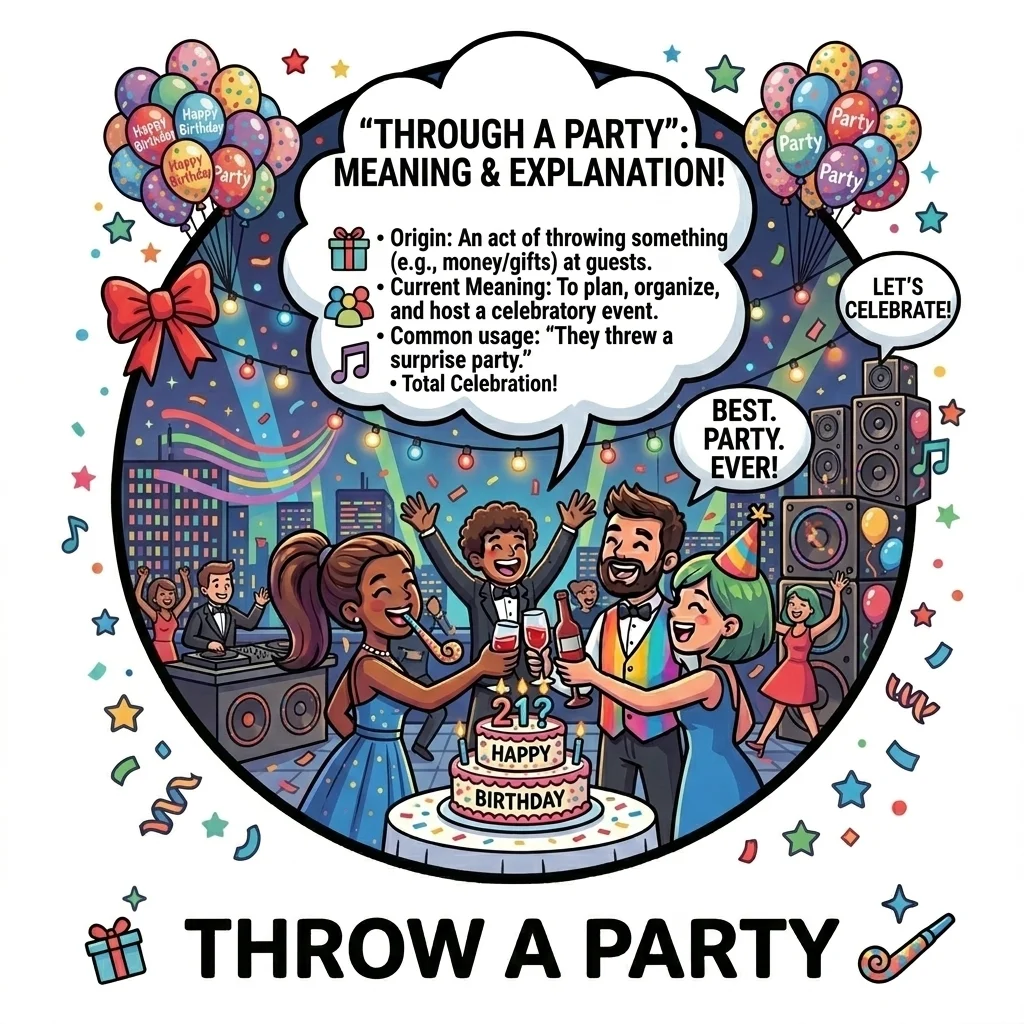
Throw a Party
Word-by-word meaning
- Throw – organize or host
- Party – celebration gathering
Idiomatic meaning
To organize a celebration.
Example sentences
- They threw a party for their anniversary.
- My friends threw me a party for my birthday.
Common error
❌ Make a party
✔ Correct phrase: throw a party
Usage note
Very common in everyday English.
Celebrate in Style
Word-by-word meaning
- Celebrate – mark a special event
- Style – elegance or luxury
Idiomatic meaning
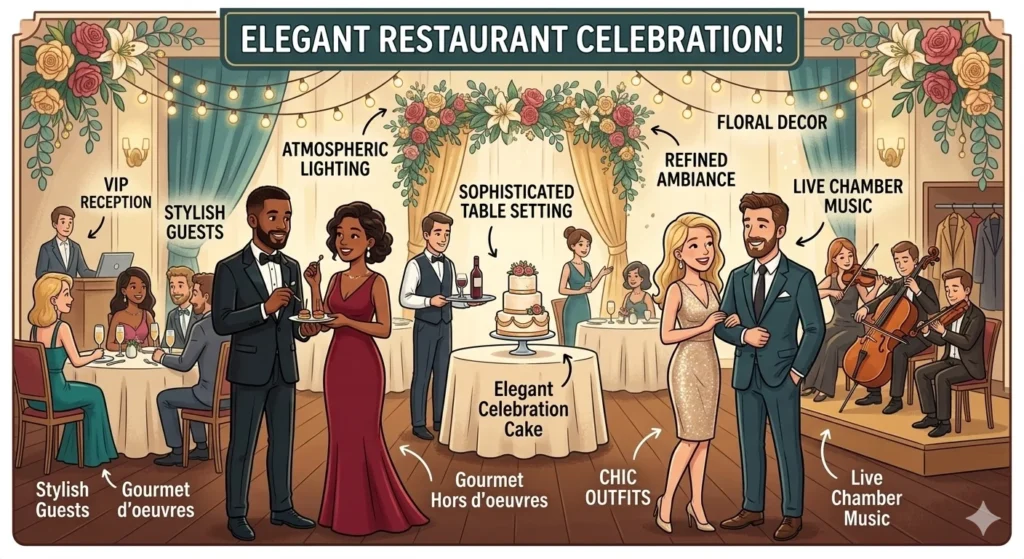
To celebrate in a grand or luxurious way.
Example sentences
- They celebrated in style at a five-star hotel.
- The company celebrated in style after reaching its target.
Common error
❌ Celebrate with style
✔ Correct: celebrate in style
Usage note
Used for fancy celebrations.
Have a Ball
Word-by-word meaning
- Have – experience
- Ball – fun event
Idiomatic meaning
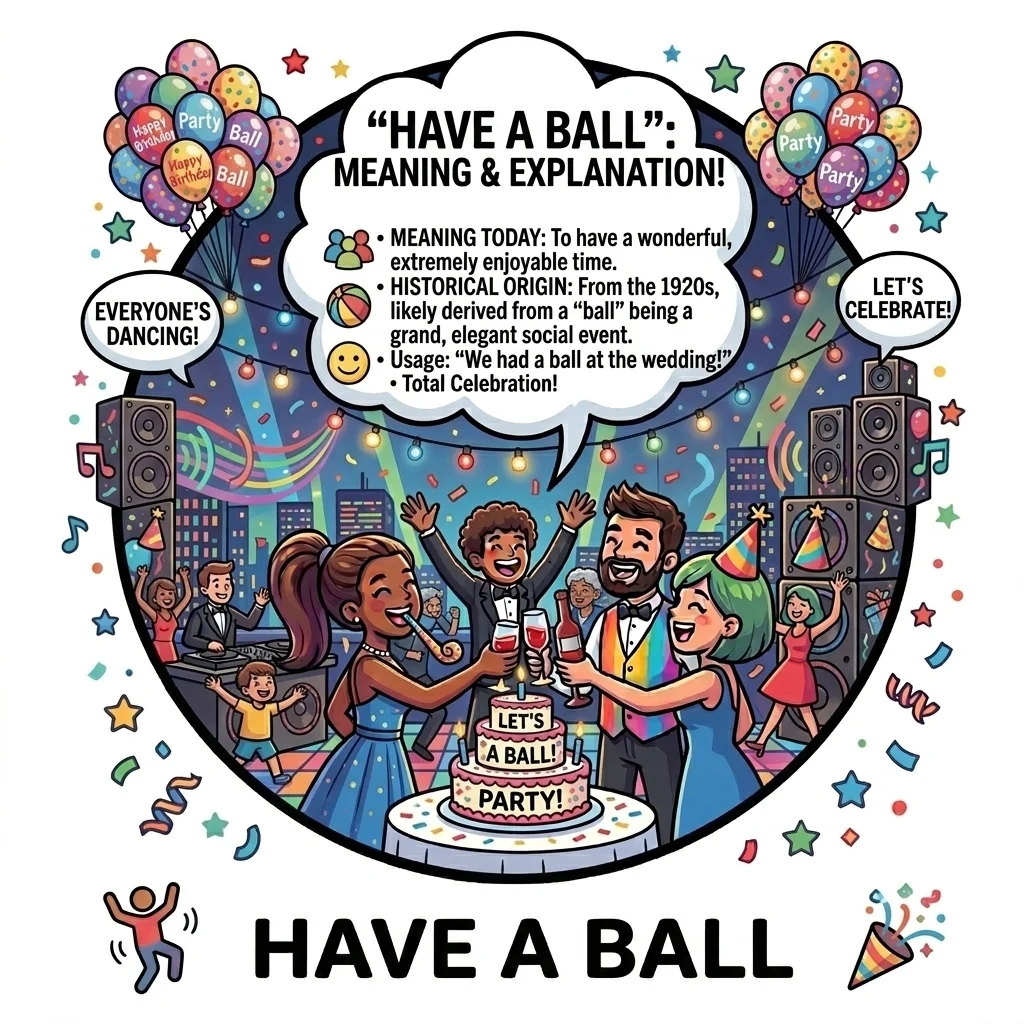
To have a lot of fun.
Example sentences
- We had a ball at the concert.
- Kids had a ball at the birthday party.
Common error
❌ Make a ball
✔ Correct: have a ball
Usage note
Informal and friendly.
Make Merry
Word-by-word meaning
- Make – create
- Merry – joyful
Idiomatic meaning
To celebrate happily with others.
Example sentences
- The villagers made merry during the festival.
- Friends gathered to make merry all night.
Common error
❌ Do merry
✔ Correct phrase: make merry
Usage note
Often used in festive contexts.
Live It Up
Word-by-word meaning
- Live – enjoy life
- Up – fully
Idiomatic meaning
To enjoy life with lots of excitement and celebration.
Example sentences
- They lived it up in Paris after graduation.
- Let’s live it up this weekend!
Common error
❌ Live up party
✔ Correct phrase: live it up
Usage note
Often used during vacations or celebrations.
Ring in the New Year
Word-by-word meaning
- Ring – announce
- New Year – start of the year
Idiomatic meaning
To celebrate the beginning of the new year.
Example sentences
- We rang in the New Year with fireworks.
- Families gather to ring in the New Year together.
Common error
❌ Ring the new year
✔ Correct phrase: ring in the New Year
Usage note
Specifically used for New Year celebrations.
Mark the Occasion
Word-by-word meaning
- Mark – acknowledge
- Occasion – special event
Idiomatic meaning
To celebrate or recognize a special event.
Example sentences
- The school marked the occasion with a ceremony.
- We had dinner to mark the occasion.
Common error
❌ Celebrate the occasion mark
✔ Correct phrase: mark the occasion
Usage note
Formal usage.
Raise a Toast
Word-by-word meaning
- Raise – lift
- Toast – drink honoring someone
Idiomatic meaning
To honor someone by making a short speech and drinking.
Example sentences
- They raised a toast to the bride and groom.
- Let’s raise a toast to your success.
Common error
❌ Make a toast raise
✔ Correct phrase: raise a toast
Usage note
Common at weddings and celebrations.
Kick Up One’s Heels
Word-by-word meaning
Kick – lift the foot
Heels – back of the foot
Idiomatic meaning
To celebrate energetically and enjoy yourself.
Example sentences
- After the exams, students kicked up their heels.
- They kicked up their heels at the wedding party.
Common error
❌ Kick the heels up
✔ Kick up one’s heels
Usage note
Often used for dancing and joyful celebration.
Have a Blast
Word-by-word meaning
Have – experience
Blast – explosion / big excitement
Idiomatic meaning
To have an extremely fun time.
Example sentences
- We had a blast at the festival.
- Kids had a blast playing games.
Common error
❌ Make a blast
✔ Have a blast
Usage note
Very common in casual conversation.
Let Your Hair Down
Word-by-word meaning
Let – allow
Hair – head hair
Down – relaxed position
Idiomatic meaning
To relax and celebrate without worrying about rules.
Example sentences
- It’s Friday night, let’s let our hair down!
- She finally let her hair down at the party.
Common error
❌ Drop your hair down
✔ Let your hair down
Usage note
Often used after a stressful period.
Make a Big Deal of Something
Word-by-word meaning
Make – create
Big deal – important event
Idiomatic meaning
To celebrate something in a big way.
Example sentences
- They made a big deal of his retirement.
- My family made a big deal of my graduation.
Common error
❌ Do a big deal
✔ Make a big deal
Usage note
Used for special achievements.
Roll Out the Red Carpet
Word-by-word meaning
Roll – spread
Red carpet – ceremonial carpet
Idiomatic meaning
To welcome or celebrate someone in a very special way.
Example sentences
- The city rolled out the red carpet for the champion.
- The hotel rolled out the red carpet for VIP guests.
Common error
❌ Put red carpet
✔ Roll out the red carpet
Usage note
Often used for celebrities or honored guests.
Go All Out
Word-by-word meaning
Go – act
All out – with full effort
Idiomatic meaning
To celebrate with maximum effort and excitement.
Example sentences
- They went all out for the wedding party.
- We went all out decorating the house.
Common error
❌ Go full out celebration
✔ Go all out
Usage note
Used for big celebrations or preparations.
Make a Splash
Word-by-word meaning
Make – create
Splash – water movement
Idiomatic meaning
To celebrate or announce something in a noticeable way.
Example sentences
- The company made a splash with its anniversary event.
- She made a splash at the party entrance.
Common error
❌ Do a splash
✔ Make a splash
Usage note
Often used in marketing or public events.
Raise the Roof
Word-by-word meaning
Raise – lift
Roof – top of building
Idiomatic meaning
To celebrate loudly and excitedly.
Example sentences
- Fans raised the roof after the victory.
- The crowd raised the roof at the concert.
Common error
❌ Lift the roof
✔ Raise the roof
Usage note
Used for energetic celebrations.
Have the Time of Your Life
Word-by-word meaning
Time – moment
Life – existence
Idiomatic meaning
To enjoy a celebration more than anything else.
Example sentences
- We had the time of our lives at the festival.
- She had the time of her life traveling.
Common error
❌ Have best time of life
✔ Have the time of your life
Usage note
Used for unforgettable experiences.
Celebrate Like There’s No Tomorrow
Word-by-word meaning
Celebrate – enjoy
No tomorrow – nothing after today
Idiomatic meaning
To celebrate very intensely and joyfully.
Example sentences
- They celebrated like there’s no tomorrow after the win.
- Friends celebrated like there was no tomorrow.
Common error
❌ Celebrate tomorrow not coming
✔ Celebrate like there’s no tomorrow
Usage note
Used for extreme celebration.
Frequently Asked Questions (FAQs)
What are celebrate idioms?
Celebrate idioms are expressions used in English to describe happiness, parties, achievements, and joyful events in a colorful way.
Why should I learn celebration idioms?
They make your English sound more natural and help you understand movies, conversations, and social situations better.
Are celebrate idioms used in daily conversations?
Yes. Many idioms like have a blast or live it up are commonly used in everyday speech.
How can I remember idioms easily?
The best way is to practice them in sentences, conversations, and storytelling.
Conclusion
Learning celebrate idioms can make your English more expressive and fun. Instead of using simple words like celebrate or party, idioms help you describe excitement, joy, and success in a more colorful way.
Start practicing these idioms in conversations, messages, or even social media posts. The more you use them, the more natural they will feel!
So next time something amazing happens, don’t just celebrate — paint the town red and have a blast!

Shirley Jackson, author at SeekIdiom, writes clear explanations of English idioms with examples to help learners improve vocabulary and communication skills.