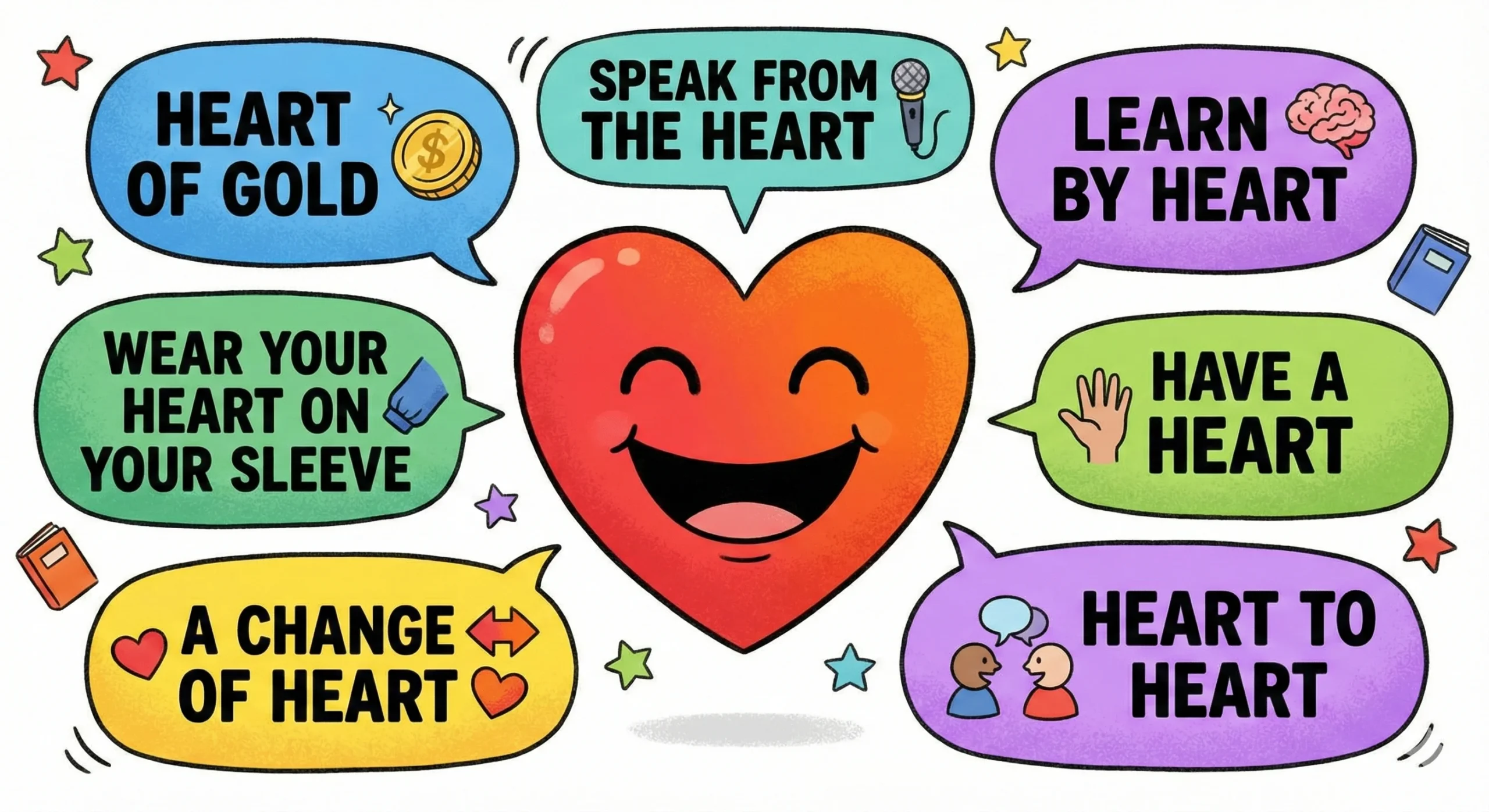
Love and heart idioms are everywhere in English—from movies to casual conversations. Understanding these idioms can make your speech sound more natural and expressive. Here, we’ll explore 20 heart and love idioms with examples, meanings, and usage tips so you can start using them confidently today.
1. Break Someone’s Heart
Word-by-Word Meaning: Break + someone’s heart = literally damaging someone’s heart
Idiomatic Meaning: To cause someone deep emotional pain, usually in love
Example Sentences:

- “It broke her heart when he moved abroad without telling her.”
Common Error: Avoid using for minor disappointments; it implies strong emotional pain
Usage Note: Often used in romantic contexts
2. Have a Change of Heart
Word-by-Word Meaning: Have + change + heart = literally changing one’s heart
Idiomatic Meaning: To change your opinion or feelings about something
Example Sentences:

- “I was going to quit, but I had a change of heart.”
Common Error: Do not confuse with “cold-hearted”
Usage Note: Can be used in love, decisions, or opinions
3. Cross My Heart
Word-by-Word Meaning: Cross + heart = literally make a cross over your heart
Idiomatic Meaning: A promise or oath of truthfulness
Example Sentences:

- “Cross my heart, I didn’t take your book.”
Common Error: Only used informally; avoid in legal contexts
Usage Note: Often used with “and hope to die” in casual speech
4. Wear Your Heart on Your Sleeve
Word-by-Word Meaning: Wear + heart + sleeve = display your heart openly
Idiomatic Meaning: To show emotions openly and transparently
Example Sentences:

- “She wears her heart on her sleeve, so everyone knows when she’s upset.”
Common Error: Don’t confuse with hiding feelings
Usage Note: Commonly used in emotional or romantic contexts
5. Follow Your Heart
Word-by-Word Meaning: Follow + heart = literally follow the heart
Idiomatic Meaning: To make a decision based on feelings rather than logic
Example Sentences:
- “He decided to follow his heart and move to Italy.”
Common Error: Not always practical; implies emotional choice
Usage Note: Often used to encourage someone in love or career
6. Heart of Gold
Word-by-Word Meaning: Heart + gold = heart as valuable as gold
Idiomatic Meaning: A very kind and generous person
Example Sentences:
- “She has a heart of gold, always helping others in need.”
Common Error: Not used sarcastically; always positive
Usage Note: Can describe friends, family, or colleagues
7. Break One’s Own Heart
Word-by-Word Meaning: Break + one’s own heart = hurt yourself emotionally
Idiomatic Meaning: To cause yourself emotional pain, often by loving someone unavailable
Example Sentences:
- “He broke his own heart by hoping she’d notice him.”
Common Error: Do not use literally; purely emotional
Usage Note: Often used in romantic disappointment
8. Eat Your Heart Out
Word-by-Word Meaning: Eat + your + heart out = literally consume your heart
Idiomatic Meaning: Feel intense jealousy or longing
Example Sentences:
- “She’s dating the star of the play—eat your heart out!”
Common Error: Avoid for serious health-related context
Usage Note: Typically humorous or teasing
9. In a Heartbeat
Word-by-Word Meaning: In + a + heartbeat = very quickly
Idiomatic Meaning: Instantly or without hesitation
Example Sentences:
- “I’d help you in a heartbeat if I could.”
Common Error: Not for long-term plans
Usage Note: Often used in offers or promises
10. Pour One’s Heart Out
Word-by-Word Meaning: Pour + one’s heart + out = reveal all emotions
Idiomatic Meaning: Share feelings honestly and completely
Example Sentences:
- “She poured her heart out about her first love.”
Common Error: Not for trivial matters
Usage Note: Used in intimate or emotional conversations
11. Have Your Heart Set On
Word-by-Word Meaning: Have + heart + set on = desire strongly
Idiomatic Meaning: To strongly want or desire something
Example Sentences:
- “He has his heart set on buying a new car.”
Common Error: Avoid using loosely for small desires
Usage Note: Common in love and goals
12. Cold-Hearted
Word-by-Word Meaning: Cold + hearted = literally a cold heart
Idiomatic Meaning: Lacking empathy or compassion
Example Sentences:
- “She’s cold-hearted, never caring about anyone else.”
Common Error: Not to describe mild unkindness
Usage Note: Strong negative connotation
13. Change of Heart
Word-by-Word Meaning: Change + heart = altered feelings
Idiomatic Meaning: Similar to #2; a shift in feelings or attitude
Example Sentences:
- “After talking to him, I had a change of heart.”
Common Error: Do not confuse with physical heart conditions
Usage Note: Common in relationships and decisions
14. A Heart-to-Heart
Word-by-Word Meaning: Heart + to + heart = conversation from the heart
Idiomatic Meaning: Honest and intimate conversation
Example Sentences:
- “We had a heart-to-heart about our future.”
Common Error: Avoid casual or superficial talks
Usage Note: Implies trust and sincerity
15. Out of the Heart
Word-by-Word Meaning: Out + heart = sincere from the heart
Idiomatic Meaning: Done sincerely and genuinely
Example Sentences:
- “She helped out of the heart, not for praise.”
Common Error: Avoid using sarcastically
Usage Note: Often in charitable or kind acts
16. Have a Heart
Word-by-Word Meaning: Have + heart = show kindness
Idiomatic Meaning: Show compassion or mercy
Example Sentences:
- “Have a heart and let him rest!”
Common Error: Not for romantic contexts
Usage Note: Used to plead or request kindness
17. Open Your Heart
Word-by-Word Meaning: Open + heart = reveal feelings
Idiomatic Meaning: Be emotionally open, often in love
Example Sentences:
- “It’s time to open your heart to new experiences.”
Common Error: Not just for talking; implies emotional vulnerability
Usage Note: Common in personal growth and relationships
18. My Heart Skipped a Beat
Word-by-Word Meaning: Heart + skipped + beat = sudden heart movement
Idiomatic Meaning: Feeling sudden excitement or shock, usually in love
Example Sentences:
- “My heart skipped a beat when I saw her smile.”
Common Error: Not literal; used figuratively
Usage Note: Romantic or thrilling context
19. With All One’s Heart
Word-by-Word Meaning: With + all + heart = completely
Idiomatic Meaning: Do something sincerely or completely
Example Sentences:
- “I support you with all my heart.”
Common Error: Avoid casual promises
Usage Note: Often used for deep commitment
20. Heart in Your Mouth
Word-by-Word Meaning: Heart + in + mouth = nervous or anxious
Idiomatic Meaning: Extremely anxious, scared, or excited
Example Sentences:
- “I had my heart in my mouth waiting for the exam results.”
Common Error: Not to describe mild discomfort
Usage Note: Used for fear, excitement, or suspense
FAQs About Heart and Love Idioms
Q1: How can I use heart idioms naturally in conversation?
A: Use them to express feelings in context—romantic, emotional, or empathetic situations.
Q2: Are all heart idioms related to love?
A: No, some express emotion, kindness, or surprise, not only romance.
Q3: Can I use heart idioms in professional writing?
A: Mostly informal, but idioms like “with all one’s heart” can fit motivational or inspirational content.
Q4: Do heart idioms exist in other languages?
A: Yes! Many languages have equivalents for expressing love, kindness, or emotions.
Q5: How do I remember these idioms easily?
A: Group them by emotion (love, kindness, excitement) and practice with example sentences.
Conclusion
Heart and love idioms make your English colorful, relatable, and emotionally expressive. Start practicing them in conversations, messages, and writing. The more you use them, the more natural they’ll feel—your speech will truly have a heart!

“Angela Carter, author at SeekIdiom, explains English idioms with clear meanings, examples, and usage to help learners improve vocabulary and communication.”