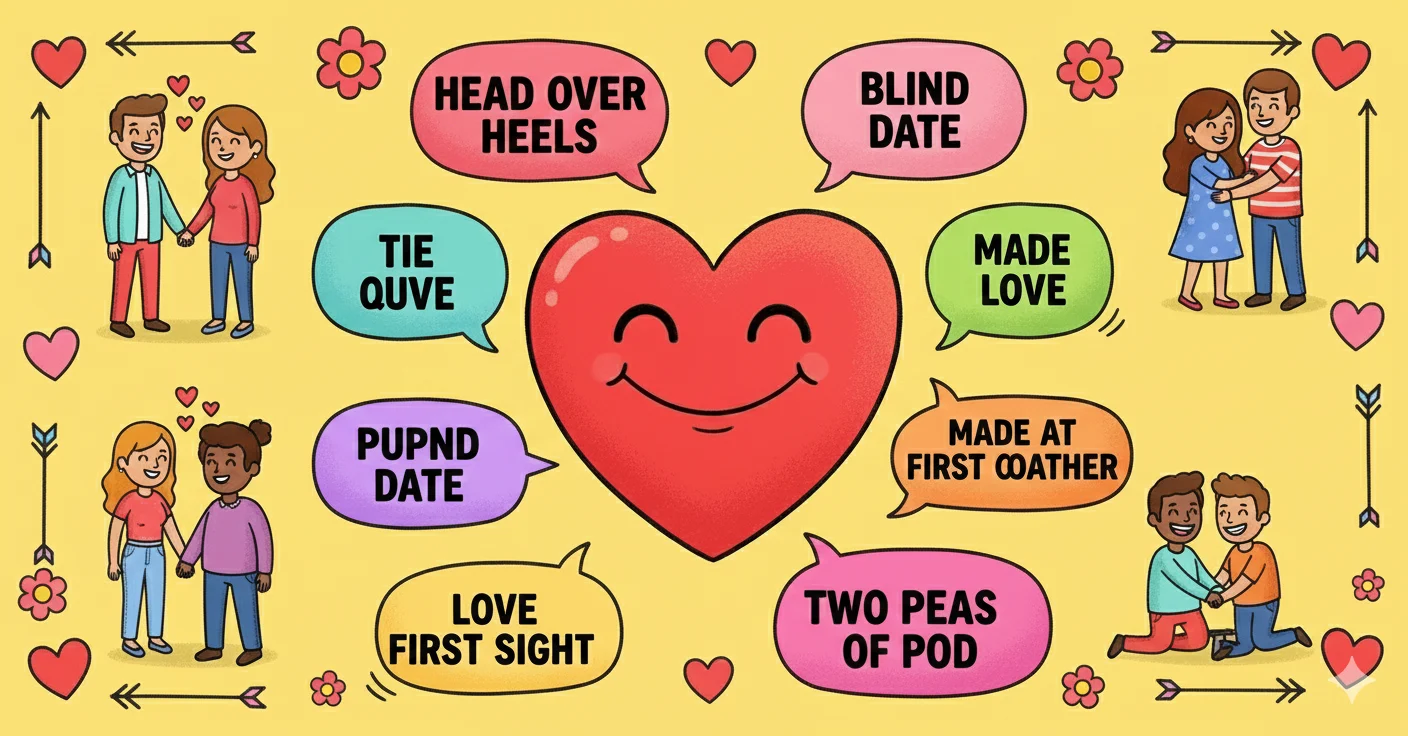
Being in love can make life feel like a whirlwind of emotions. 🌹 Whether you’re head over heels for someone or just exploring romantic expressions in English, idioms for being in love are a fun and expressive way to capture feelings. In this guide, we’ll explore 20 famous idioms for being in love, explain their meanings, and show how to use them naturally in conversations.
1. Head Over Heels
Word-by-Word Meaning:
Head above heels — literally upside down.
Idiomatic Meaning:
Completely in love with someone.

Example Sentence:
She’s head over heels for her new boyfriend.
Common Error:
Using “heels over head” instead of “head over heels.”
Usage Note:
Used for strong, passionate feelings of love, often in informal speech.
2. Love at First Sight
Word-by-Word Meaning:
Falling in love the first time you see someone.
Idiomatic Meaning:
Instant romantic attraction upon first meeting.

Example Sentence:
It was love at first sight when they met at the café.
Common Error:
Confusing it with “like at first sight,” which implies friendship, not romance.
Usage Note:
Common in storytelling and romantic contexts.
3. Puppy Love
Word-by-Word Meaning:
Love similar to a young puppy’s affection.
Idiomatic Meaning:
A young or immature romantic feeling, often temporary.

Example Sentence:
Their relationship was just puppy love in high school.
Common Error:
Using it for serious adult relationships.
Usage Note:
Typically refers to adolescent or early-stage love.
4. Carry a Torch For Someone
Word-by-Word Meaning:
Holding a torch — symbol of passion.
Idiomatic Meaning:
To have unrequited love for someone.

Example Sentence:
He’s still carrying a torch for his college crush.
Common Error:
Thinking it means mutual love; it’s usually one-sided.
Usage Note:
Used in both formal and informal writing about unreturned affection.
5. Love is Blind
Word-by-Word Meaning:
Love prevents clear judgment.
Idiomatic Meaning:
When in love, people overlook faults.

Example Sentence:
She ignored his flaws because love is blind.
Common Error:
Interpreting it literally; it’s a figurative expression.
Usage Note:
Often used in proverbs, stories, or advice.
6. On Cloud Nine
Word-by-Word Meaning:
Floating high in the sky, like cloud nine.
Idiomatic Meaning:
Extremely happy, often due to love.
Example Sentence:
He was on cloud nine after their first date.
Common Error:
Using it exclusively for romantic love; it can describe general happiness.
Usage Note:
Informal expression for euphoric feelings.
7. Fall for Someone
Word-by-Word Meaning:
Literally fall toward someone.
Idiomatic Meaning:
To develop romantic feelings for someone.
Example Sentence:
I think I’m starting to fall for him.
Common Error:
Using “fall in love someone” instead of “fall for someone.”
Usage Note:
Casual and widely used in spoken English.
8. Match Made in Heaven
Word-by-Word Meaning:
A pairing created in the skies/heaven.
Idiomatic Meaning:
A perfect romantic pair.
Example Sentence:
They’re a match made in heaven; their personalities fit perfectly.
Common Error:
Using for friendships or work partnerships — it’s romantic.
Usage Note:
Great for romantic storytelling or compliments.
9. Have a Crush on Someone
Word-by-Word Meaning:
A small infatuation or “crush” on a person.
Idiomatic Meaning:
To like someone romantically but subtly.
Example Sentence:
She has a crush on her classmate.
Common Error:
Confusing it with “love someone,” which implies deeper feelings.
Usage Note:
Used casually, especially among teens and young adults.
10. Wear Your Heart on Your Sleeve
Word-by-Word Meaning:
Showing your emotions openly on your arm.
Idiomatic Meaning:
To openly display your romantic feelings.
Example Sentence:
He wears his heart on his sleeve, so everyone knows he loves her.
Common Error:
Misunderstanding it as hiding emotions.
Usage Note:
Common in literature, movies, and conversational English.
11. Smitten with Someone
Word-by-Word Meaning:
Struck by affection.
Idiomatic Meaning:
Infatuated or deeply in love.
Example Sentence:
She’s completely smitten with her new colleague.
Common Error:
Using “smitten by someone” instead of “smitten with someone.”
Usage Note:
Polite and slightly formal expression for being in love.
12. Head in the Clouds
Word-by-Word Meaning:
Thinking in the clouds, not on the ground.
Idiomatic Meaning:
Daydreaming, often about love.
Example Sentence:
Ever since he met her, he’s had his head in the clouds.
Common Error:
Interpreting it as being careless; it specifically relates to dreamy love context here.
Usage Note:
Used for romantic or whimsical daydreaming.
13. Lovebirds
Word-by-Word Meaning:
Birds that pair and mate for life.
Idiomatic Meaning:
Two people in a loving relationship.
Example Sentence:
Look at those lovebirds walking hand in hand.
Common Error:
Using for non-romantic friends.
Usage Note:
Informal and affectionate.
14. Have Eyes Only for Someone
Word-by-Word Meaning:
Looking exclusively at one person.
Idiomatic Meaning:
Being romantically focused on only one person.
Example Sentence:
He has eyes only for his wife.
Common Error:
Confusing it with general admiration; it’s romantic-specific.
Usage Note:
Polite and romantic expression.
15. Swept off Your Feet
Word-by-Word Meaning:
Literally carried away by waves.
Idiomatic Meaning:
To be suddenly and completely in love.
Example Sentence:
She was swept off her feet by his charm.
Common Error:
Using “swept on your feet” — incorrect preposition.
Usage Note:
Common in storytelling and romance contexts.
16. Crazy About Someone
Word-by-Word Meaning:
Acting crazy because of love.
Idiomatic Meaning:
Very much in love or obsessed with someone.
Example Sentence:
He’s crazy about her new hairstyle.
Common Error:
Overusing “crazy” for dislike; context is key.
Usage Note:
Informal and expressive.
17. Fall Head Over Heels
Word-by-Word Meaning:
Same as “head over heels,” emphasizing intensity.
Idiomatic Meaning:
Completely in love with someone.
Example Sentence:
They fell head over heels during summer vacation.
Common Error:
Mixing it with casual “like someone.”
Usage Note:
Very common in spoken English for strong love.
18. Made for Each Other
Word-by-Word Meaning:
Created to fit perfectly together.
Idiomatic Meaning:
Two people perfectly compatible in love.
Example Sentence:
You two are made for each other!
Common Error:
Using for friends or colleagues — romantic context only.
Usage Note:
Popular in wedding speeches and romantic movies.
19. Heartthrob
Word-by-Word Meaning:
Someone who makes hearts beat faster.
Idiomatic Meaning:
A very attractive person who makes others fall in love.
Example Sentence:
The actor became a teen heartthrob overnight.
Common Error:
Using it for ordinary admiration; it’s romantic/fan-based.
Usage Note:
Mostly used in media, celebrity context, or youthful infatuation.
20. In Someone’s Arms
Word-by-Word Meaning:
Physically in the embrace of another.
Idiomatic Meaning:
Being romantically close and secure with someone.
Example Sentence:
She felt safe in his arms.
Common Error:
Using it literally without romantic connotation.
Usage Note:
Used in romantic writing and poetry.
FAQ
Q1: What is an idiom for being in love?
A: An idiom for being in love is a figurative expression describing romantic feelings, such as “head over heels.”
Q2: Can idioms for love be used in writing?
A: Yes, they add color and relatability to stories, poems, or conversational writing.
Q3: Are all love idioms informal?
A: Not all; some, like “smitten with someone,” can be formal, while others like “crazy about someone” are casual.
Q4: How do idioms help in learning English?
A: They make expressions more vivid, improve comprehension, and help communicate emotions naturally.
Q5: Can idioms for love be translated directly?
A: Usually not; literal translations may not carry the figurative meaning, so understanding context is key.
Conclusion
Mastering these 20 famous idioms for being in love will make your English sound more natural, expressive, and romantic. Practice using them in conversations, writing, and storytelling, and watch your language skills soar! 💕

Anita Brookner, author at SeekIdiom, shares easy explanations of English idioms with examples to help learners expand vocabulary and speak more confidently.