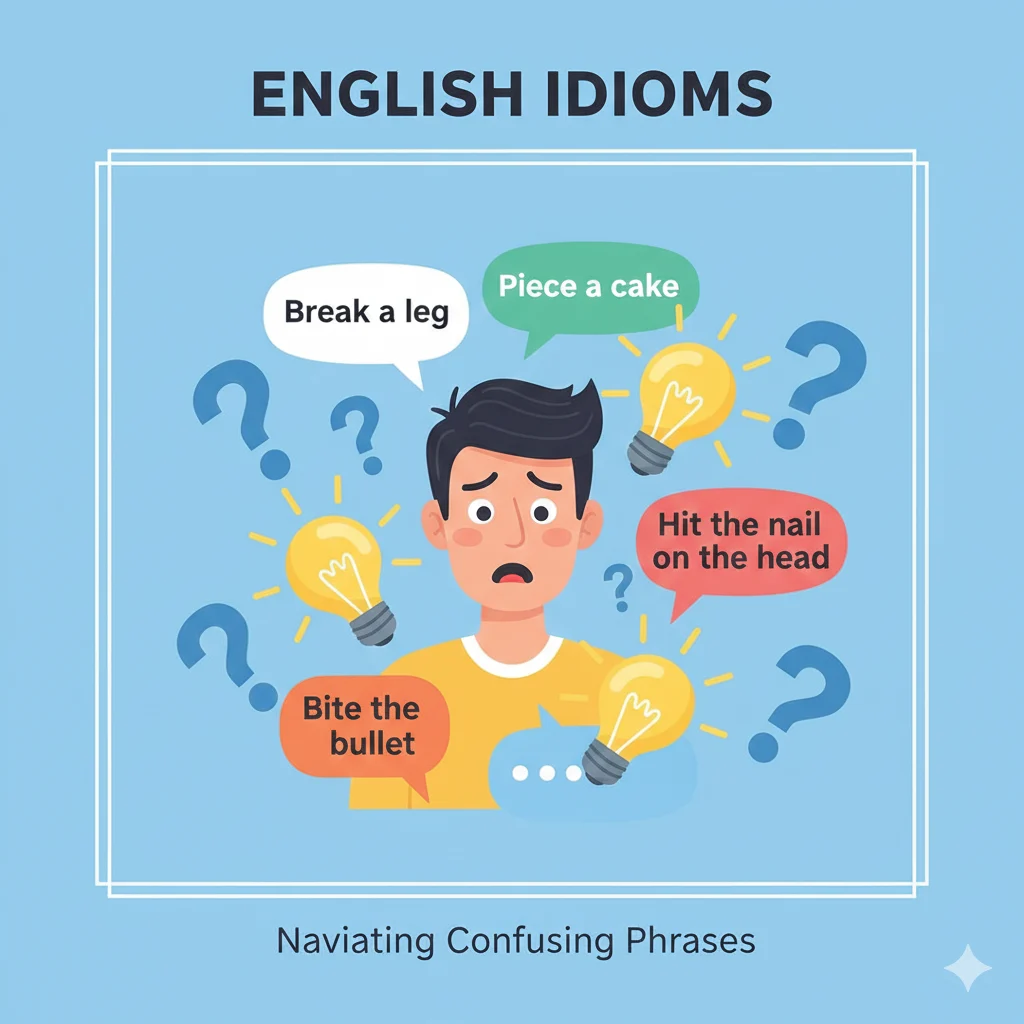
Ever felt totally lost in a situation and didn’t know how to explain it in English? 😵💫 Idioms for confused help you express uncertainty, misunderstanding, or mental overload in a natural, native-like way.
Whether you’re confused by instructions, emotions, people, or life itself, these everyday idioms will help you sound fluent and confident.
Below are 20 of the most famous idioms for confused, each explained clearly with meanings, examples, common mistakes, and usage notes.
At Sea
Word-by-word meaning
Being on the ocean without direction.
Idiomatic / Figurative meaning
Feeling confused or unsure about what to do.
Example sentences
- I’m completely at sea about these new rules.
- She looked at sea during her first day at work.

Common error
❌ “I am at the sea”
✅ “I am at sea”
Usage note
Commonly used to describe mental confusion, not physical location.
In a Fog
Word-by-word meaning
Surrounded by thick fog.
Idiomatic / Figurative meaning
Unable to think clearly; mentally confused.
Example sentences
- After the exam, my brain was in a fog.
- He’s been in a fog since the meeting.
Common error
❌ “In fog”
✅ “In a fog”
Usage note
Often used after shock, stress, or lack of sleep.
All Mixed Up
Word-by-word meaning
Things mixed incorrectly.
Idiomatic / Figurative meaning
Mentally confused or emotionally tangled.
Example sentences
- I’m all mixed up about the dates.
- Her feelings are all mixed up.
Common error
❌ “All mix up”
✅ “All mixed up”
Usage note
Casual and very common in spoken English.
Can’t Make Head or Tail of It
Word-by-word meaning
Unable to find the beginning or end.
Idiomatic / Figurative meaning
Completely unable to understand something.
Example sentences
- I can’t make head or tail of this document.
- He spoke so fast I couldn’t understand anything.
Common error
❌ “Make head and tail”
✅ “Make head or tail”
Usage note
Used for written or spoken confusion.
Out of One’s Depth
Word-by-word meaning
In water deeper than one can handle.
Idiomatic / Figurative meaning
Facing something too difficult to understand.
Example sentences
- I feel out of my depth in this class.
- She was out of her depth during the debate.

Common error
❌ “Out from my depth”
✅ “Out of my depth”
Usage note
Often used in learning or professional situations.
In Two Minds
Word-by-word meaning
Having two thoughts at once.
Idiomatic / Figurative meaning
Unable to decide; mentally confused.
Example sentences
- I’m in two minds about quitting my job.
- She’s in two minds whether to go or stay.
Common error
❌ “In double mind”
✅ “In two minds”
Usage note
More common in British English.
All at Sixes and Sevens
Word-by-word meaning
Numbers out of order.
Idiomatic / Figurative meaning
In a state of confusion or disorder.
Example sentences
- My schedule is at sixes and sevens.
- Everything felt chaotic after the move.
Common error
❌ “Six and seven”
✅ “Sixes and sevens”
Usage note
Sounds formal but still widely used.
Throw Someone for a Loop
Word-by-word meaning
To spin someone unexpectedly.
Idiomatic / Figurative meaning
To confuse or shock someone.
Example sentences
- His question threw me for a loop.
- The sudden news confused everyone.
Common error
❌ “Throw me in a loop”
✅ “Throw me for a loop”
Usage note
Very common in American English.
Go Around in Circles
Word-by-word meaning
Moving in a circle repeatedly.
Idiomatic / Figurative meaning
Not making progress due to confusion.
Example sentences
- We keep going around in circles.
- The discussion solved nothing.
Common error
❌ “Go in circles around”
✅ “Go around in circles”
Usage note
Used in meetings and problem-solving contexts.
At a Loss
Word-by-word meaning
Experiencing loss.
Idiomatic / Figurative meaning
Unsure what to say or do.
Example sentences
- I was at a loss for words.
- She seemed at a loss about the rules.
Common error
❌ “At loss”
✅ “At a loss”
Usage note
Polite and formal expression.
Draw a Blank
Word-by-word meaning
To draw nothing.
Idiomatic / Figurative meaning
Failing to understand or remember.
Example sentences
- I drew a blank during the interview.
- His name just disappeared from my mind.
Common error
❌ “Draw blank”
✅ “Draw a blank”
Usage note
Often used with memory confusion.
Mind Goes Blank
Word-by-word meaning
The mind becomes empty.
Idiomatic / Figurative meaning
Sudden confusion or inability to think.
Example sentences
- My mind went blank during the test.
- She forgot everything suddenly.
Common error
❌ “Mind become blank”
✅ “Mind goes/went blank”
Usage note
Very natural in spoken English.
All Over the Place
Word-by-word meaning
Scattered everywhere.
Idiomatic / Figurative meaning
Disorganized or mentally confused.
Example sentences
- My thoughts are all over the place.
- He couldn’t focus properly.
Common error
❌ “All in the place”
✅ “All over the place”
Usage note
Casual and expressive.
Lose the Plot
Word-by-word meaning
Forget the storyline.
Idiomatic / Figurative meaning
Become confused or irrational.
Example sentences
- He’s completely lost the plot.
- The discussion made no sense.
Common error
❌ “Lost a plot”
✅ “Lost the plot”
Usage note
British English, informal.
Scratching One’s Head
Word-by-word meaning
Physically scratching the head.
Idiomatic / Figurative meaning
Trying to understand something confusing.
Example sentences
- Everyone was scratching their heads.
- The puzzle confused us all.
Common error
❌ “Scratch head”
✅ “Scratching one’s head”
Usage note
Often used descriptively.
Baffled
Word-by-word meaning
Blocked or stopped.
Idiomatic / Figurative meaning
Completely confused.
Example sentences
- I’m baffled by his behavior.
- The instructions were unclear.
Common error
❌ “Baffle about”
✅ “Baffled by”
Usage note
Strong word for deep confusion.
Beat One’s Brains
Word-by-word meaning
Hit the brain.
Idiomatic / Figurative meaning
Think very hard but still feel confused.
Example sentences
- I beat my brains trying to solve it.
- Nothing made sense.
Common error
❌ “Beat my brain”
✅ “Beat my brains”
Usage note
Informal and expressive.
In a Tangle
Word-by-word meaning
Knotted together.
Idiomatic / Figurative meaning
Confused emotionally or mentally.
Example sentences
- My thoughts are in a tangle.
- His feelings are complicated.
Common error
❌ “In tangle”
✅ “In a tangle”
Usage note
Used for emotional confusion.
Puzzle Over
Word-by-word meaning
Think about a puzzle.
Idiomatic / Figurative meaning
Try to understand something confusing.
Example sentences
- I’m puzzling over this problem.
- She couldn’t understand the message.
Common error
❌ “Puzzle on”
✅ “Puzzle over”
Usage note
Neutral and academic-friendly.
Go Cross-Eyed
Word-by-word meaning
Eyes cross physically.
Idiomatic / Figurative meaning
Become extremely confused or overwhelmed.
Example sentences
- These numbers make me go cross-eyed.
- The data was too complex.
Common error
❌ “Cross eye”
✅ “Cross-eyed”
Usage note
Informal and humorous.
FAQs About Idioms for Confused
Q1: Are idioms for confused used in daily English?
Yes, native speakers use them constantly in conversations, work, and storytelling.
Q2: Are these idioms suitable for exams?
Some formal ones like at a loss are exam-friendly, while others are better for speaking.
Q3: Can I use these idioms in writing?
Yes, especially in blogs, stories, and informal essays.
Q4: Which idiom is best for emotional confusion?
All mixed up and in a tangle work best.
Conclusion
Feeling confused is part of learning—but expressing it clearly makes all the difference. By mastering these idioms for confused, you’ll sound more natural, confident, and fluent in English.
👉 Try using one idiom a day in your conversations or writing, and soon confusion will turn into clarity!

Anita Brookner, author at SeekIdiom, shares easy explanations of English idioms with examples to help learners expand vocabulary and speak more confidently.