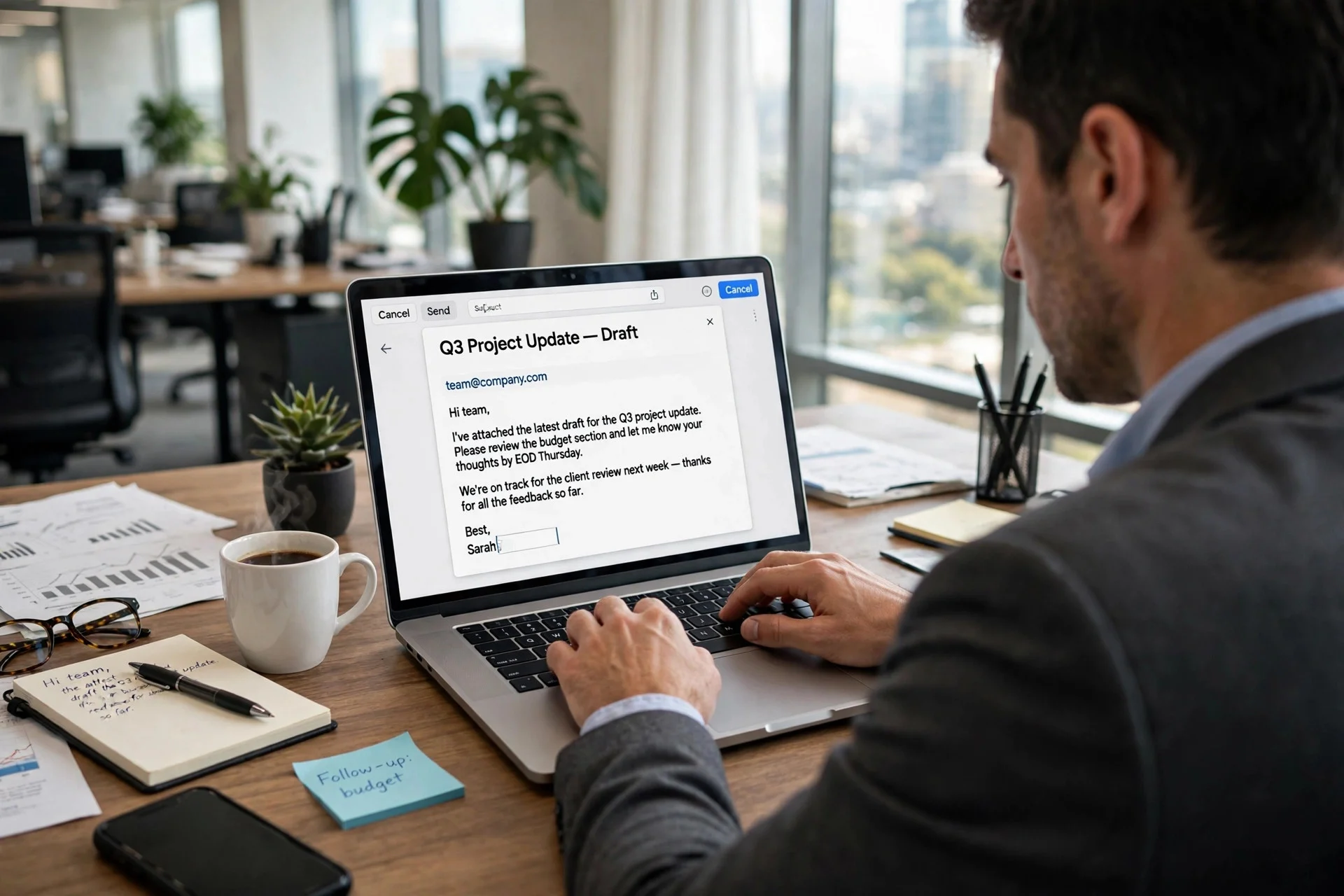
25 Business Email Idioms: Write Emails Like a Pro
Think about how many emails you write every week. Requests, follow-ups, updates, nudges, thank-yous. Now think about how many of them actually get the response you want. The difference between an email that gets action and one that gets ignored often comes down to language — the right phrase, at the right moment, in the right tone.
Native English speakers don’t just “write emails” — they loop people in, circle back, and close the loop. These small expressions carry big meaning. They signal professionalism, set expectations, and make your intent clear without sounding robotic or rude. Whether you’re writing to a manager, a client, or a colleague, these 25 business email idioms will help you sound natural, confident, and in control of your inbox.
What Are Business Email Idioms?
Business email idioms are figurative expressions and shorthand phrases used in professional email writing to make messages shorter, clearer, and more natural. They cover the whole lifecycle of an email thread: adding people, following up, summarizing, nudging politely, setting expectations, and signing off. Mastering them helps you write emails that native speakers instantly understand — and respect.
25 Essential Business Email Idioms
1. Loop someone in
Word-by-word meaning: To add someone into a circular information flow.
Idiomatic meaning: To include someone in an email conversation or update them on a discussion.
Example (formal): “I’m looping in our finance director, who can approve the budget.”
Example (casual): “Looping you in on this thread so you can see what we’ve decided.”
When to use: When a new person needs visibility on an email thread.
When NOT to use: Don’t loop in senior people just to pressure someone — it backfires.
2. Keep me in the loop
Word-by-word meaning: Keep me inside the circle of information.
Idiomatic meaning: Please continue to update me on this matter.
Example (formal): “Please keep me in the loop regarding the client’s decision.”
Example (casual): “Keep me in the loop on how the interview goes!”
When to use: When you need ongoing updates without being in every meeting.
When NOT to use: Don’t ask to be kept in the loop on things you can’t influence — it’s inbox clutter.
3. Touch base
Word-by-word meaning: To make brief contact, like runners tagging a base.
Idiomatic meaning: To have a quick check-in or brief conversation.
Example (formal): “Let’s touch base next week to review the timeline.”
Example (casual): “Just wanted to touch base — everything OK on your end?”
When to use: Proposing a short, low-pressure check-in.
When NOT to use: Don’t use it to mean a full meeting — it promises brevity, so keep it brief.
4. Circle back
Word-by-word meaning: To return along a circular path.
Idiomatic meaning: To return to a topic or person later, after some time has passed.
Example (formal): “I’ll circle back with you once the data is finalized.”
Example (casual): “Let me circle back after lunch — I need to check with the team.”
When to use: When you need more time or information before responding.
When NOT to use: Don’t circle back forever — if you’ve said it twice, set a real date.
5. Per my last email
Word-by-word meaning: According to my previous message.
Idiomatic meaning: I’m repeating something I already told you (often with a hint of frustration).
Example (formal): “Per my last email, the deadline remains Friday, March 14.”
Example (casual): Rarely used casually — it’s almost always pointed.
When to use: When you must restate something that was already clearly communicated.
When NOT to use: Avoid unless necessary — it famously reads as passive-aggressive. “As mentioned below” is softer.
6. FYI
Word-by-word meaning: Abbreviation of “for your information.”
Idiomatic meaning: This is just information — no action needed from you.
Example (formal): “FYI: the vendor contract has been renewed for another year.”
Example (casual): “FYI, I’m working from home tomorrow.”
When to use: Sharing information that needs no reply.
When NOT to use: Don’t use FYI when you actually need action — be explicit instead.
7. TL;DR
Word-by-word meaning: Abbreviation of “too long; didn’t read.”
Idiomatic meaning: A short summary placed before (or after) a long message.
Example (formal): Use sparingly; “Summary:” is the safer formal alternative.
Example (casual): “TL;DR: We’re pushing the launch to May 2.”
When to use: Internal messages where a quick summary helps busy readers.
When NOT to use: Never with clients or in formal external emails — it can seem dismissive.
8. Action required
Word-by-word meaning: Something needs to be done.
Idiomatic meaning: You must do something — this email needs a response or task completed.
Example (formal): “Action required: Please approve the invoice by Thursday.”
Example (casual): “Quick one — action required on the attached form.”
When to use: Subject lines or openings where you need a clear response.
When NOT to use: Don’t use it for FYI messages — crying wolf kills its power.
9. At your earliest convenience
Word-by-word meaning: As soon as it suits you.
Idiomatic meaning: Please do this soon, but I’m giving you polite flexibility.
Example (formal): “Please send the signed copy at your earliest convenience.”
Example (casual): “No rush, but send me the notes at your earliest convenience.”
When to use: Polite requests where you want speed without sounding demanding.
When NOT to use: When there is a hard deadline — say the actual date instead.
10. Just bumping this
Word-by-word meaning: To push something back to the top.
Idiomatic meaning: A light, friendly nudge on an unanswered email.
Example (formal): “Just bumping this to the top of your inbox — any update on the approval?”
Example (casual): “Bumping this — did you get a chance to look at it?”
When to use: First follow-up on a message that got no reply after a few days.
When NOT to use: Don’t bump the same thread three times — escalate or call instead.
11. Gentle reminder
Word-by-word meaning: A soft prompt.
Idiomatic meaning: A polite way to say “you haven’t done this yet” without sounding annoyed.
Example (formal): “This is a gentle reminder that the registration closes on Friday.”
Example (casual): “Gentle reminder about the team lunch RSVP!”
When to use: Polite follow-ups on deadlines and requests.
When NOT to use: The third “gentle reminder” isn’t gentle anymore — change your approach.
12. Please advise
Word-by-word meaning: Please give me guidance.
Idiomatic meaning: Tell me what to do next or share your recommendation.
Example (formal): “The shipment has been delayed; please advise on next steps.”
Example (casual): “Stuck on this — please advise?”
When to use: When you genuinely need direction from someone senior or expert.
When NOT to use: Don’t use it to dodge responsibility for decisions you should make yourself.
13. Going forward
Word-by-word meaning: Moving ahead from now.
Idiomatic meaning: From this point on; describing a new rule or process.
Example (formal): “Going forward, all invoices must include a purchase order number.”
Example (casual): “Going forward, let’s keep these updates in the shared doc.”
When to use: Announcing process changes or new expectations.
When NOT to use: Don’t overuse it as filler — one “going forward” per email is plenty.
14. As discussed
Word-by-word meaning: As we talked about.
Idiomatic meaning: Referencing an earlier conversation to anchor this email.
Example (formal): “As discussed, I’ve attached the revised proposal for your review.”
Example (casual): “As discussed, I’ll handle the slides and you’ll handle the demo.”
When to use: Confirming verbal agreements in writing.
When NOT to use: Don’t invent discussions that never happened — people will notice.
15. Heads up
Word-by-word meaning: Lift your head (pay attention).
Idiomatic meaning: An advance warning or early notice about something coming.
Example (formal): “Just a heads up — the client may ask about the budget increase.”
Example (casual): “Heads up, the boss is in a mood today.”
When to use: Warning someone early so they can prepare.
When NOT to use: Don’t give a heads up about confidential matters to the wrong people.
16. Close the loop
Word-by-word meaning: To complete a circle.
Idiomatic meaning: To finish a task or confirm that an issue is fully resolved.
Example (formal): “Closing the loop on this: the refund has been processed.”
Example (casual): “Just closing the loop — all good on my end!”
When to use: Final update that resolves an open thread.
When NOT to use: Don’t claim the loop is closed if loose ends remain — you’ll reopen it yourself.
17. CC (carbon copy)
Word-by-word meaning: From the old carbon-paper copies of letters.
Idiomatic meaning: To copy someone on an email for visibility, with no action expected.
Example (formal): “I’ve CC’d legal so they’re aware of the new terms.”
Example (casual): “I’ll CC you on the thread so you can follow along.”
When to use: Giving someone visibility without asking them to act.
When NOT to use: Don’t CC someone’s boss to intimidate them — everyone sees through it.
18. Get back to you
Word-by-word meaning: To return with an answer.
Idiomatic meaning: I will respond later, once I have the information.
Example (formal): “I’ll get back to you by Thursday with the final numbers.”
Example (casual): “Let me get back to you — need to check something first.”
When to use: Acknowledging a request you can’t answer immediately.
When NOT to use: Always give a time frame — “I’ll get back to you” with no date feels like a brush-off.
19. Follow up
Word-by-word meaning: To pursue after an initial contact.
Idiomatic meaning: To check on the status of something or continue a conversation.
Example (formal): “I’m following up on my email of March 3 regarding the contract.”
Example (casual): “Following up — did the client sign off?”
When to use: Any polite check-in on an earlier message or meeting.
When NOT to use: Don’t follow up daily — give people reasonable time to respond.
20. Escalate
Word-by-word meaning: To move up to a higher level.
Idiomatic meaning: To raise an issue to someone with more authority.
Example (formal): “If we can’t resolve this today, I’ll need to escalate it to the director.”
Example (casual): “This is the third outage — time to escalate.”
When to use: When normal channels have failed and authority is needed.
When NOT to use: Don’t threaten escalation in your first email — it poisons the relationship.
21. Put it in writing
Word-by-word meaning: To document something formally.
Idiomatic meaning: To get an agreement or statement recorded in an email or document.
Example (formal): “Could you put that approval in writing so we have it on file?”
Example (casual): “Get it in writing — verbal promises don’t count.”
When to use: Confirming important agreements, approvals, or commitments.
When NOT to use: Don’t demand things in writing for trivial matters — it signals distrust.
22. Paper trail
Word-by-word meaning: A trail made of paper documents.
Idiomatic meaning: A written record of events, usually emails, that proves what happened.
Example (formal): “Keep a paper trail of all vendor communications.”
Example (casual): “Good thing we have a paper trail — she definitely agreed to it.”
When to use: Advising documentation of important decisions.
When NOT to use: Don’t weaponize the paper trail — use it for clarity, not courtroom drama.
23. Read between the lines
Word-by-word meaning: To find meaning in the spaces of text.
Idiomatic meaning: To understand the hidden or implied message behind someone’s words.
Example (formal): “Reading between the lines, the client seems open to renegotiating.”
Example (casual): “Read between the lines of that email — he’s not happy.”
When to use: Discussing the implied meaning of a message (in conversation, not in the email itself).
When NOT to use: Don’t accuse someone based only on what you read “between the lines” — ask directly.
24. Short and sweet
Word-by-word meaning: Brief and pleasant.
Idiomatic meaning: Keep the message concise and friendly.
Example (formal): “I’ll keep this short and sweet: the proposal is approved.”
Example (casual): “Keeping it short and sweet — yes, I’m in!”
When to use: Opening brief emails or apologizing for length upfront.
When NOT to use: Don’t promise “short and sweet” and then write five paragraphs.
25. Cut to the chase
Word-by-word meaning: To skip straight to the action scene.
Idiomatic meaning: To get directly to the point without small talk.
Example (formal): “To cut to the chase: we need your decision by Friday.”
Example (casual): “Let me cut to the chase — can you cover my shift?”
When to use: When the situation is urgent and pleasantries would waste time.
When NOT to use: Don’t cut to the chase in sensitive emails — a little warmth goes a long way.
An Email Thread in Action
Context: Two colleagues, Maya and Tom, grabbing coffee and dissecting a tricky email exchange with a difficult client.
Maya: “Did you see the client’s reply? He completely ignored my request for the signed contract.”
Tom: “Time for a gentle reminder. But maybe read between the lines first — his tone suggested he’s stalling.”
Maya: “True. I’ll keep it short and sweet. Something like: ‘Just bumping this — please advise if there’s anything blocking the signature.'”
Tom: “Good. And loop in his assistant. She usually moves things along. Keep me in the loop on what he says.”
Maya: “Will do. If nothing happens by Friday, I’ll escalate to his manager. I want a proper paper trail before I do.”
Tom: “Smart. Put it in writing now, and you’ll close the loop without any drama.”
Quick Quiz: Test Your Business Email Idioms
1. To “loop someone in” means to:
a) Exclude them from a conversation
b) Include them in an email thread or update them ✅
c) Send them a calendar invite
2. If you “touch base” with a colleague, you:
a) Have a quick check-in ✅
b) Start an argument
c) Schedule a full-day workshop
3. “Per my last email” is best described as:
a) A warm greeting
b) A restatement that often sounds passive-aggressive ✅
c) An apology
4. To “close the loop” means to:
a) Start a new project
b) Confirm an issue is fully resolved ✅
c) Delete an email thread
5. A “paper trail” is:
a) A written record proving what happened ✅
b) A recycling program
c) A type of stationery
Frequently Asked Questions
Q1: How many follow-up emails are too many?
Two polite follow-ups (a gentle reminder, then a bump) are standard. After that, change tactics: call, loop in someone else, or escalate. Sending a fifth “just bumping this” email rarely works — it just trains people to ignore you.
Q2: Is “per my last email” always rude?
Not always, but it leans that way. If the information was genuinely missed and you need to restate it, soften it: “As mentioned below” or “Just resharing in case it got buried.” Save the blunt version for when someone is clearly not reading.
Q3: When should I CC someone’s manager?
Rarely, and only for visibility — never as a threat. A good rule: CC the manager if they’d genuinely want to know the outcome, not because you want the recipient to behave. When in doubt, ask yourself how you’d feel if someone CC’d your manager on you.
Q4: What’s the difference between “touch base” and “circle back”?
“Touch base” is a quick check-in, usually about something general or relationship-related. “Circle back” means returning to a specific topic later with an answer or update. You touch base to chat; you circle back with information.
Q5: Are TL;DR and FYI too informal for work emails?
FYI is widely accepted in professional emails, including to clients. TL;DR is casual — fine for internal team messages, but never for clients, executives, or formal correspondence. When in doubt, use “Summary:” instead.
Q6: How do I follow up without sounding pushy?
Add value or context instead of repeating yourself: share a relevant update, mention a deadline, or offer help removing a blocker. “Just bumping this — happy to jump on a quick call if that’s easier” sounds helpful. “Just bumping this” alone sounds like a nag.
Conclusion: Hit Send With Confidence
Great email writing isn’t about fancy vocabulary — it’s about clarity, tone, and timing. These 25 idioms give you the professional shorthand that native speakers use every day: to loop people in without over-explaining, to follow up without nagging, and to close the loop with authority. Use them thoughtfully, and your emails will get more replies, fewer misunderstandings, and better results.
The inbox is where modern careers are built — one message at a time. So write with intention, read between the lines when you need to, and keep your professional correspondence sharp. Your next email could be the one that gets noticed.
Related reading: Sharpen your workplace language with 25 Office Politics Idioms: Navigate Workplace Power Games, 25 Performance Review Idioms to Ace Your Next Appraisal, and 25 Promotion Idioms to Talk About Career Growth Like a Pro.
Julian Mercer, author at SeekIdiom, writes clear explanations of English idioms with examples to help learners improve vocabulary and communication skills.