
Insulting idioms can make English sound more expressive, humorous, or sarcastic—but they can also be rude or offensive depending on the situation. From calling someone a big mouth to saying they are full of themselves, English has many colorful ways to criticize someone’s behavior or personality.
In this guide, you’ll learn 20 common insult idioms and rude expressions, what they mean, how to use them naturally, and when to avoid them.

Big Mouth
Word-by-word meaning: A person with a large mouth.
Idiomatic meaning: Someone who talks too much or cannot keep secrets.
Example:
- “Don’t tell Jake about the surprise. He’s such a big mouth.”
- “She has a big mouth, so I wouldn’t share anything private with her.”
Common error: Don’t use big mouth to describe someone’s physical appearance when you mean that they reveal secrets.
Usage note: This is an informal and mildly insulting expression.
Smart Mouth
Word-by-word meaning: A clever or intelligent mouth.
Idiomatic meaning: Someone who makes rude, sarcastic, or disrespectful comments.
Example:
- “Don’t be such a smart mouth.”
- “That smart mouth of yours is going to get you into trouble.”

Common error: Smart mouth does not simply mean an intelligent person.
Usage note: It is usually used when criticizing someone’s attitude or way of speaking.
Full of Yourself
Word-by-word meaning: Completely filled with yourself.
Idiomatic meaning: Too confident and overly impressed with yourself.
Example:
- “He’s so full of himself that he never listens to anyone else.”
- “She became full of herself after winning the competition.”

Common error: Don’t confuse it with being simply confident. Full of yourself usually suggests excessive self-confidence.
Usage note: This is a common everyday expression and can be mildly insulting.
A Pain in the Neck
Word-by-word meaning: Physical pain in the neck.
Idiomatic meaning: An annoying or troublesome person or thing.
Example:
- “My little brother can be a real pain in the neck.”
- “That noisy neighbor is becoming a pain in the neck.”

Common error: Don’t interpret it literally when it is used to describe a person.
Usage note: This is a relatively mild way to describe someone annoying.
Get on Someone’s Nerves
Word-by-word meaning: Affect someone’s nerves.
Idiomatic meaning: To annoy or irritate someone.
Example:
- “His constant complaining really gets on my nerves.”
- “Stop tapping your pen. You’re getting on my nerves.”
Common error: Say get on someone’s nerves, not get in someone’s nerves.
Usage note: This expression is common in everyday English and isn’t necessarily a serious insult.
A Piece of Work
Word-by-word meaning: An object made or produced.
Idiomatic meaning: A difficult, strange, unpleasant, or complicated person.
Example:
- “Your new manager is quite a piece of work.”
- “He’s a real piece of work when things don’t go his way.”
Common error: The meaning depends heavily on context. It doesn’t always mean something negative.
Usage note: This expression is often sarcastic and can be humorous.
A Chip on Your Shoulder
Word-by-word meaning: Having a small piece of wood on your shoulder.
Idiomatic meaning: Having a persistent feeling of resentment or believing that you’ve been treated unfairly.
Example:
- “He seems to have a chip on his shoulder about his old workplace.”
- “She has a chip on her shoulder and takes every comment personally.”
Common error: This doesn’t directly mean that someone insults others.
Usage note: It describes resentment or hostility rather than being a direct insult.
All Bark and No Bite
Word-by-word meaning: Someone who only barks but never bites.
Idiomatic meaning: Someone who makes threats or acts aggressive but rarely takes action.
Example:
- “Don’t worry about him. He’s all bark and no bite.”
- “The boss sounds scary, but he’s mostly all bark and no bite.”
Common error: Don’t use it to describe someone who is genuinely dangerous.
Usage note: It can be teasing or insulting depending on the context.
A Loose Cannon
Word-by-word meaning: A cannon that is not securely attached.
Idiomatic meaning: An unpredictable person who may act recklessly or cause problems.
Example:
- “You never know what he’ll say next. He’s a loose cannon.”
- “The team avoided putting him in charge because he’s too much of a loose cannon.”
Common error: It doesn’t simply mean someone who is rude.
Usage note: This expression is often used in workplaces, politics, sports, and other group situations.
Sourpuss
Word-by-word meaning: A person with a sour-looking face.
Idiomatic meaning: Someone who is habitually gloomy, grumpy, or unpleasant.
Example:
- “Why are you being such a sourpuss today?”
- “He’s a bit of a sourpuss in the morning.”
Common error: Sourpuss is not normally used for someone who is physically ill.
Usage note: It is informal and often playful rather than seriously offensive.
Crybaby
Word-by-word meaning: A baby who cries.
Idiomatic meaning: Someone who complains or cries too easily, especially over minor problems.
Example:
- “Stop being a crybaby and try again.”
- “He’s acting like a crybaby because he lost the game.”
Common error: Don’t use this expression in formal or professional writing.
Usage note: It can sound quite rude, especially when directed at a child or someone who is genuinely upset.
Lazybones
Word-by-word meaning: Someone with lazy bones.
Idiomatic meaning: A lazy person who doesn’t want to work or make an effort.
Example:
- “Get out of bed, lazybones!”
- “That lazybones never helps around the house.”
Common error: Lazybones is normally used as a noun or nickname, not as a formal adjective.
Usage note: It is usually informal and can be teasing.
Airhead
Word-by-word meaning: A head filled with air.
Idiomatic meaning: A person considered unintelligent, absent-minded, or lacking common sense.
Example:
- “I felt like an airhead after forgetting my own password.”
- “Don’t call her an airhead just because she made one mistake.”
Common error: It is insulting, so avoid using it to describe someone directly in formal situations.
Usage note: It can be humorous among friends but may easily offend someone.
Stuck-Up
Word-by-word meaning: Stuck in an elevated position.
Idiomatic meaning: Acting as though you are better or more important than other people.
Example:
- “He seems really stuck-up and never talks to anyone.”
- “I thought she was stuck-up at first, but I was wrong.”
Common error: Don’t confuse stuck-up with stuck in the sense of being unable to move.
Usage note: This is a common informal insult describing an arrogant attitude.
Big-Headed
Word-by-word meaning: Having a physically large head.
Idiomatic meaning: Too proud of yourself; arrogant or conceited.
Example:
- “Don’t get big-headed just because you won one award.”
- “His success made him a little big-headed.”
Common error: It does not normally refer to someone’s physical head size.
Usage note: Big-headed is especially common in British English and can be less harsh than some stronger insults.
A Bad Apple
Word-by-word meaning: A rotten or spoiled apple.
Idiomatic meaning: A person whose bad behavior negatively affects other people.
Example:
- “Every organization can have a bad apple.”
- “One bad apple shouldn’t ruin the reputation of the whole team.”
Common error: Don’t assume it means every person in a group is bad.
Usage note: This expression is often used for someone whose behavior causes trouble for others.
A Few Cards Short of a Full Deck
Word-by-word meaning: A card deck missing several cards.
Idiomatic meaning: A humorous way of saying someone is not very sensible or intelligent.
Example:
- “He suggested driving there without checking the fuel. He’s a few cards short of a full deck.”
- “That plan sounds a little few-cards-short-of-a-full-deck.”
Common error: It should not be interpreted as a literal comment about playing cards.
Usage note: This is a humorous but potentially insulting expression, so use it carefully.
Not Playing with a Full Deck
Word-by-word meaning: Not playing with a complete set of cards.
Idiomatic meaning: Acting as though someone is not thinking clearly or sensibly.
Example:
- “You’d have to be not playing with a full deck to agree to that deal.”
- “Sometimes he makes decisions that make me wonder if he’s not playing with a full deck.”
Common error: It doesn’t literally refer to whether someone has enough cards.
Usage note: This expression can be offensive if used to mock someone’s intelligence or mental ability, so choose your words car
A Know-It-All
Word-by-word meaning: Someone who supposedly knows everything.
Idiomatic meaning: A person who behaves as though they know more than everyone else.
Example:
- “Nobody likes working with a know-it-all.”
- “He always corrects everyone. What a know-it-all!”
Common error: Don’t use know-it-all simply for someone who is knowledgeable. The negative meaning comes from their attitude.
Usage note: This is a common informal ins
Wise Guy
Word-by-word meaning: A supposedly wise or clever person.
Idiomatic meaning: Someone who makes sarcastic, disrespectful, or overly clever comments.
Example:
- “Okay, wise guy, why don’t you show us how it’s done?”
- “Don’t get smart with me, wise guy.”
Common error: Wise guy can be playful, sarcastic, or genuinely insulting depending on tone.
Usage note: Context and voice matter greatly with this expression.
Funny Insulting Idioms and Expressions
Some insulting idioms funny enough to use among friends can make criticism sound less serious. Expressions such as lazybones, sourpuss, crybaby, know-it-all, and all bark and no bite can sometimes be used playfully.

For example:
- “Stop being such a sourpuss!”
- “Come on, lazybones. Get off the couch.”
- “Don’t be a crybaby.”
- “Okay, wise guy, you win.”
- “He’s all bark and no bite.”
However, even funny idiom insults can hurt someone’s feelings if the relationship or situation isn’t right.
Rude Idioms vs. Offensive Idioms: What’s the Difference?
Rude idioms and offensive idioms are not always the same.
A rude expression may sound impolite, sarcastic, or disrespectful without targeting someone’s identity or using highly offensive language.
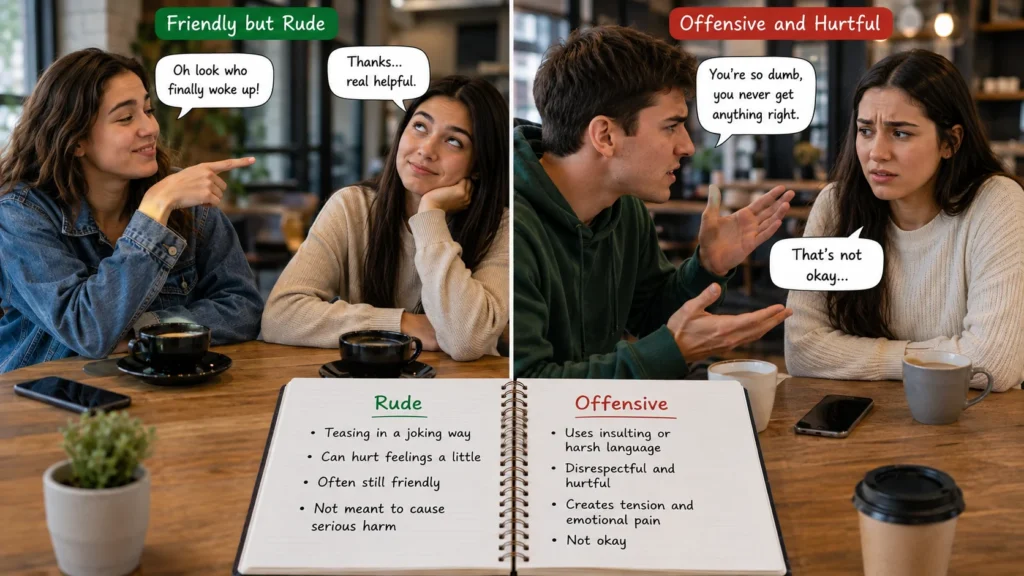
For example:
“He’s such a know-it-all.”
This is rude because it criticizes someone’s behavior.
An expression becomes more offensive when it contains hateful, degrading, or discriminatory language. Those expressions should generally be avoided, especially in professional or educational settings.
When learning English, understanding the difference between rude idioms and phrases and genuinely offensive language helps you communicate more appropriately.
Best Idioms to Insult Someone: Use Them Carefully
If you’re searching for the best idioms to insult someone, remember that the “best” expression depends on what you want to communicate.

| Expression | What it suggests | Tone |
|---|---|---|
| Big mouth | Reveals secrets | Mildly rude |
| Smart mouth | Makes disrespectful comments | Rude |
| Full of yourself | Too self-important | Critical |
| Pain in the neck | Annoying | Mild |
| Sourpuss | Always grumpy | Playful |
| Crybaby | Complains too much | Rude |
| Stuck-up | Thinks they’re superior | Rude |
| Big-headed | Too proud | Critical |
| Know-it-all | Acts as if they know everything | Rude |
| Wise guy | Makes sarcastic remarks | Sarcastic |
These expressions are generally more useful for understanding insult idioms in everyday English than for deliberately offending someone.
Idioms for Insulting Someone in Everyday English
You may hear idioms for insulting someone in movies, TV shows, social media, casual conversations, and humorous writing. Their meaning often depends on tone.
For example:
“You’re such a know-it-all.”
This can sound playful between close friends but harsh in a serious argument.

“You’re a pain in the neck.”
This is usually milder than directly calling someone annoying.
“Don’t be a smart mouth.”
This directly criticizes someone’s disrespectful way of speaking.
The same expression can therefore have different effects depending on the relationship between the speakers.
Are Vulgar Idioms the Same as Rude Idioms?
No. Vulgar idioms generally contain language considered crude, obscene, or socially inappropriate. Rude idioms may simply be insulting, sarcastic, or impolite.
For language learners, it’s important to understand that knowing what an expression means does not necessarily mean you should use it.
Before using a potentially offensive phrase, consider:
- Who are you speaking to?
- Is the situation formal or casual?
- Could the person take it personally?
- Is the expression common in your variety of English?
- Is there a more polite way to express the same idea?
Common Mistakes When Using Insulting Idioms
Taking the expression literally
Many idioms have meanings that are completely different from their individual words.
For example, “big mouth” doesn’t refer to the physical size of someone’s mouth when it means that the person reveals secrets.
Using an insult in a formal setting
Expressions such as airhead, crybaby, smart mouth, and know-it-all are informal. They don’t belong in most professional or academic writing.
Assuming every negative expression is an insult
Some expressions simply describe behavior.
For example, “all bark and no bite” describes someone who threatens without acting. It can be insulting, but the expression itself is not always intended as a direct insult.
Ignoring tone
Tone can completely change how an expression is understood. A friend saying “Okay, wise guy!” may be joking, while the same words during an argument may sound aggressive.
Is “Drop an Insult on the Ground” an Idiom?
No. “Drop an insult on the ground” is not a standard English idiom.
It may appear as a search phrase or an unusual combination of words, but native speakers do not normally use it as an established expression meaning “insult someone.”
If you’re looking for natural English expressions for insulting someone, phrases such as “give someone a hard time,” “get on someone’s nerves,” “call someone a name,” or “make a sarcastic remark” are more appropriate depending on the intended meaning.
How to Use Insulting Expressions Without Sounding Too Harsh
If you’re learning English, you don’t need to avoid every negative expression. Instead, learn how strong each one sounds.
A useful approach is:
Mild:
“She’s a bit of a sourpuss.”
Moderate:
“He’s such a know-it-all.”
More direct:
“Don’t be such a smart mouth.”
Potentially offensive:
Personal attacks or vulgar language targeting someone’s identity, appearance, or personal characteristics.
For everyday communication, milder expressions are usually safer.
Frequently Asked Questions
What are insulting idioms?
Insulting idioms are idiomatic expressions used to criticize, tease, mock, or describe someone’s unpleasant behavior or personality. Examples include big mouth, know-it-all, sourpuss, and full of yourself.
What are some funny insulting idioms?
Some playful examples include lazybones, sourpuss, all bark and no bite, and wise guy. Their effect depends on the relationship and tone.
What is an idiom for someone who thinks they are better than everyone?
“Stuck-up” is a common expression for someone who acts as though they are better than other people. “Full of yourself” and “big-headed” can also describe excessive self-importance.
What is an idiom for someone who talks too much?
“Big mouth” is a common informal expression for someone who talks too much or reveals information they should keep secret.
Are insulting idioms appropriate in professional English?
Usually, no. Most insulting expressions are informal and can sound disrespectful in professional situations. In formal communication, it’s better to describe the specific behavior politely.
Final Thoughts
Learning insulting idioms is useful because these expressions appear frequently in conversations, films, books, and online communication. Expressions such as big mouth, smart mouth, full of yourself, sourpuss, know-it-all, and a pain in the neck can help you understand how native speakers describe annoying or difficult behavior.
The key is to understand meaning, tone, and context. Some expressions are playful, some are mildly rude, and others can genuinely offend people. Learn them so you can recognize them naturally—and use them only when the situation and relationship make them appropriate.

Hazel Monroe, author at SeekIdiom, explains English idioms through simple meanings and examples, helping learners improve vocabulary and everyday usage.