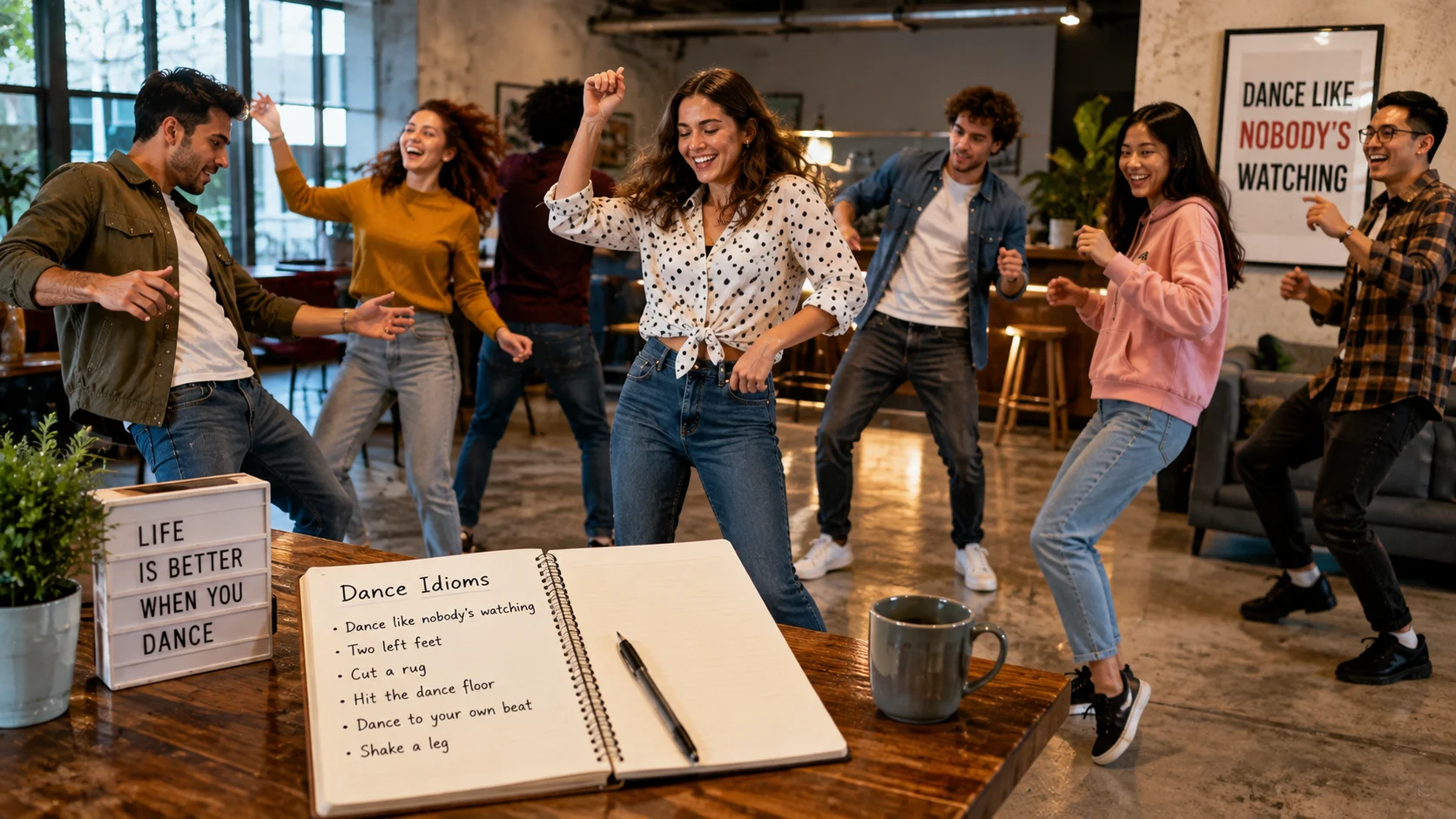
Dancing is more than movement—it is also part of everyday English. Idioms for dancing can describe dancing, having fun, following someone’s lead, or even handling situations in life. From “cut a rug” to “dance around the issue,” these expressions make English more colorful and natural.
In this guide, you’ll learn 20 popular dance idioms and expressions, their meanings, examples, common mistakes, and when to use them.
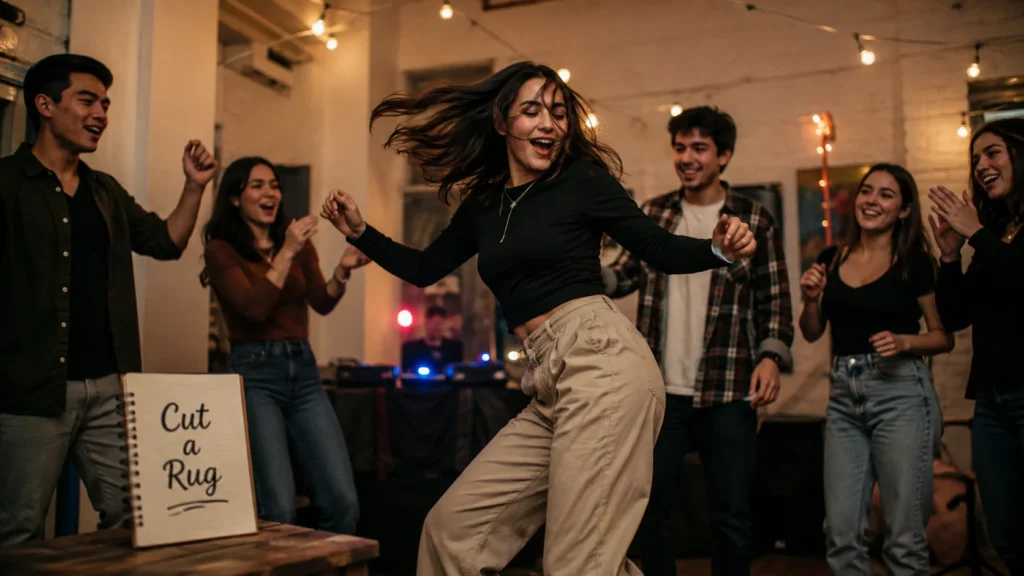
Cut a Rug
Word-by-word meaning: To cut a rug literally means to cut a piece of carpet.
Idiomatic meaning: To dance energetically, especially at a party or social event.
Example sentences:
- Everyone was cutting a rug at the wedding.
- She loves to cut a rug whenever her favorite song comes on.
Common mistake: Don’t interpret this expression literally.
Usage note: “Cut a rug” is informal and often used in a fun, playful way.
Dance the Night Away
Word-by-word meaning: To dance throughout the night.
Idiomatic meaning: To spend a long time dancing and enjoying yourself.

Example sentences:
- We danced the night away at the festival.
- They went to the club and danced the night away.
Common mistake: It does not necessarily mean dancing continuously until sunrise.
Usage note: This expression is common when describing parties, celebrations, and nights out.
Have Two Left Feet
Word-by-word meaning: To have two left feet instead of one left and one right foot.
Idiomatic meaning: To be awkward or uncoordinated when dancing.
Example sentences:
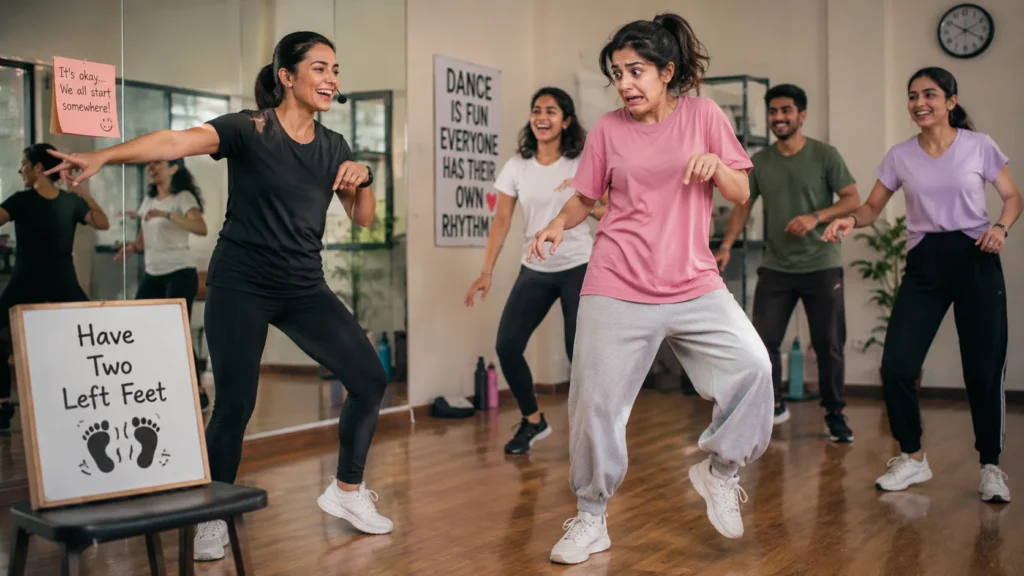
- I have two left feet, so I usually avoid dancing.
- He has two left feet, but he still enjoys dancing.
Common mistake: It doesn’t mean someone actually has two left feet.
Usage note: This is a humorous way to describe poor dancing ability.
Put on Your Dancing Shoes
Word-by-word meaning: To put on shoes suitable for dancing.
Idiomatic meaning: To get ready to dance, celebrate, or have a good time.

Example sentences:
- It’s Saturday night, so put on your dancing shoes!
- We’re going to a wedding—time to put on our dancing shoes.
Common mistake: The expression doesn’t always refer to special shoes.
Usage note: It is informal, cheerful, and commonly associated with celebrations.
Dance Up a Storm
Word-by-word meaning: To dance as if creating a storm.
Idiomatic meaning: To dance with a lot of energy and enthusiasm.
Example sentences:

- The couple danced up a storm at the reception.
- She danced up a storm when her favorite song played.
Common mistake: It has nothing to do with an actual storm.
Usage note: This is a lively and informal expression.
Get Your Groove On
Word-by-word meaning: To get into your “groove.”
Idiomatic meaning: To start dancing, enjoying yourself, or getting into a rhythm.
Example sentences:
- The DJ played a great song, and everyone got their groove on.
- Let’s get our groove on and enjoy the party!
Common mistake: “Groove” here refers to a rhythm or enjoyable state, not a physical groove.
Usage note: This is casual and especially common in conversational English.
Take to the Floor
Word-by-word meaning: To go onto the floor.
Idiomatic meaning: To begin dancing, especially at a social event.
Example sentences:
- The bride and groom took to the floor for their first dance.
- Everyone took to the floor after dinner.
Common mistake: The phrase can have meanings beyond dancing depending on context.
Usage note: In a dance setting, it means to step onto the dance floor and start dancing.
Trip the Light Fantastic
Word-by-word meaning: To move or dance lightly and gracefully.
Idiomatic meaning: To dance.
Example sentences:
- The dancers tripped the light fantastic across the stage.
- They spent the evening tripping the light fantastic.
Common mistake: This is not common modern conversational English.
Usage note: It is a literary and somewhat old-fashioned expression, often used humorously or poetically.
Dance to Someone’s Tune
Word-by-word meaning: To dance according to someone else’s music.
Idiomatic meaning: To do what another person wants or demands.
Example sentences:
- He expects everyone to dance to his tune.
- She refuses to dance to her boss’s tune.
Common mistake: It usually has a figurative meaning rather than describing actual dancing.
Usage note: This expression can suggest that someone is being controlled or influenced by another person.
Dance to a Different Tune
Word-by-word meaning: To dance according to different music.
Idiomatic meaning: To behave differently from others or have different opinions, attitudes, or methods.
Example sentences:
- Most people supported the plan, but she danced to a different tune.
- He has always danced to a different tune.
Common mistake: It doesn’t necessarily mean someone is physically dancing.
Usage note: This expression is useful for describing independent or unconventional behavior.
Dance Around the Issue
Word-by-word meaning: To move around an issue instead of facing it directly.
Idiomatic meaning: To avoid discussing a difficult or sensitive subject directly.
Example sentences:
- Stop dancing around the issue and tell me what happened.
- The manager kept dancing around the issue instead of giving a clear answer.
Common mistake: “Dance around the issue” is figurative, not about physical dancing.
Usage note: It is commonly used in conversations, workplace discussions, and arguments.
83+ Dancing Idioms to Boost Vocabulary and Speaking Skills 🚀
Dance Around the Subject
Word-by-word meaning: To move around a subject.
Idiomatic meaning: To avoid addressing the main topic directly.
Example sentences:
- He kept dancing around the subject during the interview.
- Instead of answering my question, she danced around the subject.
Common mistake: Don’t confuse this with literally moving around while dancing.
Usage note: This expression is very similar to “dance around the issue.”
Lead Someone by the Nose
Word-by-word meaning: To control someone as if leading them by the nose.
Idiomatic meaning: To control or manipulate someone easily.
Example sentences:
- She leads him by the nose.
- He allows his friends to lead him by the nose.
Common mistake: Although it can sound dance-related because of “leading,” it is not actually a dance idiom.
Usage note: It is a general English idiom. If you’re looking specifically for dance expressions, “follow someone’s lead” is more directly connected to dancing.
Follow Someone’s Lead
Word-by-word meaning: To follow the direction of someone who is leading.
Idiomatic meaning: To do what someone else does or follow their example.
Example sentences:
- I wasn’t sure what to do, so I followed her lead.
- The new dancers followed the instructor’s lead.
Common mistake: It does not always refer to dancing.
Usage note: This expression works both literally in dancing and figuratively in everyday situations.
Step on Someone’s Toes
Word-by-word meaning: To put your foot on another person’s toes.
Idiomatic meaning: To interfere with someone’s responsibilities, upset someone, or offend them.
Example sentences:
- I don’t want to step on your toes by changing the schedule.
- She felt that her colleague was stepping on her toes.
Common mistake: The figurative meaning is different from physically stepping on someone’s foot.
Usage note: This expression is especially common in workplace and social situations.
Sweep Someone Off Their Feet
Word-by-word meaning: To sweep someone away from their feet.
Idiomatic meaning: To impress, charm, or strongly attract someone.
Example sentences:
- He completely swept her off her feet.
- The romantic gesture swept her off her feet.
Common mistake: It doesn’t necessarily mean physically picking someone up.
Usage note: The expression is often used in romantic contexts.
Put Someone Through Their Paces
Word-by-word meaning: To make someone perform a series of movements or exercises.
Idiomatic meaning: To make someone demonstrate their abilities, skills, or performance.
Example sentences:
- The dance instructor put the students through their paces.
- The audition really put the dancers through their paces.
Common mistake: It is not limited to dancing.
Usage note: This expression is useful for talking about training, testing, sports, and performance.
Tread on Someone’s Toes
Word-by-word meaning: To step on someone’s toes.
Idiomatic meaning: To offend someone or interfere in an area that belongs to them.
Example sentences:
- I hope I’m not treading on your toes by making this suggestion.
- The new manager was careful not to tread on anyone’s toes.
Common mistake: This expression is figurative when used in everyday conversation.
Usage note: “Step on someone’s toes” is generally more common in modern English.
Dance Till You Drop
Word-by-word meaning: To dance until you physically collapse from tiredness.
Idiomatic meaning: To dance or party for a very long time until you are exhausted.
Example sentences:
- We’re going to dance till we drop tonight!
- They danced till they dropped at the wedding.
Common mistake: “Drop” is usually figurative here.
Usage note: This is an informal, exaggerated expression used for energetic celebrations.
Boogie Down
Word-by-word meaning: To dance energetically.
Idiomatic meaning: To dance, have fun, or enjoy yourself.
Example sentences:
- The crowd was ready to boogie down.
- Put on some music and let’s boogie down!
Common mistake: This is very informal, so it may not fit formal writing.
Usage note: “Boogie” is a playful word for dancing and is especially common in casual speech.
Quick Guide to Common Dance Idioms
| Expression | Meaning |
|---|---|
| Cut a rug | Dance energetically |
| Dance the night away | Spend a long time dancing |
| Have two left feet | Dance awkwardly |
| Put on your dancing shoes | Get ready to have fun or dance |
| Dance up a storm | Dance energetically |
| Get your groove on | Start dancing or enjoying yourself |
| Take to the floor | Begin dancing |
| Trip the light fantastic | Dance gracefully |
| Dance to someone’s tune | Do what someone else wants |
| Dance to a different tune | Behave or think differently |
| Dance around the issue | Avoid a difficult subject |
| Follow someone’s lead | Follow someone’s example |
| Step on someone’s toes | Interfere or offend |
| Sweep someone off their feet | Charm or impress someone |
| Dance till you drop | Dance until exhausted |
| Boogie down | Dance and have fun |
Funny Idioms for Dancing
If you’re looking for funny dance idioms, English has several expressions that make conversations more entertaining.
“Have two left feet” is one of the most common. You can use it when someone is a terrible dancer but doesn’t take themselves too seriously.
“I have two left feet, but I’m still joining the dance floor!”
“Cut a rug” is another playful expression:
“Come on, Grandma! Let’s cut a rug!”
And if someone dances with incredible energy, you can say:
“She really danced up a storm!”
These expressions are informal, so they work best in conversations, parties, social media captions, and casual writing.
Dance Idioms Used in Everyday English
Not all dance-related expressions are actually about dancing. Many use dance as a metaphor for how people behave.
For example:
- Dance around the issue → avoid a difficult topic.
- Dance to someone’s tune → follow someone’s demands.
- Dance to a different tune → behave differently from others.
- Follow someone’s lead → follow someone’s example.
- Step on someone’s toes → interfere with someone’s responsibilities.
- Sweep someone off their feet → charm or impress someone.
These expressions are particularly useful because they help English learners understand how physical actions can develop figurative meanings.
Dance Idioms vs. Dance Expressions
The terms dance idioms and dance expressions are often used interchangeably, but there is a small difference.
A true idiom has a meaning that cannot always be understood literally, such as “have two left feet.”
A dance expression can be a broader phrase associated with dancing, such as “take to the floor” or “put on your dancing shoes.”
Some expressions in lists of dance idioms are therefore better described as dance-related expressions rather than strict dictionary-defined idioms. Using both terms gives learners a more accurate picture of natural English.
Common Mistakes With Dance Idioms
1. Taking idioms literally
If someone says:
“I have two left feet.”
They aren’t saying they physically have two left feet. They mean they are awkward at dancing.
2. Using informal expressions in formal writing
Expressions such as “cut a rug,” “boogie down,” and “get your groove on” are casual. They are better suited to conversations and informal writing.
3. Confusing dance expressions with general idioms
Some expressions, such as “follow someone’s lead” and “step on someone’s toes,” are used far beyond dancing.
4. Assuming every dance phrase is an idiom
Some phrases simply describe dancing literally. A good learner should distinguish between literal dance phrases, dance-related expressions, and figurative idioms.
How to Use Dancing Idioms Naturally
The easiest way to learn dance idioms is to connect each expression with a situation.
For example:
At a party:
“Everyone was dancing the night away.”
Talking about poor dancing:
“I have two left feet.”
Encouraging someone to dance:
“Come on, put on your dancing shoes!”
Talking about avoiding a topic:
“Stop dancing around the issue.”
Talking about someone being controlled:
“He always dances to his boss’s tune.”
Learning idioms through real situations makes them easier to remember and use naturally.
Frequently Asked Questions
What are some common idioms for dancing?
Some common dance-related idioms and expressions include “cut a rug,” “dance the night away,” “have two left feet,” “dance up a storm,” “get your groove on,” and “take to the floor.”
What is a funny idiom for dancing?
“Have two left feet” is a funny expression used to say that someone is awkward or uncoordinated when dancing.
What does “cut a rug” mean?
“Cut a rug” means to dance energetically. It is an informal and playful expression.
What does “dance around the issue” mean?
“Dance around the issue” means to avoid discussing a difficult or sensitive topic directly.
What does “dance to someone’s tune” mean?
“Dance to someone’s tune” means to do what another person wants or demands, often because they have influence or control over you.
What does “dance till you drop” mean?
“Dance till you drop” means to dance or party for a very long time until you become extremely tired.
Conclusion
Learning idioms for dancing can make your English more expressive, natural, and fun. Expressions such as “cut a rug,” “have two left feet,” and “dance the night away” are useful for talking about actual dancing, while phrases like “dance around the issue” and “dance to someone’s tune” bring dance imagery into everyday conversations.
The key is to learn each expression in context. Once you understand both the literal image and the figurative meaning, these dance idioms and expressions become much easier to remember and use confidently.

Anita Brookner, author at SeekIdiom, shares easy explanations of English idioms with examples to help learners expand vocabulary and speak more confidently.