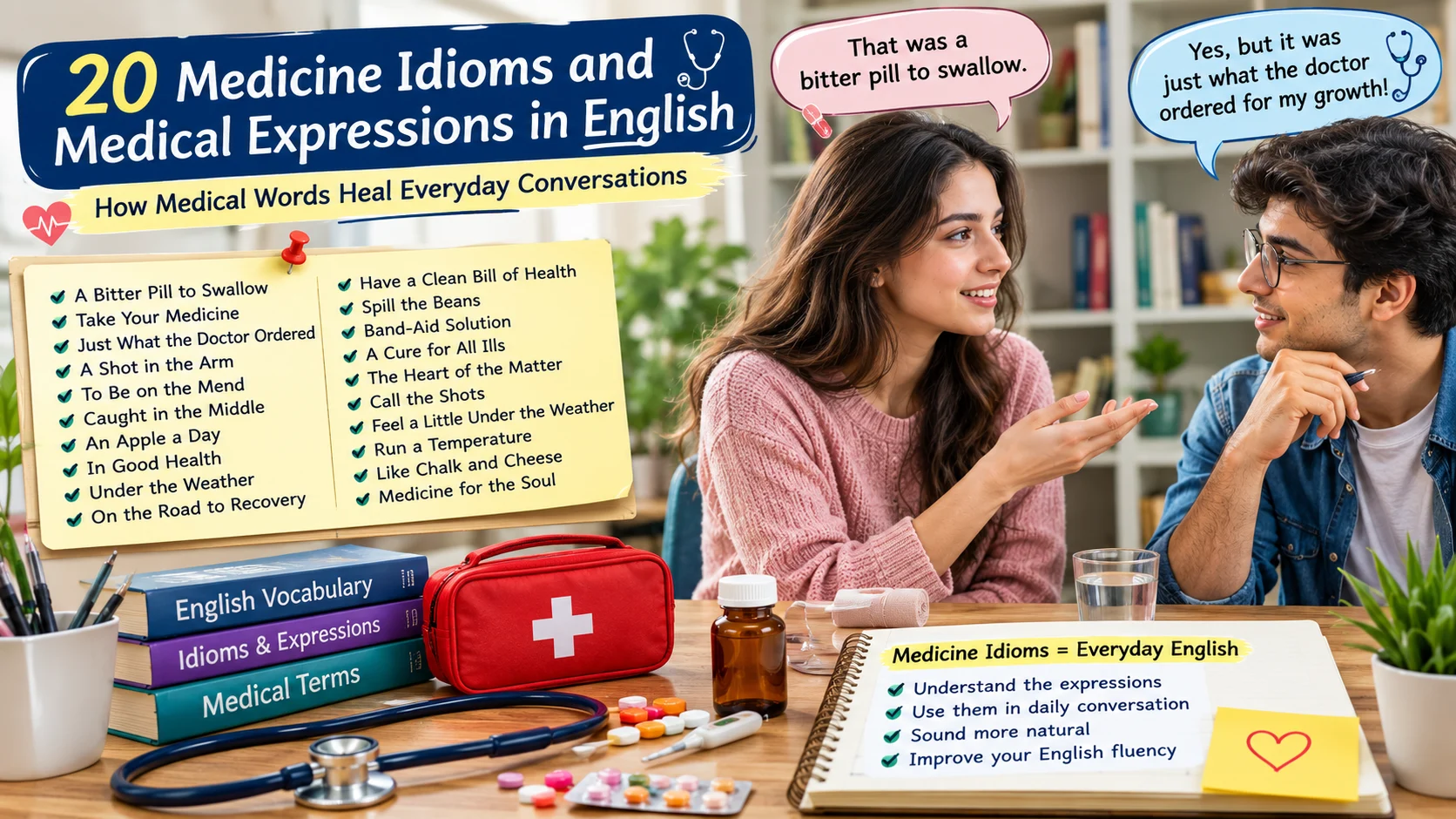
Medicine idioms are everywhere in everyday English. From saying something is “a bitter pill to swallow” to describing a quick fix as “a Band-Aid solution,” these expressions use medicine, doctors, and healing as metaphors for everyday experiences.
In this guide, you’ll learn 20 common medical idioms and phrases, including idioms about doctors, doctor idioms, idioms about healing, and expressions related to medicine. Each one includes its meaning, examples, common mistakes, and a simple usage note so you can use it naturally.
Why Learn Medicine Idioms?
Learning idioms about medicine can make your English sound more natural and help you understand conversations, books, movies, and social media.
These expressions can help you:
- Express difficult emotions and experiences
- Describe problems and solutions creatively
- Understand native speakers more easily
- Make everyday English more colorful
- Recognize common medical idioms and phrases
- Use medicine metaphors naturally in conversation and writing
Some are closely connected to healthcare, while others use medical ideas to describe situations that have nothing to do with actual illness.
Let’s explore them.
A Bitter Pill to Swallow
Word-by-word meaning:
A pill that tastes unpleasant.
Idiomatic meaning:
A difficult or unpleasant fact or situation that someone must accept.
Example sentences:
- Losing the championship was a bitter pill to swallow.
- Being rejected for the job was a bitter pill to swallow.
- Admitting that he was wrong was a bitter pill to swallow.

Common mistake:
❌ Using it only when talking about actual medicine
✔️ Use it for disappointment, failure, criticism, or an unpleasant truth.
Usage note:
This is one of the most common medicine idioms and works well in both conversation and writing.
Take Your Medicine
Word-by-word meaning:
Take prescribed medicine.
Idiomatic meaning:
Accept the consequences of your actions, especially when those consequences are unpleasant.
Example sentences:
- You broke the rules, so now you have to take your medicine.
- He knew he had made a mistake and was ready to take his medicine.
- If you ignore the warnings, you’ll eventually have to take your medicine.

Common mistake:
❌ Assuming it always refers to taking medication
✔️ Look at the context. It can be metaphorical.
Usage note:
This take your medicine idiom is informal and can sound firm or slightly humorous.
A Dose of Your Own Medicine
Word-by-word meaning:
Receiving the same medicine you gave someone else.
Idiomatic meaning:
Being treated in the same unpleasant way that you have treated another person.
Example sentences:
- He constantly criticized everyone, so receiving a dose of his own medicine wasn’t surprising.
- She finally got a dose of her own medicine when her friends ignored her advice.
- The bully got a dose of his own medicine.

Common mistake:
❌ Using it for a positive favor
✔️ It normally refers to negative or unpleasant treatment.
Usage note:
This expression is often used when someone experiences the consequences of their own behavior.
Just What the Doctor Ordered
Word-by-word meaning:
Exactly what a doctor prescribed.
Idiomatic meaning:
Something that is exactly what someone needs.
Example sentences:
- A relaxing weekend was just what the doctor ordered.
- That vacation was just what the doctor ordered after a stressful month.
- A good night’s sleep was just what the doctor ordered.

Common mistake:
❌ Using it only for medical treatment
✔️ It can describe anything that provides exactly the needed benefit.
Usage note:
This is a positive and very natural expression in everyday English.
Rub Salt in the Wound
Word-by-word meaning:
Put salt on an injury.
Idiomatic meaning:
Make an already painful or difficult situation even worse.
Example sentences:
- Laughing at his mistake only rubbed salt in the wound.
- Losing the game was bad enough, but his friend’s joke rubbed salt in the wound.
- Her criticism rubbed salt in the wound after the disappointing result.

Common mistake:
❌ Using it for every negative action
✔️ It usually involves making an existing problem, embarrassment, or hurt worse.
Usage note:
Although this isn’t strictly a medical idiom, it uses the image of an injury to create a powerful medicine metaphor for emotional pain.
Laughter Is the Best Medicine
Word-by-word meaning:
Laughter is the best treatment.
Idiomatic meaning:
Laughing and having fun can make difficult situations feel easier.
Example sentences:
- We were stressed about the exam, but laughter is the best medicine.
- She always makes me laugh when I’m having a bad day.
- Sometimes laughter really is the best medicine.
Common mistake:
❌ Treating it as a literal medical claim
✔️ It is a proverb expressing the emotional benefits of humor.
Usage note:
This is one of the best-known expressions among idioms about healing and emotional well-being.
An Apple a Day Keeps the Doctor Away
Word-by-word meaning:
Eating an apple every day keeps you from needing a doctor.
Idiomatic meaning:
Healthy habits can help prevent illness and support good health.
Example sentences:
- My grandmother always said, “An apple a day keeps the doctor away.”
- Regular exercise and a balanced diet reflect the idea that an apple a day keeps the doctor away.
Common mistake:
❌ Taking the saying literally
✔️ Understand it as a proverb encouraging healthy habits.
Usage note:
This is a famous health proverb rather than a strict idiom.
Under the Weather
Word-by-word meaning:
Being beneath bad weather.
Idiomatic meaning:
Feeling slightly ill, tired, or unwell.
Example sentences:
- I’m feeling a little under the weather today.
- She stayed home because she was under the weather.
- I’ve been under the weather all week.
Common mistake:
❌ Using it to describe a serious medical condition
✔️ It usually suggests mild illness or feeling generally unwell.
Usage note:
This is one of the most common everyday health expressions in English.
Sick as a Dog
Word-by-word meaning:
As sick as a dog.
Idiomatic meaning:
Very sick or extremely nauseous.
Example sentences:
- I was sick as a dog after eating something bad.
- He was sick as a dog all night.
- She felt sick as a dog during the trip.
Common mistake:
❌ Using it in formal medical communication
✔️ Use it in informal conversation.
Usage note:
This is a colorful informal expression, not something you’d normally use in a doctor’s report.
Prevention Is Better Than Cure
Word-by-word meaning:
Preventing a problem is better than treating it afterward.
Idiomatic meaning:
It is better to prevent a problem than deal with its consequences later.
Example sentences:
- Back up your files regularly. Prevention is better than cure.
- Wearing protective equipment shows that prevention is better than cure.
- Saving money early is another example of the idea that prevention is better than cure.
Common mistake:
❌ Assuming it can only be used for physical health
✔️ It can apply to many problems in everyday life.
Usage note:
This is a widely used proverb and an excellent example of a medical metaphor applied to non-medical situations.
Pull Through
Word-by-word meaning:
Come through a difficult situation.
Idiomatic meaning:
Survive a serious illness or recover from a difficult experience.
Example sentences:
- The doctors were worried, but fortunately he pulled through.
- She pulled through after a long illness.
- With support from his family, he pulled through a difficult period.
Common mistake:
❌ Using it to mean instant recovery
✔️ It suggests successfully surviving or recovering from a difficult situation.
Usage note:
This expression often carries a hopeful or reassuring tone.
Go Under the Knife
Word-by-word meaning:
Go beneath a knife.
Idiomatic meaning:
Have surgery.
Example sentences:
- He went under the knife last month.
- She may have to go under the knife to repair the injury.
- After years of discomfort, he decided to go under the knife.
Common mistake:
❌ Interpreting it as violence
✔️ In this expression, it refers specifically to undergoing surgery.
Usage note:
This is an informal expression commonly heard in conversations about operations.
On the Mend
Word-by-word meaning:
Being repaired or fixed.
Idiomatic meaning:
Recovering from an illness, injury, or difficult situation.
Example sentences:
- She’s finally on the mend after her surgery.
- His health is slowly on the mend.
- The company is on the mend after a difficult year.
Common mistake:
❌ Using it when there is no sign of improvement
✔️ It suggests that recovery or improvement has already begun.
Usage note:
It has a positive, reassuring tone and can describe both health and non-medical situations.
A Clean Bill of Health
Word-by-word meaning:
A statement saying that someone is healthy.
Idiomatic meaning:
A confirmation that someone or something has no serious problems.
Example sentences:
- After several tests, she received a clean bill of health.
- The doctor gave him a clean bill of health.
- The building received a clean bill of health after the inspection.
Common mistake:
❌ Assuming it can only describe a person’s health
✔️ It can also be used metaphorically for organizations, systems, products, or projects.
Usage note:
This expression can work in both everyday and more formal English.
A Shot in the Arm
Word-by-word meaning:
An injection into the arm.
Idiomatic meaning:
Something that provides a sudden boost of energy, confidence, encouragement, or success.
Example sentences:
- The new investment was a shot in the arm for the company.
- Winning the award gave the team a shot in the arm.
- The good news was a much-needed shot in the arm.
Common mistake:
❌ Assuming it always means a vaccination or injection
✔️ In metaphorical use, it means a boost.
Usage note:
This is a useful expression for business, sports, motivation, and everyday conversation.
Time Is the Best Healer
Word-by-word meaning:
Time acts like a healer.
Idiomatic meaning:
Emotional pain often becomes easier to handle as time passes.
Example sentences:
- Losing someone you love is painful, but time is the best healer.
- Give yourself time after a difficult experience; time is the best healer.
- She eventually moved on because time is the best healer.
Common mistake:
❌ Assuming it means emotional pain disappears immediately
✔️ The expression emphasizes gradual healing.
Usage note:
This is a reflective saying often used when discussing grief, heartbreak, disappointment, or emotional recovery.
Nurse Someone Back to Health
Word-by-word meaning:
Care for someone until they become healthy again.
Idiomatic meaning:
Take care of someone and help them recover from illness or weakness.
Example sentences:
- Her mother nursed her back to health after the illness.
- The family stayed together and helped nurse him back to health.
- Good care helped nurse the injured bird back to health.
Common mistake:
❌ Assuming only a professional nurse can do this
✔️ Anyone who provides care can be described as nursing someone back to health.
Usage note:
This is one of the warmer idioms about healing, emphasizing care and recovery.
A Band-Aid Solution
Word-by-word meaning:
A temporary bandage placed over a wound.
Idiomatic meaning:
A quick or temporary solution that doesn’t address the underlying problem.
Example sentences:
- Cutting costs may be only a Band-Aid solution.
- The new policy is a Band-Aid solution rather than a permanent fix.
- We need to solve the real problem instead of applying another Band-Aid solution.
Common mistake:
❌ Using it to describe a complete or permanent solution
✔️ It usually suggests that the solution is temporary or superficial.
Usage note:
This is a particularly useful medical idiom in business, politics, education, and analytical writing.
Doctor’s Orders
Word-by-word meaning:
Instructions given by a doctor.
Idiomatic meaning:
An instruction or recommendation that should be followed, sometimes used humorously.
Example sentences:
- A weekend at the beach? Doctor’s orders!
- You need to get some rest—consider it doctor’s orders.
- He took a day off and jokingly called it doctor’s orders.
Common mistake:
❌ Assuming the phrase always refers to a real doctor
✔️ It is often used playfully to emphasize that something is necessary.
Usage note:
This is one of the most recognizable doctor idioms in casual English.
Feel Like Death Warmed Over
Word-by-word meaning:
Something that resembles death after being warmed again.
Idiomatic meaning:
To feel extremely ill, exhausted, or miserable.
Example sentences:
- I barely slept last night and feel like death warmed over.
- After the long flight, she felt like death warmed over.
- He looked like death warmed over after being sick all weekend.
Common mistake:
❌ Using it in formal medical situations
✔️ It’s a humorous and dramatic informal expression.
Usage note:
This expression is quite vivid, so it is best suited to casual conversations.
Medical Idioms and Phrases in Everyday English
Many medical idioms and phrases aren’t really about medicine at all. Instead, they borrow ideas from doctors, illness, treatment, injury, and recovery to describe ordinary experiences.
For example:
- A bitter pill to swallow → accepting disappointment
- A shot in the arm → receiving a boost
- A Band-Aid solution → using a temporary fix
- A clean bill of health → finding no major problems
- On the mend → gradually improving
- A dose of your own medicine → experiencing the same treatment you gave others
These expressions show how strongly health and medicine influence everyday English.
Medicine Idioms vs. Medical Idioms
The terms medicine idiom, medical idiom, and idiom about medicine are often used interchangeably when people search for these expressions, but there is a small distinction.
Medicine idioms often focus on pills, doses, treatment, or remedies:
- A bitter pill to swallow
- Take your medicine
- A dose of your own medicine
Medical idioms can have a broader connection to doctors, illness, surgery, recovery, and healthcare:
- Go under the knife
- A clean bill of health
- Doctor’s orders
- Pull through
Together, they form a useful group of medical idioms and phrases for English learners.
Common Mistakes With Medicine Idioms
Taking medical expressions literally
Many of these expressions are figurative.
For example, when someone says:
“That was a bitter pill to swallow.”
They usually aren’t talking about medication. They mean that something was difficult to accept.
Using informal idioms in formal medical situations
Expressions such as sick as a dog and feel like death warmed over are suitable for casual conversation but would sound inappropriate in a formal medical report.
Confusing similar expressions
A Band-Aid solution means a temporary fix, while a shot in the arm means a boost or improvement.
Understanding the difference prevents common mistakes.
Assuming every health expression is an idiom
Some expressions are actually proverbs or sayings, such as “An apple a day keeps the doctor away” and “Laughter is the best medicine.”
It’s useful to know the difference, especially if you’re studying English terminology.
How to Use Medicine Idioms Naturally
The easiest way to learn idiom medicine expressions is to connect each phrase with a situation rather than memorizing individual words.
For example:
Bad news → A bitter pill to swallow
Temporary solution → A Band-Aid solution
Encouragement or boost → A shot in the arm
Recovery → On the mend
Exact solution → Just what the doctor ordered
Once you connect the expression with its meaning, it becomes much easier to recognize and use naturally.
Frequently Asked Questions About Medicine Idioms
What are medicine idioms?
Medicine idioms are expressions that use words related to medicine, doctors, illness, treatment, or healing to communicate figurative meanings. Examples include a bitter pill to swallow, a shot in the arm, and take your medicine.
What are some common idioms about doctors?
Popular idioms about doctors and doctor-related expressions include just what the doctor ordered, doctor’s orders, and a clean bill of health.
What are some medical idioms?
Common medical idioms include go under the knife, pull through, on the mend, a Band-Aid solution, and a shot in the arm.
What are some idioms about healing?
Examples of idioms about healing include on the mend, pull through, nurse someone back to health, and time is the best healer.
Is “Laughter Is the Best Medicine” an idiom?
It is more accurately described as a proverb or saying rather than a traditional idiom. It expresses the idea that humor and laughter can help people cope with difficult situations.
Can I use medical idioms in academic or exam writing?
Yes, but use them only when they fit naturally. Expressions such as a Band-Aid solution can work well in argumentative or analytical writing, while very informal expressions such as sick as a dog are better suited to casual contexts.
Conclusion:
Medicine idioms bring everyday English to life by turning ideas about doctors, illness, treatment, and healing into memorable expressions. From a bitter pill to swallow and a dose of your own medicine to on the mend and a shot in the arm, these phrases can help you understand native speakers and express yourself more naturally.
Start by learning two or three expressions at a time. Write your own examples, listen for them in real conversations, and pay attention to their tone and context. With regular practice, these medical idioms and phrases will become a natural part of your English vocabulary.

Sophie Langford, author at SeekIdiom, explains English idioms with clear meanings, examples, and usage to help learners improve vocabulary and communication.