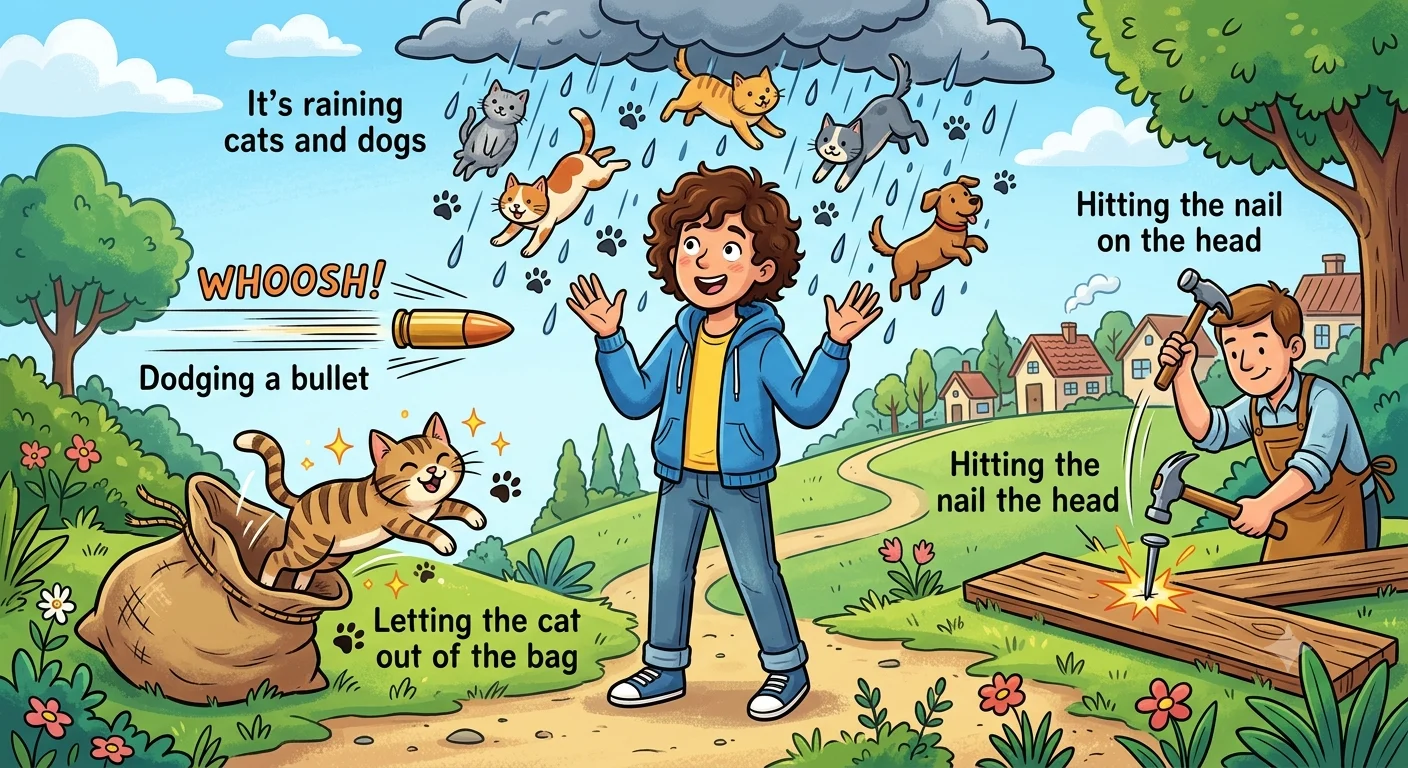
Have you ever heard someone say, “It’s raining cats and dogs” and wondered what it meant? Crazy idioms phrases like this can sound bizarre but make English fun and memorable. These quirky expressions are used by native speakers every day, and mastering them will make your conversations lively and impressive!
Raining Cats and Dogs
Word-by-Word Meaning
Raining = water falling from the sky
Cats and Dogs = literal animals
Idiomatic/Figurative Meaning
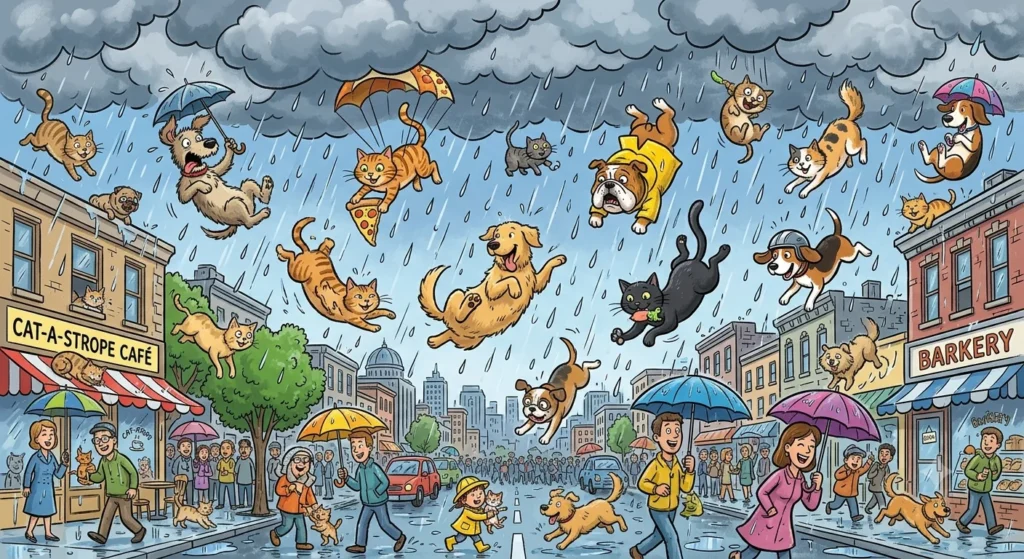
It’s raining very heavily.
Example Sentences
- “Take your umbrella! It’s raining cats and dogs outside.”
- “We had to cancel the picnic because it was raining cats and dogs.”
Common Error
- Saying “It’s raining dogs and cats.”
Usage Note
Informal and commonly used in spoken English.
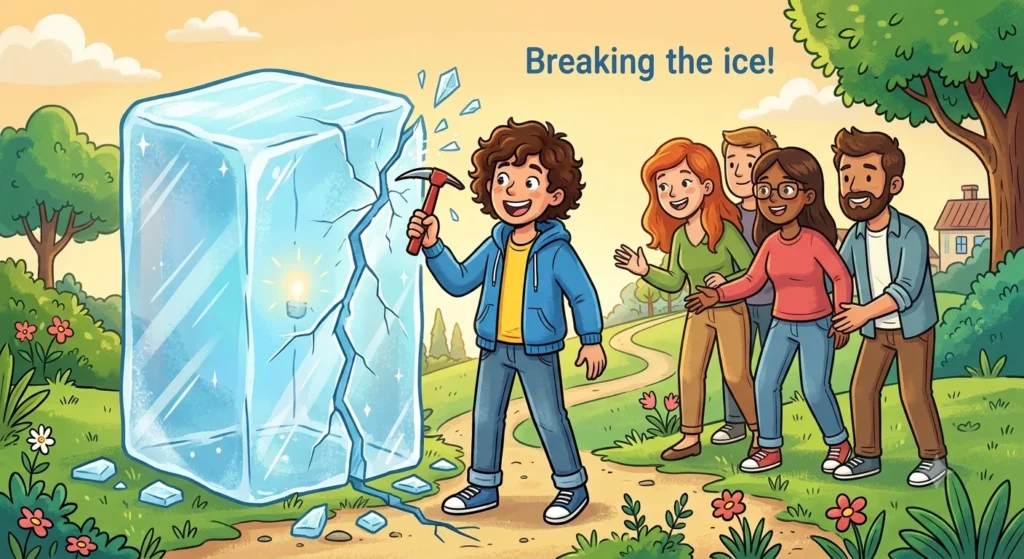
Break the Ice
Word-by-Word Meaning
Break = smash
Ice = frozen water
Idiomatic/Figurative Meaning
To start a conversation or ease tension in a social setting.
Example Sentences
- “He told a joke to break the ice at the meeting.”
- “Games can help break the ice in new classrooms.”
Common Error
- Confusing it with literally breaking ice.
Usage Note
Used in both casual and professional situations.
Bite the Bullet
Word-by-Word Meaning
Bite = use teeth to cut
Bullet = ammunition
Idiomatic/Figurative Meaning
To endure a painful or difficult situation bravely.

Example Sentences
- “I hate going to the dentist, but I’ll bite the bullet.”
- “She bit the bullet and faced her fear of public speaking.”
Common Error
- Using “bite the ball” instead of “bullet.”
Usage Note
Often used in formal or written English.
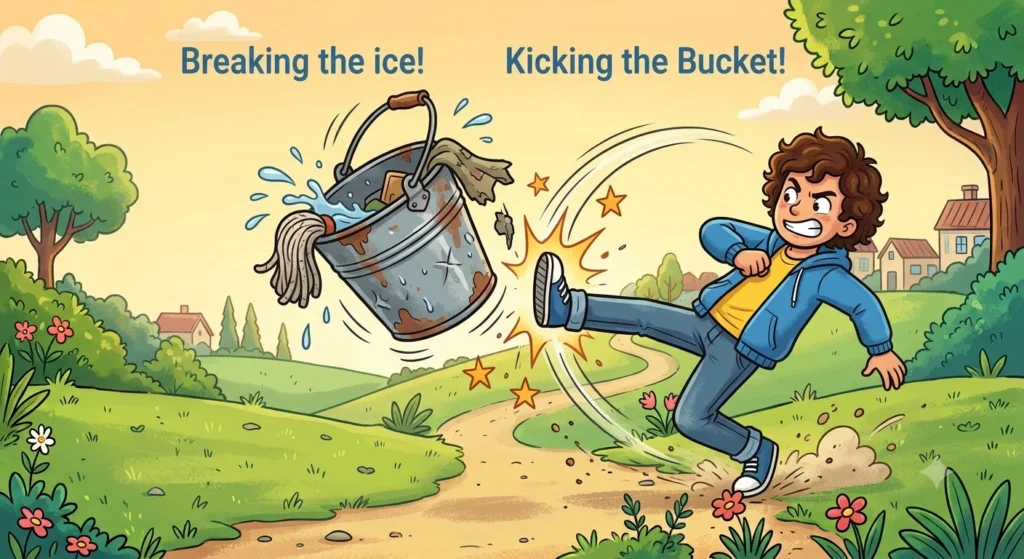
Kick the Bucket
Word-by-Word Meaning
Kick = strike with foot
Bucket = container for liquids
Idiomatic/Figurative Meaning
To die.
Example Sentences
- “The old man finally kicked the bucket last night.”
- “Many movies jokingly say, ‘He kicked the bucket.’”
Common Error
- Using it casually for minor accidents or frustrations.
Usage Note
Slightly informal; can be humorous in context.
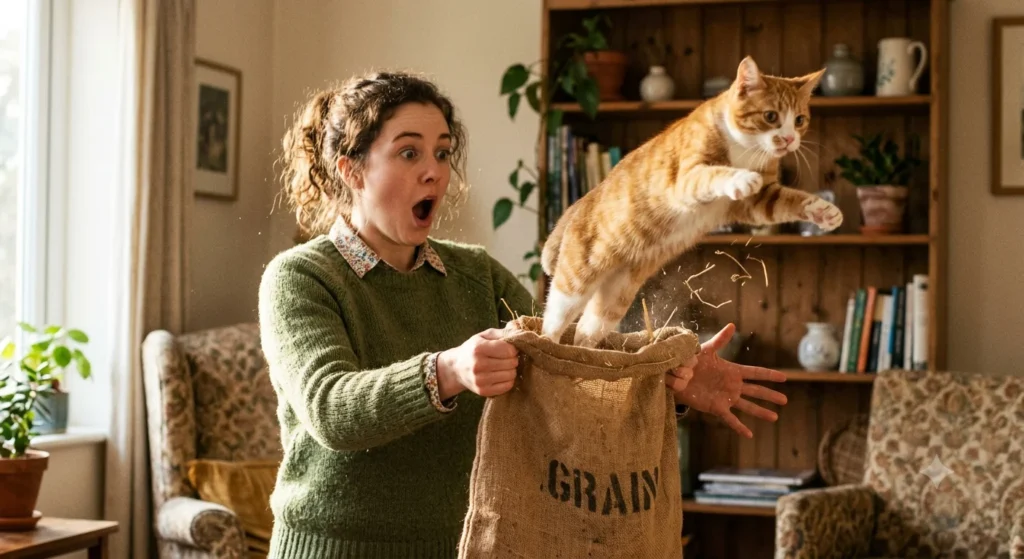
Let the Cat Out of the Bag
Word-by-Word Meaning
Let = allow
Cat = animal
Out of the bag = literal action
Idiomatic/Figurative Meaning
To reveal a secret accidentally.
Example Sentences
- “He let the cat out of the bag about the surprise party.”
- “Try not to let the cat out of the bag about the project.”
Common Error
- Saying “let the dog out of the bag.”
Usage Note
Informal, used frequently in conversation.
Hit the Nail on the Head
Word-by-Word Meaning
Hit = strike
Nail = metal spike
Head = top part
Idiomatic/Figurative Meaning
To describe something accurately or find the exact solution.
Example Sentences
- “You hit the nail on the head with your comment.”
- “Her analysis hit the nail on the head.”
Common Error
- Saying “hit the nail in the head.”
Usage Note
Works in formal and informal contexts.
Piece of Cake
Word-by-Word Meaning
Piece = portion
Cake = dessert
Idiomatic/Figurative Meaning
Something very easy to do.
Example Sentences
- “This homework is a piece of cake.”
- “Don’t worry about the test; it’s a piece of cake.”
Common Error
- Saying “a cake of piece.”
Usage Note
Informal; common in casual conversations.
Costs an Arm and a Leg
Word-by-Word Meaning
Costs = requires payment
Arm and Leg = body parts
Idiomatic/Figurative Meaning
Very expensive.
Example Sentences
- “This car costs an arm and a leg.”
- “Their wedding cost them an arm and a leg.”
Common Error
- Misunderstanding it as literal body parts.
Usage Note
Used in informal speech.
Burn the Midnight Oil
Word-by-Word Meaning
Burn = set on fire
Midnight oil = oil burned in lamps at night
Idiomatic/Figurative Meaning
Work late into the night.
Example Sentences
- “She burned the midnight oil to finish her report.”
- “I had to burn the midnight oil to meet the deadline.”
Common Error
- Saying “burn the candle at both ends” (different idiom with similar meaning).
Usage Note
Can be used in formal or informal contexts.
The Ball is in Your Court
Word-by-Word Meaning
Ball = object for playing
Court = playing field
Idiomatic/Figurative Meaning
It’s your decision or responsibility.
Example Sentences
- “I’ve given my advice; now the ball is in your court.”
- “The next move is yours; the ball is in your court.”
Common Error
- Saying “the ball is on your court.”
Usage Note
Informal and metaphorical; often used in business.
Under the Weather
Word-by-Word Meaning
Under = below
Weather = atmospheric condition
Idiomatic/Figurative Meaning
Feeling sick or unwell.
Example Sentences
- “I’m feeling under the weather today.”
- “He’s under the weather, so he’s staying home.”
Common Error
- Using it to describe emotions rather than physical sickness.
Usage Note
Informal; very common in daily conversation.
Spill the Beans
Word-by-Word Meaning
Spill = drop
Beans = food item
Idiomatic/Figurative Meaning
To reveal a secret.
Example Sentences
- “Don’t spill the beans about the surprise.”
- “She spilled the beans by mistake.”
Common Error
- Confusing with literally dropping beans.
Usage Note
Informal; widely recognized idiom.
Cry Over Spilled Milk
Word-by-Word Meaning
Cry = shed tears
Spilled milk = milk that has fallen
Idiomatic/Figurative Meaning
Worrying about something that cannot be changed.
Example Sentences
- “No use crying over spilled milk; let’s move on.”
- “He cried over spilled milk after losing the game.”
Common Error
- Using it for current problems rather than past mistakes.
Usage Note
Common in both written and spoken English.
Cut to the Chase
Word-by-Word Meaning
Cut = trim
Chase = pursuit
Idiomatic/Figurative Meaning
Get to the main point without wasting time.
Example Sentences
- “Let’s cut to the chase and discuss the main issue.”
- “I don’t have much time, so cut to the chase.”
Common Error
- Misusing in casual conversation to mean “avoid something.”
Usage Note
Informal; often used in meetings.
Elephant in the Room
Word-by-Word Meaning
Elephant = large animal
Room = enclosed space
Idiomatic/Figurative Meaning
An obvious problem that no one wants to discuss.
Example Sentences
- “We need to address the elephant in the room.”
- “The missing funds were the elephant in the room.”
Common Error
- Using it for minor issues.
Usage Note
Widely used in professional and social discussions.
Hit the Sack
Word-by-Word Meaning
Hit = strike
Sack = bed or bag
Idiomatic/Figurative Meaning
Go to bed or sleep.
Example Sentences
- “I’m exhausted. Time to hit the sack.”
- “After the long trip, he hit the sack immediately.”
Common Error
- Confusing with “hit the sackcloth” (different meaning).
Usage Note
Informal, common in daily conversation.
70+ Funny Idioms Examples for Students That Sound Hilarious 🤪
Kick the Habit
Word-by-Word Meaning
Kick = strike
Habit = routine behavior
Idiomatic/Figurative Meaning
Stop a bad habit.
Example Sentences
- “He finally kicked the habit of smoking.”
- “I’m trying to kick the habit of late-night snacking.”
Common Error
- Using “kick the habit” for good habits.
Usage Note
Informal; motivational context works well.
Once in a Blue Moon
Word-by-Word Meaning
Once = one time
Blue Moon = rare astronomical event
Idiomatic/Figurative Meaning
Something that happens very rarely.
Example Sentences
- “We go out for dinner once in a blue moon.”
- “She visits her hometown once in a blue moon.”
Common Error
- Using it for frequent events.
Usage Note
Informal; great for storytelling.
Add Fuel to the Fire
Word-by-Word Meaning
Add = put more
Fuel = flammable substance
Fire = burning
Idiomatic/Figurative Meaning
Make a bad situation worse.
Example Sentences
- “His comments only added fuel to the fire.”
- “Don’t add fuel to the fire by arguing further.”
Common Error
- Using it literally for actual fire.
Usage Note
Widely used in casual and formal contexts.
Barking Up the Wrong Tree
Word-by-Word Meaning
Barking = making dog sounds
Wrong tree = incorrect tree
Idiomatic/Figurative Meaning
Blaming the wrong person or pursuing the wrong approach.
Example Sentences
- “If you think I’m guilty, you’re barking up the wrong tree.”
- “He’s barking up the wrong tree by asking her for help.”
Common Error
- Confusing with literal barking.
Usage Note
Informal; often used in discussions and debates.
FAQs About Crazy Idioms Phrases
Q1: Can idioms be used in formal writing?
A: Some idioms like “hit the nail on the head” are fine, but casual ones are better for conversation.
Q2: How can I remember idioms easily?
A: Use them in sentences, stories, or conversations. Visualizing the phrase also helps.
Q3: Are idioms the same in every English-speaking country?
A: No, some idioms are regional. For example, British English has unique idioms.
Q4: Can idioms have multiple meanings?
A: Yes, context is key. For example, “break the ice” can mean starting a conversation or easing tension.
Q5: Is it okay to make new idioms?
A: You can create expressions, but established idioms are widely understood.
Conclusion
Crazy idioms phrases make English fun, colorful, and expressive. Practice using at least one new idiom every day, and soon, you’ll speak like a native! Don’t just memorize—use them in real conversations and stories for maximum impact.

Hazel Monroe, author at SeekIdiom, explains English idioms through simple meanings and examples, helping learners improve vocabulary and everyday usage.