
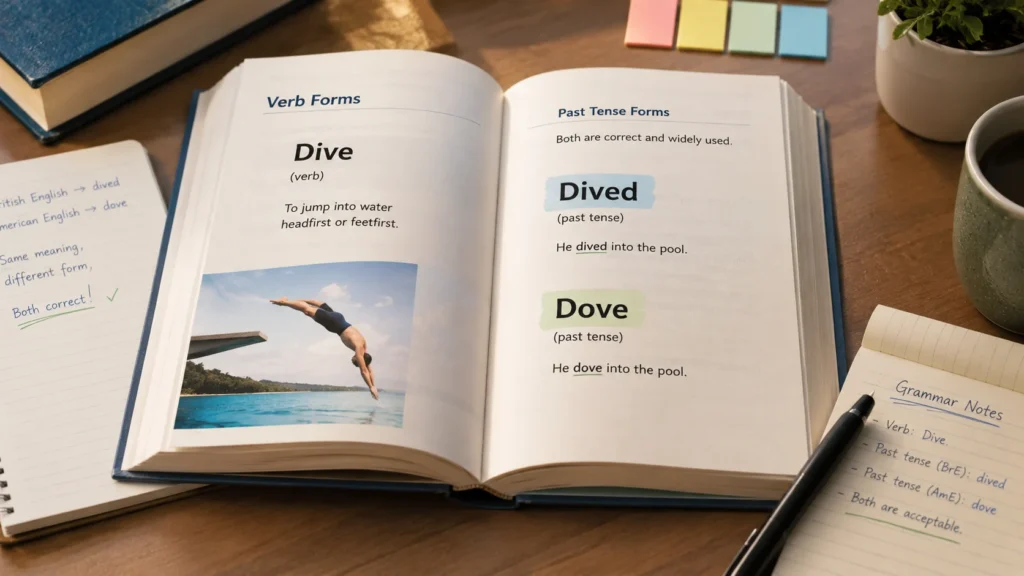
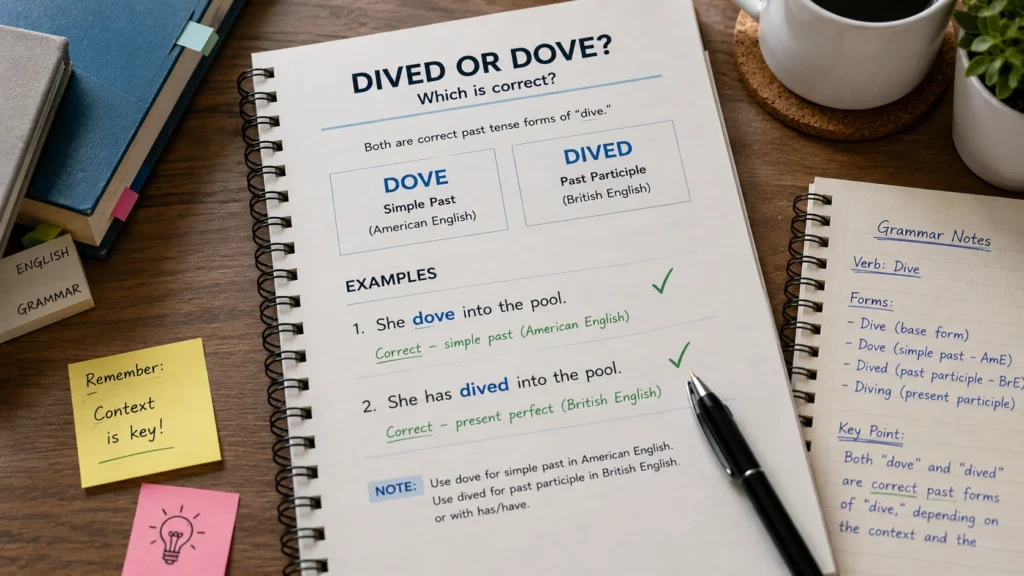
If you are wondering whether dived or dove is correct, the answer is that both are accepted simple past forms of the verb dive. The main difference is regional usage. Dove is especially common in American English, while dived is generally preferred in British English and is also widely recognized internationally.
For example:
- American English: She dove into the pool.
- British English: She dived into the pool.
Both sentences are grammatically correct and have the same meaning. The important distinction comes when you use dive in perfect tenses, such as with has, have, or had. In those constructions, dived is the standard past participle.
Why Are There Two Past Forms?
The confusion comes from the fact that dive has developed two accepted simple past forms.
Dived follows the regular pattern of adding ed to the verb, while dove developed as an irregular alternative past form and became particularly established in American English.
Neither form describes a different type of diving. They are simply two past tense forms with different regional preferences.
For example:
- She dived into the pool.
- She dove into the pool.
Both describe the same action.
Quick Reference Table
| Form | Grammatical Role | Common Usage | Example |
|---|---|---|---|
| Dive | Present tense | All varieties | I dive every summer. |
| Dived | Simple past | Especially British English | She dived into the pool. |
| Dove | Simple past | Especially American English | She dove into the pool. |
| Dived | Past participle | Standard usage | She has dived into the pool. |
| Diving | Present participle | All varieties | They are diving now. |
What Does Dived Mean?
Dived is a form of the verb dive. It can function as both the simple past and the past participle.
As a simple past form, it describes an action that happened in the past.
Examples:
- She dived into the swimming pool.
- The goalkeeper dived to save the ball.
- The eagle dived toward the lake.
- He dived under the table.
As a past participle, dived is used with helping verbs such as has, have, and had.
Examples:
- She has dived into that pool several times.
- They have dived beneath the waves.
- He had dived into the water before the lifeguard arrived.
Dived is especially common in British English, but it is also a valid and widely understood form in American English.
What Does Dove Mean?
Dove is an alternative simple past form of dive. It is especially common in American English.
Examples:
- She dove into the swimming pool.
- He dove into the lake.
- The player dove for the ball.
- The eagle dove toward the water.
In these sentences, dove has exactly the same basic meaning as dived.
However, dove has another meaning as a noun. It can refer to a type of bird.
Compare these sentences:
- The swimmer dove into the water.
Here, dove is the past tense of dive. - A white dove landed on the roof.
Here, dove is a noun referring to a bird.
The context makes the difference clear.
Dived vs. Dove in American English
In American English, dove is generally the more natural choice for a completed diving action.
For example:
- The swimmer dove into the pool.
- The goalkeeper dove for the ball.
- The eagle dove toward the river.
- She dove under the waves.
You may still see dived in American writing. It is not incorrect. It can appear in formal, international, or regionally influenced writing.
If your goal is natural everyday American English, dove is usually the better choice for the simple past.

Dived vs. Dove in British English
British English generally favors dived as the simple past form.
For example:
- The swimmer dived into the pool.
- The goalkeeper dived for the ball.
- The eagle dived toward the river.
- She dived under the waves.
A British English speaker will understand dove, but dived is generally the more conventional choice.
This is a difference in usage preference, not a difference in meaning.
Past Tense vs. Past Participle
One of the most useful things to understand about dived or dove is the difference between the simple past and the past participle.
| Tense | Form | Example |
|---|---|---|
| Simple past | dived or dove | She dived/dove into the pool. |
| Past participle | dived | She has dived into the pool. |
The simple past describes a completed action:
She dove into the pool yesterday.
The past participle is used with helping verbs:
She has dived into the pool several times.
For standard formal writing, dived is the safest choice as the past participle.
You may encounter has dove or had dove in informal American usage, but has dived, have dived, and had dived are the standard forms to use in careful writing.
What Is the Past Tense of Dive?
The simple past of dive can be either dived or dove.
For example:
I dived into the water.
I dove into the water.
Both are correct.
The choice generally depends on the variety of English being used. American English commonly favors dove, while British English generally favors dived.
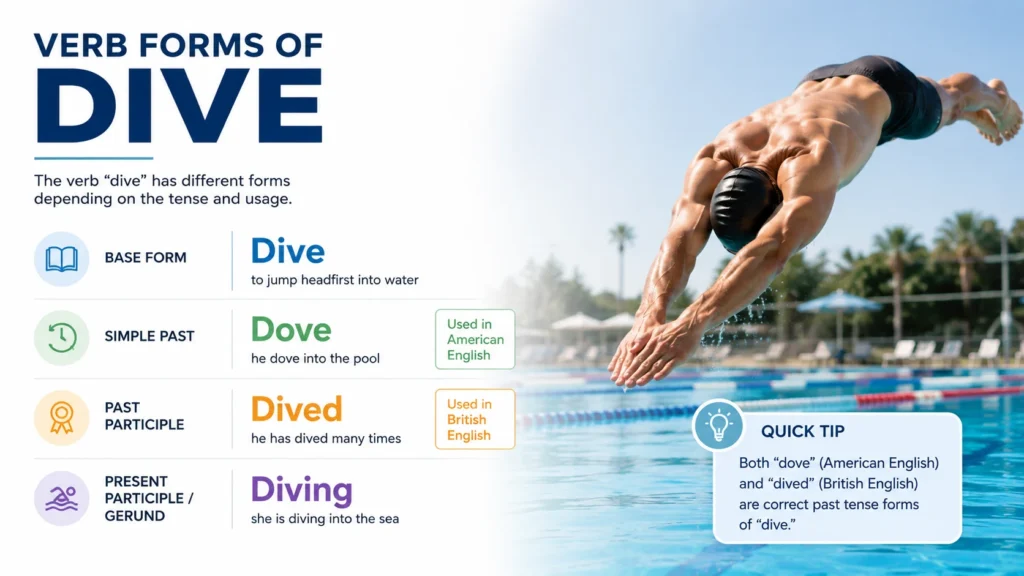
What Is the Past Participle of Dive?
The standard past participle is dived.
Use it after has, have, or had:
She has dived into the pool before.
They have dived beneath the waves.
He had dived into the water before the boat arrived.
This is different from the simple past, where both dived and dove can be used.
A useful pattern to remember is:
Present: I dive.
Simple past: I dived or dove.
Past participle: I have dived.
Present participle: I am diving.
Practical Examples of Dived and Dove
Swimming
American English:
Jake dove into the deep end.
British English:
Jake dived into the deep end.
Sports
American English:
The baseball player dove for the ball.
British English:
The baseball player dived for the ball.
Animals
American English:
The eagle dove toward the water.
British English:
The eagle dived toward the water.
Moving Under Something
American English:
She dove under the fence.
British English:
She dived under the fence.
The meaning remains the same in each pair.
Common Uses of the Verb Dive
The verb dive can describe several types of movement, not just jumping into a swimming pool.
Diving Into Water
This is the most familiar meaning.
The kids dove into the pool.
You could also say:
The kids dived into the pool.
Diving for Something
The verb is commonly used in sports when someone quickly moves toward an object.
The goalkeeper dove for the ball.
Birds Moving Downward
Birds can dive toward water, prey, or the ground.
The hawk dove toward the field.
Moving Beneath Something
Dive can also describe suddenly moving under an object.
He dove under the table.
Moving Quickly Downward
The verb can describe rapid downward movement in other situations.
The plane dived toward the ground.
The appropriate past form depends on the variety of English and the writer’s preference.
Common Mistakes to Avoid
Mistake 1: Thinking Dove Is Wrong
Some learners assume that dove must be incorrect because dived follows the familiar ed pattern.
That is not true.
The swimmer dove into the pool.
This is a correct sentence, particularly in American English.
Mistake 2: Thinking Dived Is Wrong
The opposite assumption is also incorrect.
The swimmer dived into the pool.
This is grammatically correct and is especially common in British English.
Mistake 3: Using Dive for a Past Action
Do not use the present form when describing a completed past event.
Incorrect:
She dive into the pool yesterday.
Correct:
She dove into the pool yesterday.
Or:
She dived into the pool yesterday.
Mistake 4: Using Dove as the Present Tense
Dove is a past tense form, not the present tense.
For a regular present activity, use dives:
She dives into the pool every Saturday.
For a past activity:
She dove into the pool every Saturday during the summer.
Mistake 5: Automatically Using Dove After Has, Have, or Had
For standard writing, use dived as the past participle.
Standard:
He has dived into the lake before.
Less standard:
He has dove into the lake before.
While the second form can occur in informal American usage, has dived is the better choice for formal and careful writing.
Mistake 6: Confusing Dove With the Bird
Remember that dove can be either a verb or a noun.
The swimmer dove into the water.
Here, dove is a verb.
A white dove sat on the branch.
Here, dove is a noun.
The context tells you which meaning applies.
Which One Should You Use?
The best choice depends on your audience and the grammatical construction.
| Situation | Recommended Form |
|---|---|
| American English simple past | Dove |
| British English simple past | Dived |
| International audience | Dived is a safe choice |
| Formal writing | Dived is a useful neutral choice |
| Perfect tenses | Dived |
| American casual conversation | Dove |
| US sports writing | Dove |
If your audience is primarily American, dove will usually sound more natural when describing a completed action.
If your audience is primarily British, dived is generally the better choice.
For an international audience, dived can be a useful neutral option because it is widely recognized across English varieties.
A Simple Rule to Remember
You can remember the forms with this pattern:
Present: I dive.
American simple past: I dove.
British simple past: I dived.
Past participle: I have dived.
The easiest rule is this: use dove as the simple past when writing natural American English, and use dived when writing British English or when you want a broadly neutral form. For perfect tenses, dived is the standard choice.
Frequently Asked Questions
Is dove or dived correct?
Both dove and dived are accepted simple past forms of dive. Dove is especially common in American English, while dived is generally preferred in British English.
Is dove the past tense of dive?
Yes. Dove is an accepted simple past form of dive, particularly in American English.
For example:
She dove into the pool.
Is dived grammatically correct?
Yes. Dived is a correct simple past form and is also the standard past participle of dive.
Do Americans say dived or dove?
Americans commonly use dove as the simple past of dive.
For example:
He dove into the pool.
Do British people say dove or dived?
British English generally prefers dived.
For example:
He dived into the water.
Can I use dove in formal writing?
Yes. Dove is acceptable in formal American English when it is used as the simple past of dive. However, dived may be a more neutral choice for an international audience.
Is dove the past participle of dive?
The standard past participle is dived.
Use:
She has dived into the pool.
For careful or formal writing, avoid using dove as the past participle.
Does dived mean something different from dove?
No. When they are used as simple past forms of dive, dived and dove have the same basic meaning. The main difference is regional preference.
Conclusion
When choosing between dived or dove, remember that both are accepted simple past forms of dive. Dove is especially common in American English, while dived is generally preferred in British English.
For a US audience, use dove for a natural simple past sentence:
She dove into the pool.
For British English, dived is generally preferred:
She dived into the pool.
And when you need the past participle after has, have, or had, dived is the standard choice:
She has dived into the pool several times.
Once you understand this simple distinction, choosing between dived and dove becomes much easier.
When choosing between dived or dove, remember that both are correct simple past forms of dive. Dove is especially common in American English, while dived is generally preferred in British English and works well for an international audience.
The key distinction is with the past participle. In standard usage, use dived with has, have, or had, as in “She has dived into the pool several times.” Once you remember this difference, choosing between dived and dove becomes simple: use dove for natural American English past tense, and dived when it better suits your audience or when you need the past participle.

Anita Brookner, author at SeekIdiom, shares easy explanations of English idioms with examples to help learners expand vocabulary and speak more confidently.