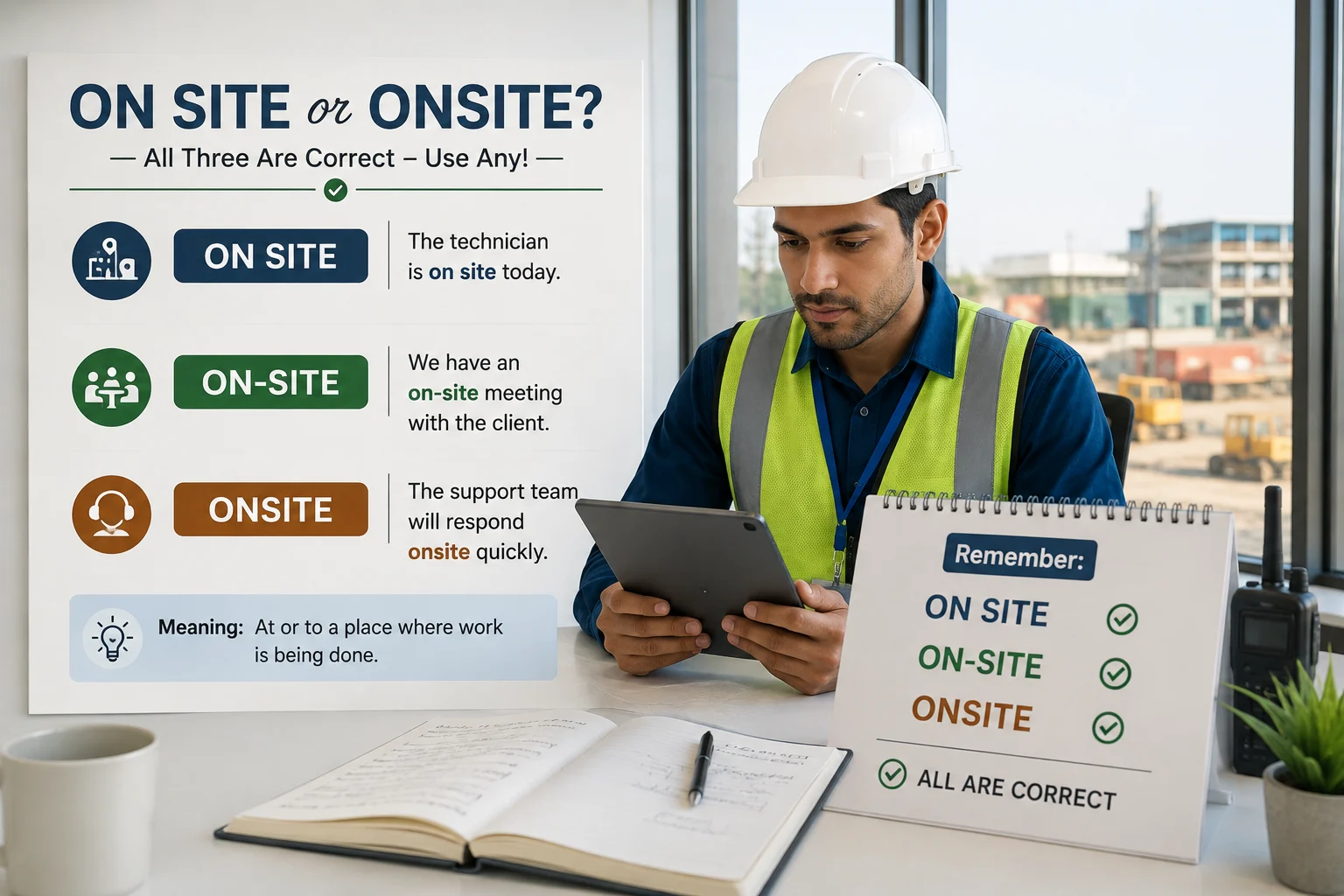
On site, onsite, and on-site can all be correct, depending on the context and style being followed. The important point is that English does not have one universal spelling for every situation. On site is commonly written as two words when it functions as a phrase, while on-site and onsite are established forms used as adjectives and adverbs. Merriam-Webster lists on-site as an adjective or adverb, while Cambridge also recognizes onsite, particularly in workplace English.
This makes on site or onsite a little more complicated than a simple right-or-wrong spelling question. The best choice depends on the sentence, the dictionary or style guide you are following, and whether you want to maintain consistency throughout your writing.
What Does On Site Mean?
On site means at a particular place or location where an activity is taking place. It is often used when referring to a person who is physically present at a workplace, construction area, event, facility, or other specific location.
For example:
- The technician is on site.
- The manager is already on site.
- Several workers remained on site overnight.
- The doctor treated the patient on site.

In these examples, on site works naturally as a phrase describing where someone is or where something happens.
Collins specifically gives on site as a phrase meaning that someone or something is in a particular area or group of buildings where people work, study, or stay.
However, on site is not the only accepted form. You will also see on-site and onsite in similar sentences.
On Site vs Onsite vs On Site
Here is the easiest way to understand the three forms:
| Form | Common use | Example |
|---|---|---|
| on site | Two word phrase | The engineer is on site. |
| on-site | Adjective or adverb | We provide on-site training. |
| onsite | Adjective or adverb, especially workplace English | We provide onsite training. |
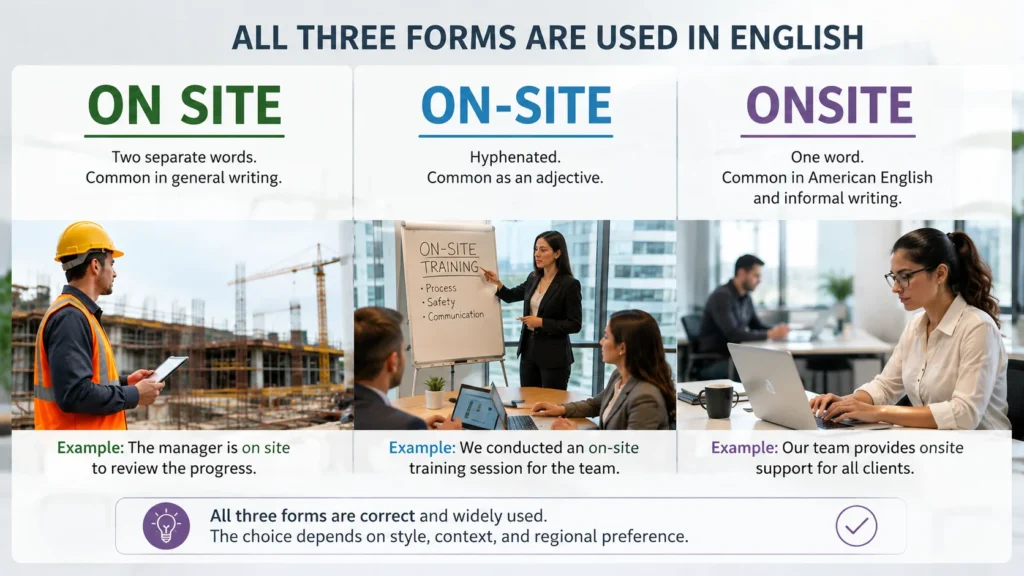
There is an important detail here: the choice is not determined entirely by grammar.
For example, dictionaries use on-site as both an adjective and an adverb. Merriam-Webster defines it as meaning at a particular place, especially a place of business.
Cambridge also lists on-site as both an adjective and an adverb, with examples such as on-site facilities and meeting the contractor on-site.
At the same time, Cambridge’s Business English Dictionary lists onsite as both an adjective and an adverb, particularly for workplace contexts.
So, it would be inaccurate to say that on site is always correct for location and onsite is always correct before a noun. Real English usage is more flexible.
When to Use On Site
Use on site when you are treating the words as a normal phrase meaning at the site or at the location.
Examples
- The contractor is on site today.
- The supervisor arrived on site early.
- Our team was on site for six hours.
- The police were already on site.
- The equipment was repaired on site.
This form is especially natural when the phrase follows a verb such as be, arrive, work, remain, stay, or operate.
For example:
The workers are on site.
The technician arrived on site at 8 a.m.
In these sentences, the phrase clearly describes someone’s location.
When to Use On Site With a Hyphen
On-site is a widely accepted spelling when the expression functions as a compound modifier or when a dictionary or style guide prefers the hyphenated form.
Examples include:

- on-site training
- on-site support
- on-site services
- on-site parking
- on-site inspections
- on-site facilities
Merriam-Webster uses on-site as its dictionary headword and gives examples such as on-site day care, on-site inspections, and on-site parking.
The hyphen helps show that on and site work together as one modifier.
For example:
We offer on-site training.
Here, on-site describes the type of training being offered.
When to Use Onsite
Onsite is also an accepted spelling. It is especially common in workplace, business, and professional English.
Examples include:
- onsite training
- onsite facilities
- onsite support
- onsite visits
- onsite services
- onsite staff

Cambridge lists onsite as an adjective and adverb in its Business English Dictionary. It defines the word in terms of something available or happening at the place where people work rather than somewhere else.
The American Heritage Dictionary also lists onsite as an adjective and adverb, showing that the closed form is not simply a spelling mistake.
So, if you see onsite training or onsite support, the spelling is legitimate.
Is On Site or Onsite More Correct?
Neither should automatically be labeled as the only correct form.
The better question is which form is appropriate for your style and context?
Merriam-Webster’s entry uses on-site, while Cambridge recognizes both on-site and onsite in different dictionary resources. Dictionary.com also lists on-site and notes on site as an alternative.
That means you may encounter all three forms in professionally edited English.
For example, these can all be found in standard usage:
- The technician is on site.
- The technician is on-site.
- The technician is onsite.
The choice often comes down to the publication’s preferred style.
On Site or Onsite in American English
In American English, on-site is a well established dictionary form, and onsite is also widely recognized, particularly in workplace and business writing. On site remains natural when the expression functions as a separate phrase.
For example:
Location phrase:
The engineer is on site.
Compound modifier:
The company offers on-site engineering support.
Workplace style:
The company offers onsite engineering support.
All three communicate essentially the same basic idea.
For formal writing, the safest approach is to choose one style based on the dictionary, publication, or style guide you are following and use it consistently.
Common Mistakes With On Site and Onsite
Mistake 1: Saying Onsite Is Always Wrong
This is one of the most common misconceptions.
Onsite is an established English word. Cambridge and American Heritage both recognize it.
Incorrect assumption:
Onsite is always a spelling mistake.
Better understanding:
Onsite is an accepted form, especially common in workplace English.
Mistake 2: Saying On Site Is Always the Only Correct Form
This is also too restrictive.
On site is perfectly natural when used as a phrase:
The technician is on site.
But on-site and onsite are also accepted in many contexts.
Mistake 3: Changing Forms Randomly
Although different forms can be correct, switching between them without a reason can make professional writing look inconsistent.
For example, avoid writing:
We provide on-site training and onsite support at all locations. Our on site team is available every day.
A consistent style is cleaner:
We provide on-site training and on-site support at all locations. Our on-site team is available every day.
Or, if your preferred style uses the closed form:
We provide onsite training and onsite support at all locations. Our onsite team is available every day.
The key is consistency.
On Site or Onsite: Easy Examples
Here are some examples to make the difference clearer:
On site
The construction crew is on site.
The manager arrived on site this morning.
The equipment is being repaired on site.
On-site
We offer on-site training.
The company provides on-site support.
The hotel has on-site parking.
Onsite
We offer onsite training.
The company provides onsite support.
The facility has onsite parking.
The last two categories can overlap in meaning. The spelling preference depends largely on style and usage rather than a strict grammatical rule.
Is On-Site Hyphenated?
Yes, on-site is a standard hyphenated form.
It is particularly common when the expression works as a compound adjective:
on-site training
on-site services
on-site inspection
However, you may also encounter the closed form onsite in the same kinds of professional contexts.
This is why you should not assume that the absence of a hyphen automatically makes a word incorrect.
On Site or Onsite: Which One Should You Use?
If you are writing for a professional or American English audience, here is a practical approach:
Use “on site” when you are clearly describing someone’s or something’s location.
The technician is on site.
Use “on-site” when you want the widely recognized hyphenated form, especially as a compound modifier.
We offer on-site training.
Use “onsite” when your preferred dictionary or workplace style uses the closed form.
We offer onsite training.
If your website, company, or publication already has a style preference, follow it throughout the content.
Frequently Asked Questions
Is “on site” one word or two?
On site is two words. It is commonly used as a phrase meaning at a particular location.
Is “onsite” a correct word?
Yes. Onsite is an established English spelling and is particularly common in workplace and business English.
Is “on-site” grammatically correct?
Yes. On-site is a standard hyphenated form listed by major dictionaries and can function as an adjective or adverb.
Is “on site” better than “onsite”?
Not always. On site is natural as a location phrase, while onsite is widely used as a closed compound, particularly in workplace English. Both can be correct.
Should I write “on-site training” or “onsite training”?
Both are used in standard English. On-site training is the traditional hyphenated form, while onsite training is also accepted, especially in workplace writing.
Is “on site” hyphenated?
Not when it is being used as a normal phrase:
The technician is on site.
When it is written as the compound on-site, the hyphen is part of that spelling.
Which spelling is best for formal writing?
Follow the style guide or dictionary preferred by your publication. If no specific guide is required, on-site is a clear, widely recognized choice, while onsite is also established. Most importantly, use your chosen form consistently.
Conclusion
So, on site or onsite is not a simple case of one spelling being correct and the other being wrong. On site, on-site, and onsite are all used in standard English, although their preferred contexts and style conventions can differ.
Use on site naturally when you mean that someone or something is physically at a particular location. On-site is a well established hyphenated form, especially common in compound expressions such as on-site training and on-site support. Onsite is also accepted and is particularly common in workplace and business English.
If you are unsure, check the style guide you are following and stay consistent. That is a much better rule than treating one spelling as universally correct and the others as mistakes.

Ruskin Bond, author at SeekIdiom, explains English idioms through simple meanings and examples, helping learners improve vocabulary and everyday usage.