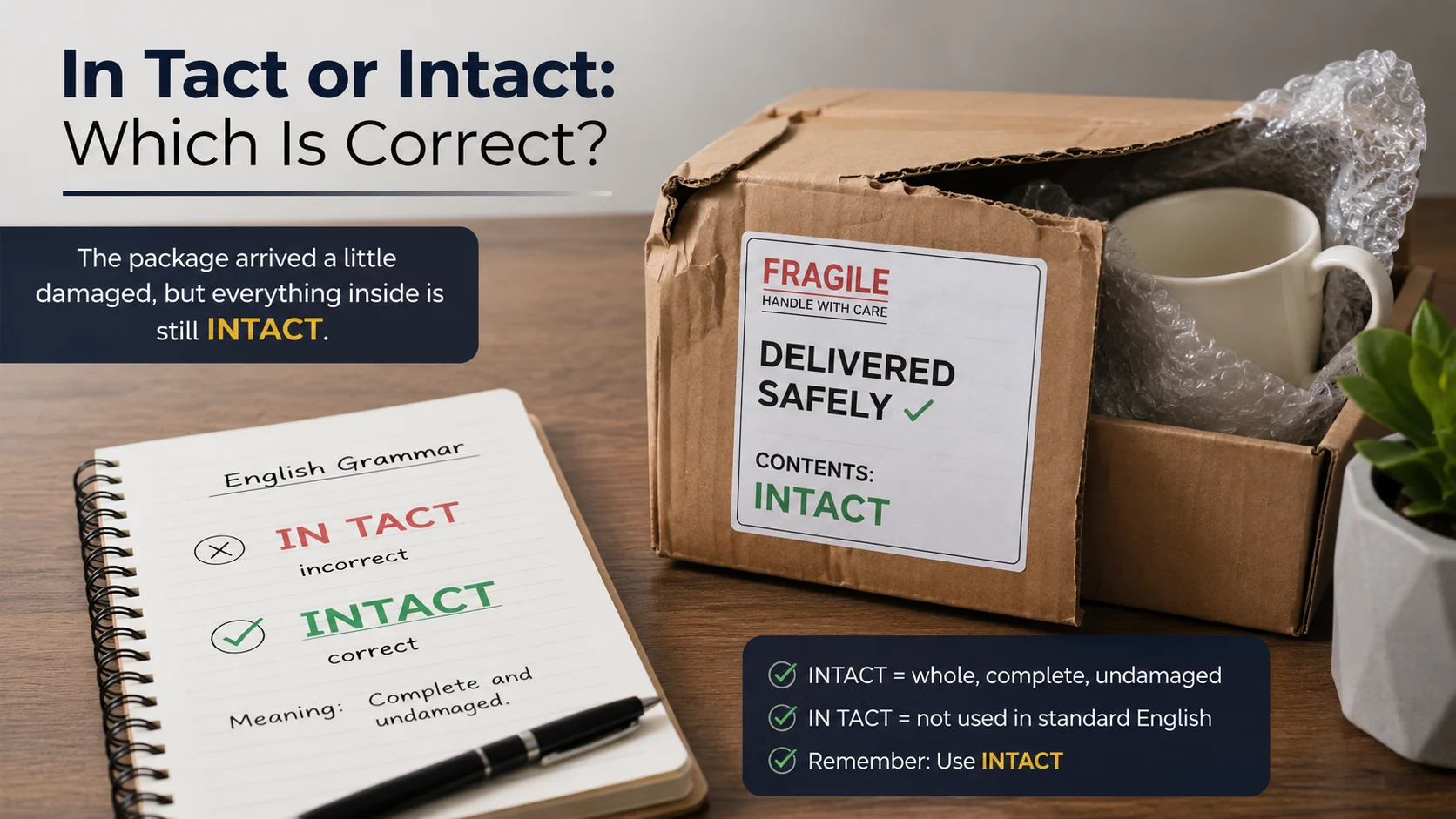
If you are wondering whether in tact or intact is correct, the answer is simple: intact is the correct spelling when you mean whole, complete, undamaged, or preserved. It is written as one word.
For example:
The package arrived intact.
The old painting remained intact despite the move.
In tact is normally incorrect when you are trying to use this meaning. The confusion is understandable because the word looks as if it could be divided into in and tact. However, intact is an established English adjective and should be written together.
What Does Intact Mean?
Intact is an adjective used to describe something that remains whole, complete, or undamaged. It can refer to physical objects, buildings, documents, plans, traditions, systems, or other things that have been preserved.
For example:
The vase fell from the shelf but remained intact.
Here, intact means the vase was still whole and had not broken.
The word can also describe something that has remained essentially preserved or unchanged:
The original agreement is still intact.
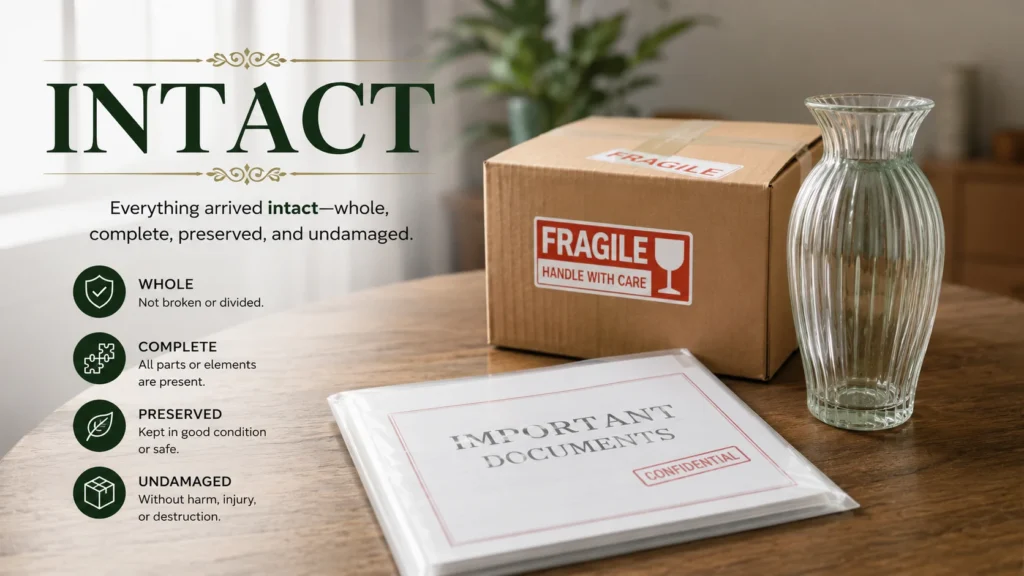
In this sentence, the agreement has been kept in its original condition.
Depending on the context, intact can mean:
- Whole
- Complete
- Undamaged
- Unbroken
- Preserved
The key idea is that something has not been damaged, destroyed, or significantly affected.
In Tact vs. Intact: Quick Comparison
| Spelling | Correct? | Meaning | Example |
|---|---|---|---|
| Intact | Yes | Whole, complete, or undamaged | The package arrived intact. |
| In tact | Usually no | Common misspelling of intact | The package arrived in tact. ❌ |
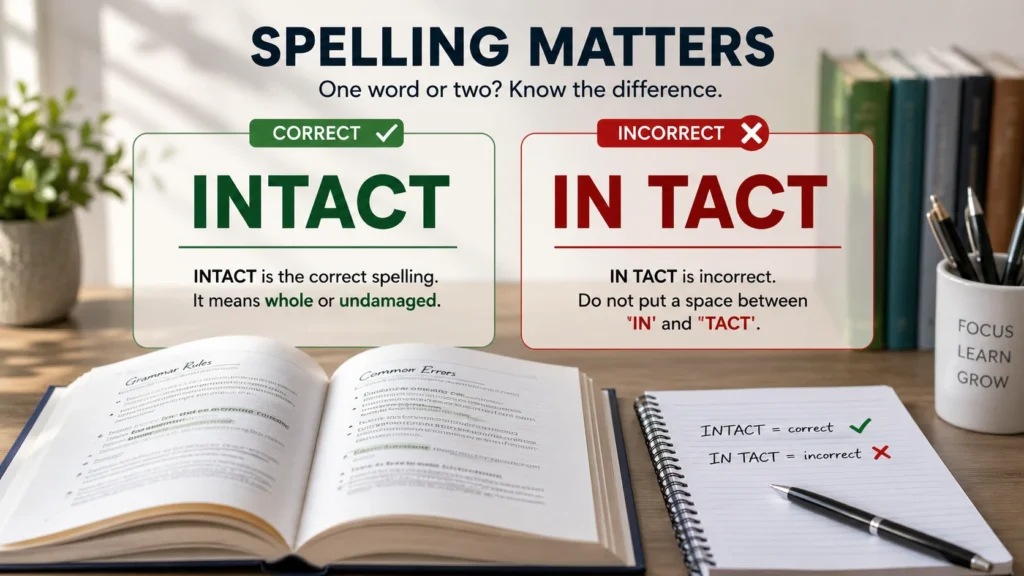
If you mean that something remains whole or undamaged, intact is the word to use.
Why Do People Write In Tact?
The spelling mistake usually happens because intact sounds as though it could be separated into two words.
English also contains many expressions beginning with in, so it is easy to assume that in tact might work in the same way.
However, the standard word is:
intact ✅
not:
in tact ❌
You can think of intact as a single vocabulary word rather than a combination of in and tact.
For example:
The documents were returned intact. ✅
The documents were returned in tact. ❌
The first sentence means the documents remained complete and undamaged.
How to Use Intact in a Sentence
Intact commonly appears after verbs such as remain, stay, keep, preserve, leave, and arrive.
Here are some natural examples:
The package arrived intact.
The ancient structure remains intact.
She managed to keep the original design intact.

The documents were found intact.
The painting survived the move intact.
The team worked to preserve the historic building intact.
The word works in both everyday and formal writing.
Examples of Intact in Everyday English
Packages and Deliveries
The gift arrived intact despite being shipped across the country.
Here, intact means the gift was not damaged during delivery.
Objects
The glass was surprisingly still intact after the move.
The glass remained whole rather than breaking.
Buildings
Much of the historic building remains intact.
This means important parts of the building have survived.
Documents
The original document was found intact in an old filing cabinet.
The document remained complete and undamaged.
Plans
We decided to keep the original plan intact.
Here, intact means the plan was preserved without major changes.
Traditions
The family has kept the tradition intact for generations.
In this context, the tradition has been preserved rather than significantly changed.
Intact vs. Unchanged
Intact and unchanged can sometimes be used in similar contexts, but they emphasize slightly different ideas.
Intact focuses on something remaining whole, complete, preserved, or undamaged.
The original document remained intact.
Unchanged focuses specifically on something remaining the same.
The original design remained unchanged.
Sometimes either word can work:
The original plan remained intact.
The original plan remained unchanged.
The first emphasizes that the plan was preserved as a whole. The second emphasizes that no changes were made to it.
Intact vs. Untouched
Intact and untouched are also related, but they do not mean exactly the same thing.
Intact means something remains whole, complete, or undamaged.
The package arrived intact.
Untouched often means something has not been handled, used, altered, or disturbed.
The meal was left untouched.
Something can be intact without being untouched. For example, someone might open a package, inspect its contents, and put everything back without causing damage. The contents could still be intact even though they were not untouched.
Is In Tact Ever Correct?
When you mean whole, complete, preserved, or undamaged, in tact is normally incorrect. The correct word is intact.
In rare circumstances, the separate words in and tact could occur next to each other because they serve separate grammatical purposes. However, that is not the expression people usually mean when they write in tact.
So, for standard English writing:
The package remained intact. ✅
not:
The package remained in tact. ❌
Common Mistakes With Intact
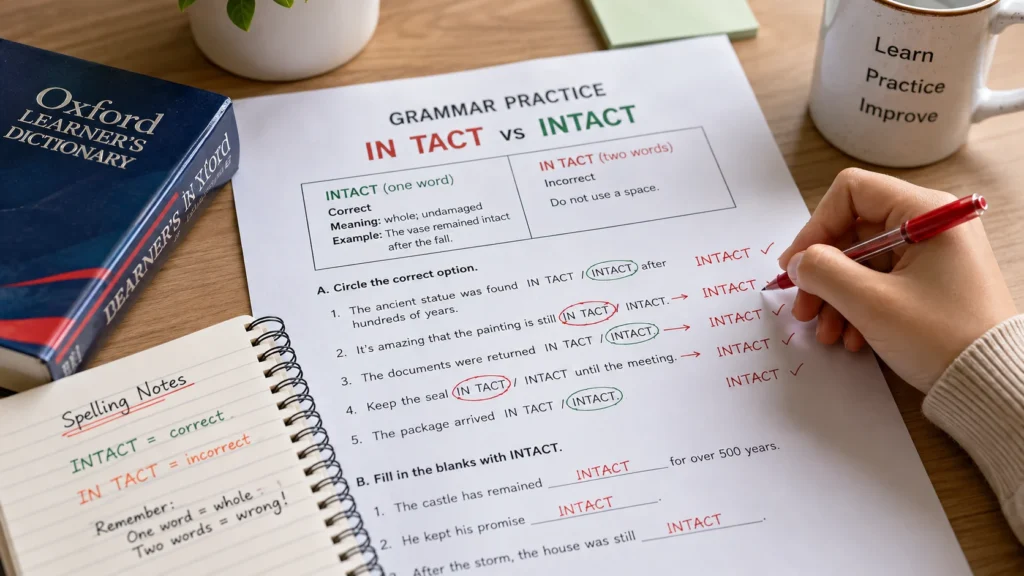
Mistake 1: Writing In Tact
This is the most common error.
The vase remained in tact. ❌
The vase remained intact. ✅
Remember that intact is one word.
Mistake 2: Thinking Intact Only Refers to Physical Objects
Although intact is frequently used for physical things, it can also describe abstract things.
For example:
She kept her confidence intact.
The original agreement remained intact.
The team’s strategy stayed intact.
In these examples, intact means preserved or not significantly affected.
Mistake 3: Confusing Intact With In Fact
These expressions look and sound different, but they can cause confusion when typing quickly.
Intact = whole or undamaged.
In fact = actually or in reality.
Compare:
The package arrived intact.
In fact, it arrived earlier than expected.
Mistake 4: Adding a Space
Always write the standard adjective as one word:
intact ✅
in tact ❌
This is especially important in professional writing, school assignments, emails, and published content.
A Simple Way to Remember Intact
Think of intact as describing something that stays whole.
For example:
The box was dropped, but it remained intact.
You can also remember:
Intact = still whole.
If the meaning is complete, whole, preserved, or undamaged, choose intact.
Frequently Asked Questions
Is in tact or intact correct?
Intact is correct when you mean whole, complete, preserved, or undamaged. In tact is normally a misspelling in this context.
What does intact mean?
Intact means whole, complete, undamaged, unbroken, or preserved without significant damage or change.
Is intact one word?
Yes. Intact is written as one word when it is used as the standard adjective meaning whole, complete, or undamaged.
Can I say “the package arrived intact”?
Yes. This is a natural and correct use of intact. It means the package arrived without being damaged.
What is the opposite of intact?
Depending on the context, possible opposites include damaged, broken, destroyed, altered, and incomplete.
Is in tact ever grammatically correct?
The separate words in and tact can theoretically occur together in a different grammatical context, but in tact is not the standard spelling when you mean whole or undamaged. In that meaning, use intact.
What is an example of intact?
The old photograph remained intact after the house was renovated.
Here, intact means the photograph remained whole and undamaged.
How do you remember the spelling of intact?
Remember that intact is one word. A simple memory phrase is intact means still whole.
Conclusion
When choosing between in tact or intact, use intact when you mean whole, complete, preserved, or undamaged. The standard spelling is one word.
For example:
The package arrived intact.
The original documents remained intact.
The historic features are still intact.
Although in tact may look logical, it is normally a spelling mistake when used with this meaning. The easiest rule to remember is: if something remains whole or undamaged, it is intact.

Anita Brookner, author at SeekIdiom, shares easy explanations of English idioms with examples to help learners expand vocabulary and speak more confidently.