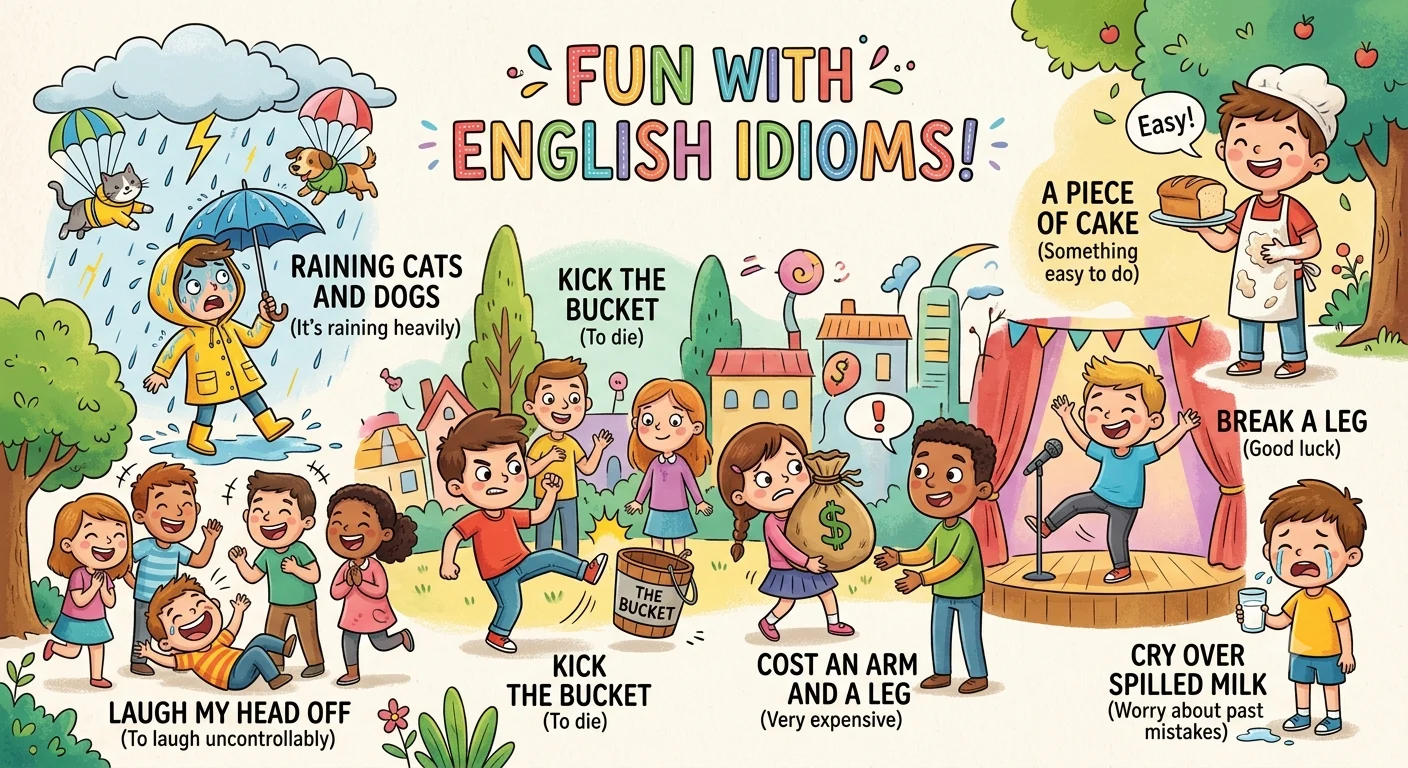
English is full of expressions that don’t make sense at first glance. Imagine someone telling you, “It’s raining cats and dogs!” You might picture pets falling from the sky—but that’s just one of the many weird idioms in English. In this article, we’ll explore 20 of the strangest idioms, break them down word by word, and show how to use them like a native speaker.
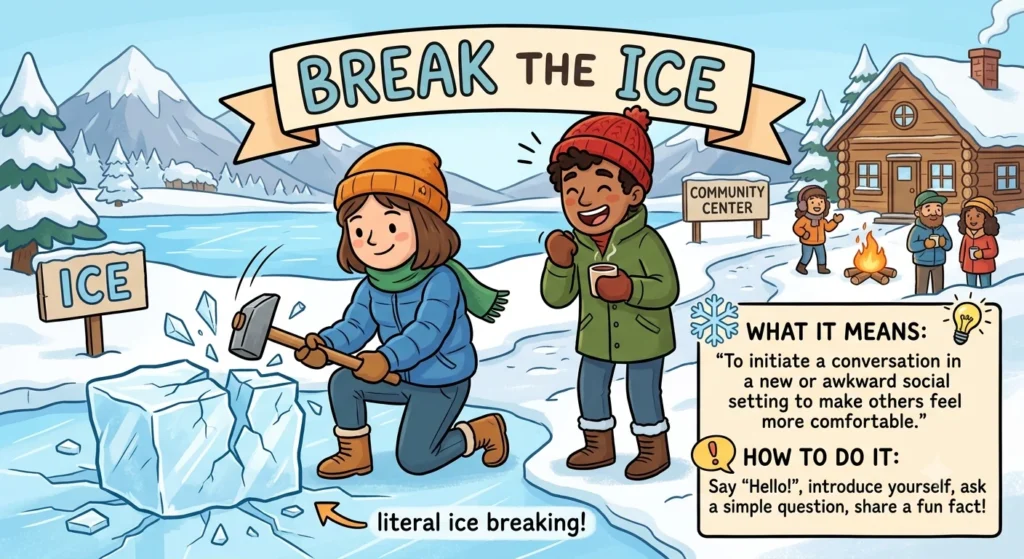
“Break the Ice”
Word-by-Word Meaning
Break = to fracture or split
Ice = frozen water
Idiomatic/Figurative Meaning
To initiate conversation or ease tension in a social situation.
Example Sentences
- “I told a joke to break the ice at the party.”
Common Error
Using it literally to mean physically breaking ice.
Usage Note
Often used in social, business, or casual settings when starting conversations.
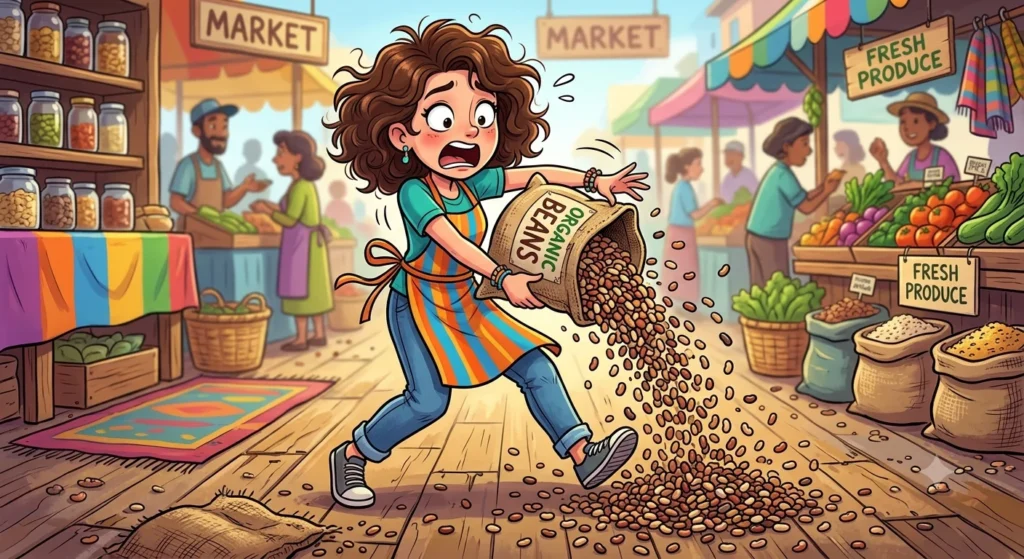
“Spill the Beans”
Word-by-Word Meaning
Spill = to accidentally drop or pour
Beans = legumes
Idiomatic/Figurative Meaning
To reveal a secret or disclose information unintentionally.
Example Sentences
- “She spilled the beans about the surprise party.”
Common Error
Assuming it refers to literally dropping food.
Usage Note
Casual context; can sound playful when used among friends.
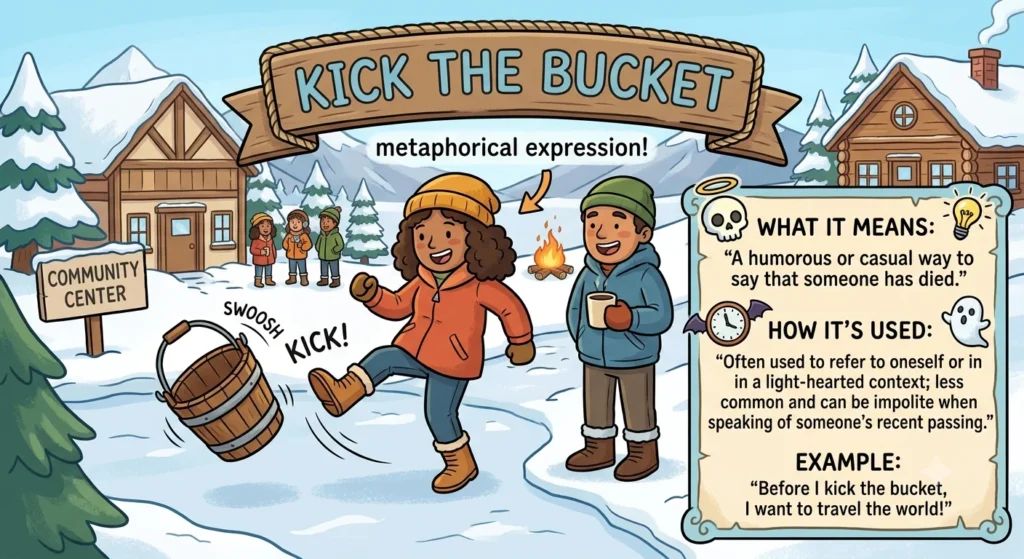
“Kick the Bucket”
Word-by-Word Meaning
Kick = strike with foot
Bucket = container for liquids
Idiomatic/Figurative Meaning
To die.
Example Sentences
- “I was sad to hear that our old neighbor kicked the bucket.”
Common Error
Using it in formal contexts—it’s considered informal/slang.
Usage Note
Often used humorously in casual conversation about death.
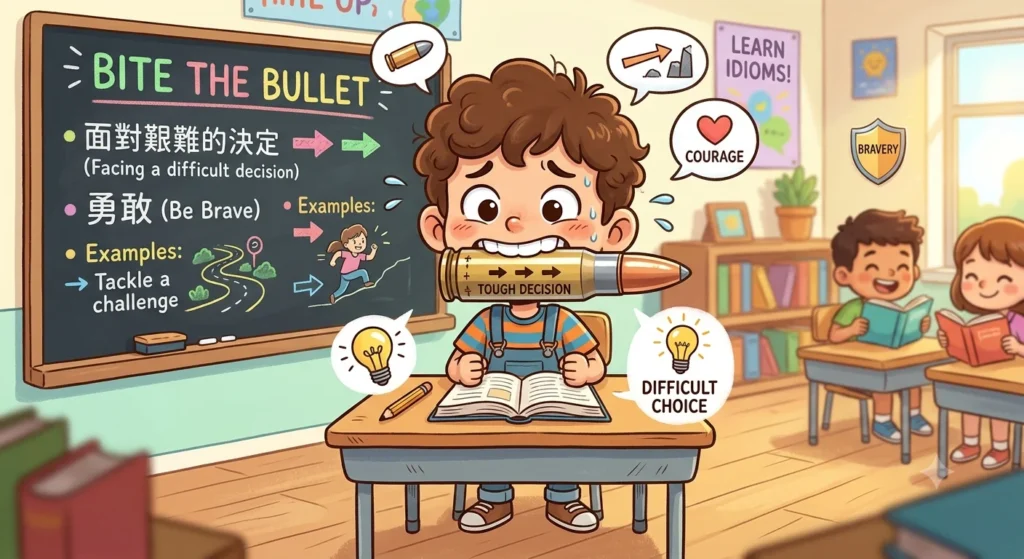
“Bite the Bullet”
Word-by-Word Meaning
Bite = to clamp down with teeth
Bullet = ammunition
Idiomatic/Figurative Meaning
To endure a painful or difficult situation bravely.
Example Sentences
- “I decided to bite the bullet and get the tooth pulled.”
Common Error
Taking it literally to mean chewing a bullet.
Usage Note
Used in contexts requiring courage or resolve.
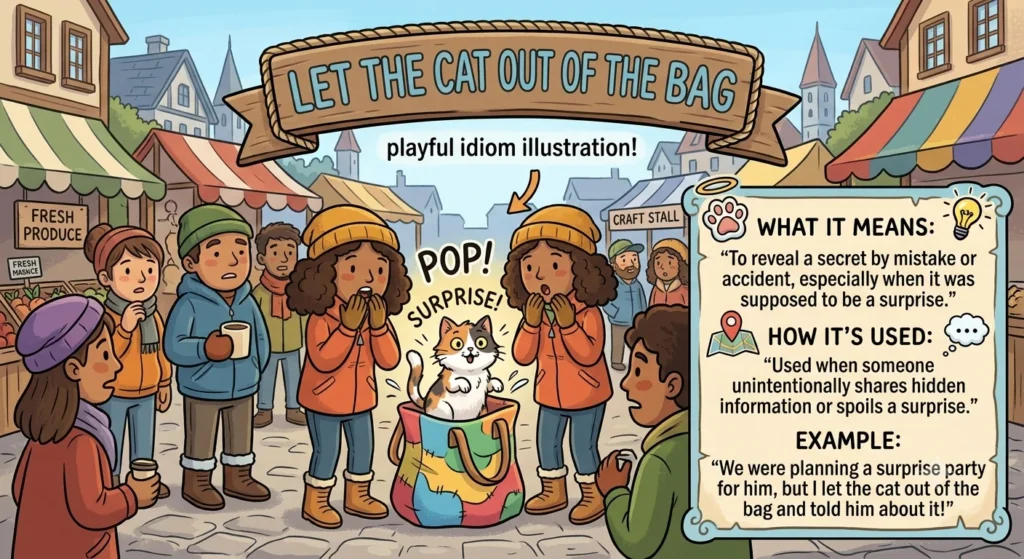
“Let the Cat Out of the Bag”
Word-by-Word Meaning
Let = allow
Cat = feline
Bag = container
Idiomatic/Figurative Meaning
To accidentally reveal a secret.
Example Sentences
- “He let the cat out of the bag about their engagement.”
Common Error
Assuming it involves actual cats.
Usage Note
Mostly used in casual or storytelling contexts.
“Hit the Sack”
Word-by-Word Meaning
Hit = strike
Sack = bag or sack (bed in old slang)
Idiomatic/Figurative Meaning
To go to sleep.
Example Sentences
- “I’m exhausted; time to hit the sack.”
Common Error
Interpreting it as physical hitting.
Usage Note
Informal, mostly spoken English.
“Under the Weather”
Word-by-Word Meaning
Under = below
Weather = atmospheric conditions
Idiomatic/Figurative Meaning
Feeling sick or unwell.
Example Sentences
- “I won’t come to work today; I’m feeling under the weather.”
Common Error
Thinking it literally means being outdoors in bad weather.
Usage Note
Used in casual health-related conversations.
“Cost an Arm and a Leg”
Word-by-Word Meaning
Cost = require payment
Arm and Leg = body parts
Idiomatic/Figurative Meaning
Very expensive.
Example Sentences
- “The new phone costs an arm and a leg.”
Common Error
Interpreting it literally as bodily harm.
Usage Note
Used to describe high-priced items informally.
“Pull Someone’s Leg”
Word-by-Word Meaning
Pull = tug
Leg = limb
Idiomatic/Figurative Meaning
To joke or tease someone.
Example Sentences
- “Are you serious or are you pulling my leg?”
Common Error
Taking it as physical action.
Usage Note
Friendly teasing context; not suitable for formal writing.
“Burn the Midnight Oil”
Word-by-Word Meaning
Burn = set on fire
Midnight Oil = oil lamp used at night
Idiomatic/Figurative Meaning
To work late into the night.
Example Sentences
- “She burned the midnight oil to finish her assignment.”
Common Error
Literal interpretation—burning actual oil at night.
Usage Note
Commonly used in academic or work contexts.
“Hit the Nail on the Head”
Word-by-Word Meaning
Hit = strike
Nail = fastener
Head = top of nail
Idiomatic/Figurative Meaning
To be exactly correct.
Example Sentences
- “You hit the nail on the head with that explanation.”
Common Error
Using in physical construction contexts unnecessarily.
Usage Note
Used to praise precision in speech or action.
“Piece of Cake”
Word-by-Word Meaning
Piece = part
Cake = dessert
Idiomatic/Figurative Meaning
Something very easy to do.
Example Sentences
- “The exam was a piece of cake.”
Common Error
Confusing it with literally eating cake.
Usage Note
Common in spoken English; light-hearted tone.
“Raining Cats and Dogs”
Word-by-Word Meaning
Raining = precipitation
Cats and Dogs = animals
Idiomatic/Figurative Meaning
Raining heavily.
Example Sentences
- “Don’t forget your umbrella; it’s raining cats and dogs.”
Common Error
Imagining actual animals falling.
Usage Note
Casual, colorful expression in weather talk.
“Barking Up the Wrong Tree”
Word-by-Word Meaning
Barking = dog sound
Tree = tree
Idiomatic/Figurative Meaning
To pursue a mistaken or misguided course.
Example Sentences
- “If you think I’m responsible, you’re barking up the wrong tree.”
Common Error
Taking it literally with dogs and trees.
Usage Note
Used in criticism or advice contexts.
“Throw in the Towel”
Word-by-Word Meaning
Throw = toss
Towel = cloth for drying
Idiomatic/Figurative Meaning
To give up.
Example Sentences
- “After failing three times, he finally threw in the towel.”
Common Error
Thinking it involves laundry.
Usage Note
Common in sports and motivational contexts.
“Every Cloud Has a Silver Lining”
Word-by-Word Meaning
Cloud = cloud
Silver Lining = shiny edge
Idiomatic/Figurative Meaning
Every bad situation has some good aspect.
Example Sentences
- “Losing that job was hard, but every cloud has a silver lining.”
Common Error
Literal interpretation—actual clouds and silver.
Usage Note
Optimistic phrase; often used to encourage.
“Cut Corners”
Word-by-Word Meaning
Cut = shorten
Corners = edge of something
Idiomatic/Figurative Meaning
To do something poorly or cheaply.
Example Sentences
- “Don’t cut corners on this project; quality matters.”
Common Error
Thinking it literally refers to trimming corners.
Usage Note
Used in work or project contexts.
“Add Fuel to the Fire”
Word-by-Word Meaning
Add = include
Fuel = combustible material
Fire = flames
Idiomatic/Figurative Meaning
To worsen a bad situation.
Example Sentences
- “His comment added fuel to the fire during the argument.”
Common Error
Literal interpretation with fire.
Usage Note
Conflict or argument contexts.
“Face the Music”
Word-by-Word Meaning
Face = confront
Music = sound
Idiomatic/Figurative Meaning
To accept unpleasant consequences.
Example Sentences
- “He knew he had to face the music for missing the deadline.”
Common Error
Literal interpretation with music.
Usage Note
Used in consequences or accountability discussions.
“Cry Over Spilled Milk”
Word-by-Word Meaning
Cry = shed tears
Spilled Milk = milk that fell
Idiomatic/Figurative Meaning
To be upset about something that can’t be changed.
Example Sentences
- “It’s just a typo; don’t cry over spilled milk.”
Common Error
Taking it literally.
Usage Note
Commonly used to encourage letting go of minor mistakes.
FAQs About Weird Idioms in English
Q1: Why are English idioms so weird?
A1: English idioms evolved from history, literature, and culture, often using metaphors or humor that may seem strange today.
Q2: Can idioms be translated literally into other languages?
A2: Usually not—idioms often lose meaning when translated word-for-word.
Q3: How can I remember idioms effectively?
A3: Use them in sentences, create flashcards, and relate them to real-life situations.
Q4: Are idioms important for learning English?
A4: Yes! They make your speech more natural and expressive.
Q5: Can idioms be used in formal writing?
A5: Some idioms are informal, so choose carefully depending on context.
Conclusion
Learning weird idioms in English can be fun and eye-opening. Start by practicing a few every day, use them in conversations, and soon you’ll sound like a native speaker. Don’t just memorize—immerse yourself, laugh at their weirdness, and enjoy the quirky side of English!

Julian Mercer, author at SeekIdiom, writes clear explanations of English idioms with examples to help learners improve vocabulary and communication skills.