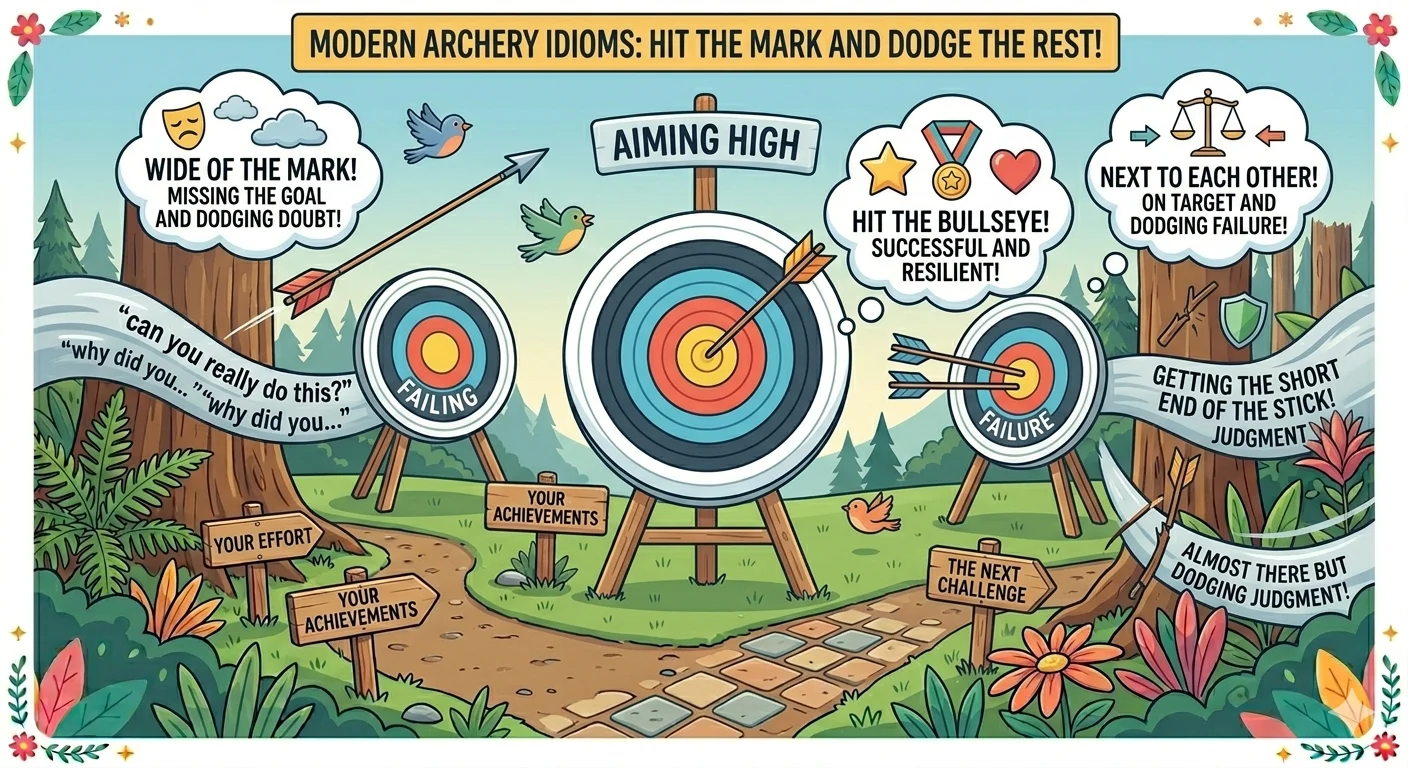
Ever noticed how often English talks about targets, shots, and arrows? That’s because archer idioms come from archery but are now used to describe success, focus, mistakes, and goals in daily life. If you want your English to sound more natural and confident, these idioms will help you hit the bull’s-eye.
Why Archer Idioms Are Important in English
Archery is one of the oldest human skills. Over time, its vocabulary became powerful metaphors for:
- Accuracy and success
- Planning and preparation
- Risk and effort
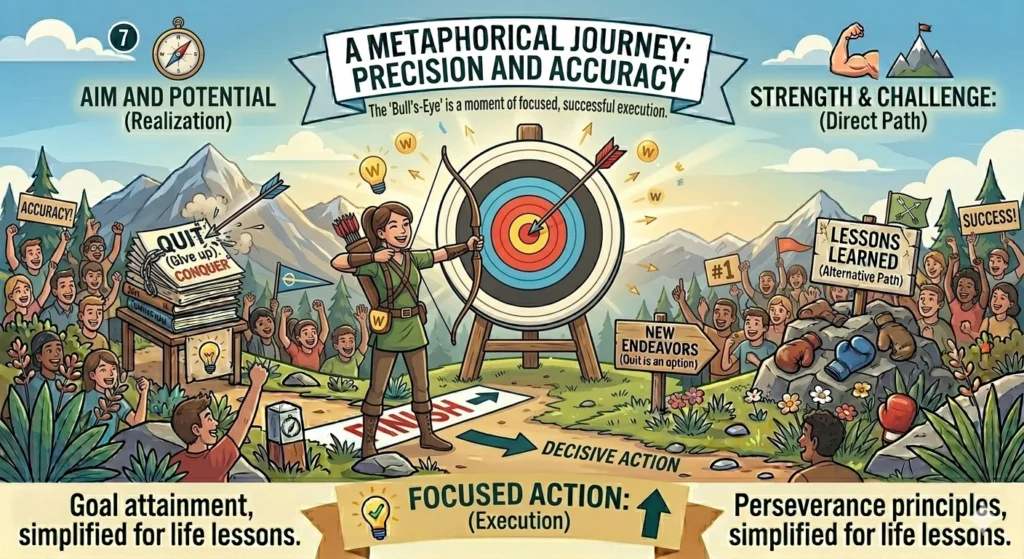
🎯 Hit the Bull’s-Eye
Word-by-word meaning:
Bull’s-eye = the exact center of a target
Idiomatic / Figurative meaning:
To be completely correct or perfectly successful
Example sentences:
- Your explanation hit the bull’s-eye.
- The ad campaign hit the bull’s-eye with customers.
Common error:
❌ Hit the bull eye
✅ Hit the bull’s-eye
Usage note:
Very common in both spoken and written English.
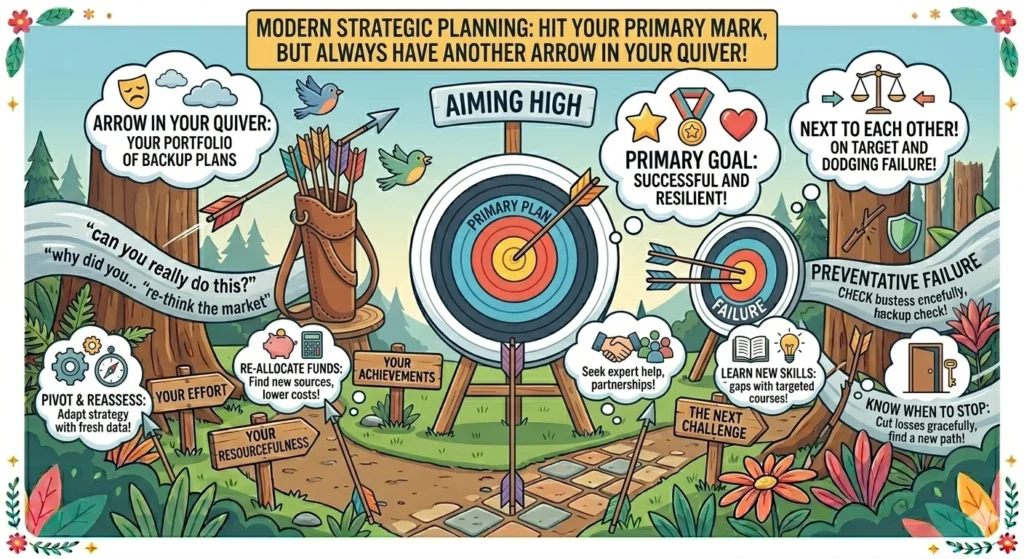
🏹 Have Another Arrow in Your Quiver
Word-by-word meaning:
Quiver = container that holds arrows
Idiomatic / Figurative meaning:
To have extra options or backup plans
Example sentences:
- If Plan A fails, we still have another arrow in our quiver.
- She always keeps another arrow in her quiver.
Common error:
Using it to mean aggression instead of strategy.
Usage note:
Often used in business and planning contexts.
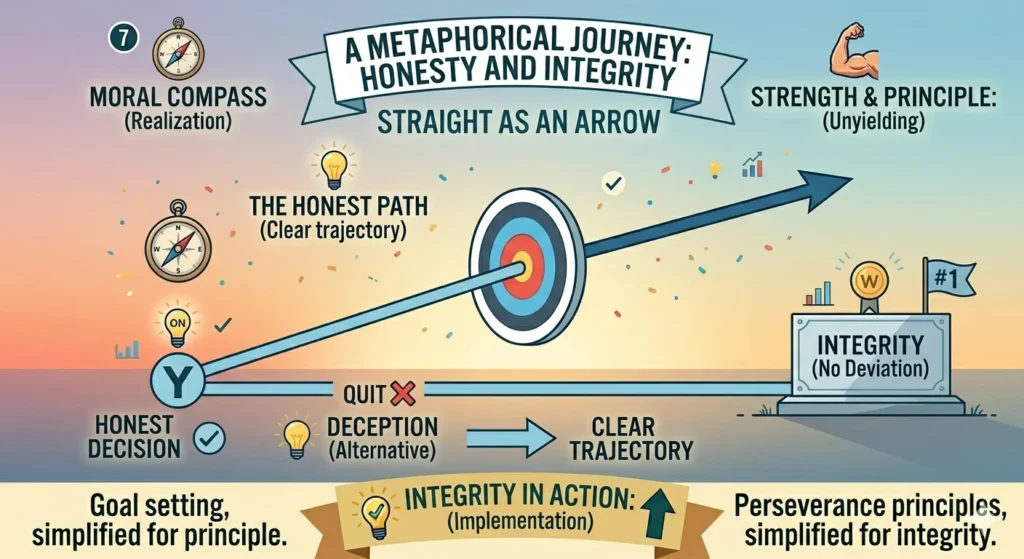
🎯 Straight as an Arrow
Word-by-word meaning:
An arrow that does not bend
Idiomatic / Figurative meaning:
Very honest, direct, or clear
Example sentences:
- He gave a straight-as-an-arrow reply.
- Her instructions were straight as an arrow.
Common error:
Using it only for physical objects.
Usage note:
Common in informal conversations.
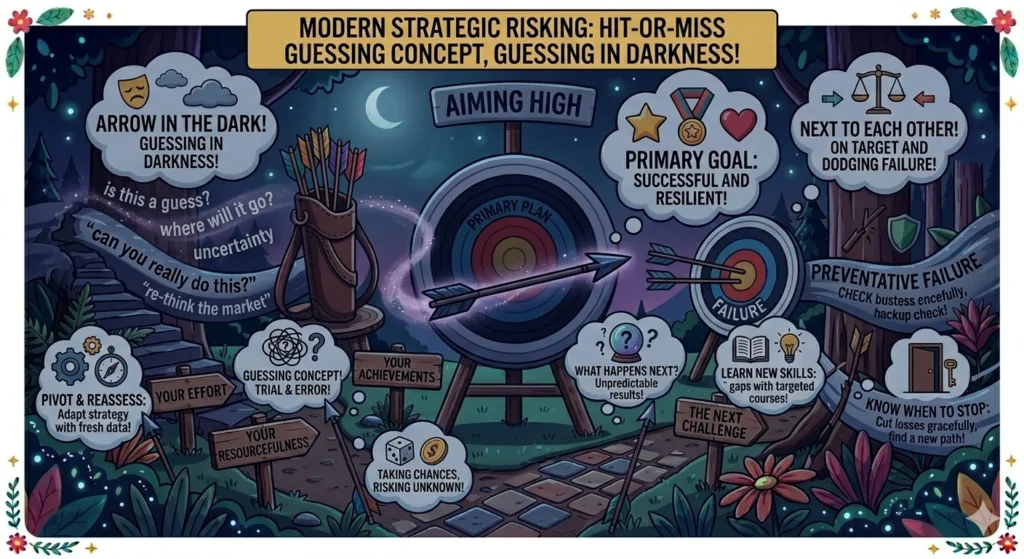
🏹 An Arrow in the Dark
Word-by-word meaning:
Shooting without seeing the target
Idiomatic / Figurative meaning:
A guess made with little information
Example sentences:
- His suggestion was just an arrow in the dark.
- Choosing that answer felt like an arrow in the dark.
Common error:
Thinking it always means failure (it doesn’t).
Usage note:
Neutral tone; result can be good or bad.
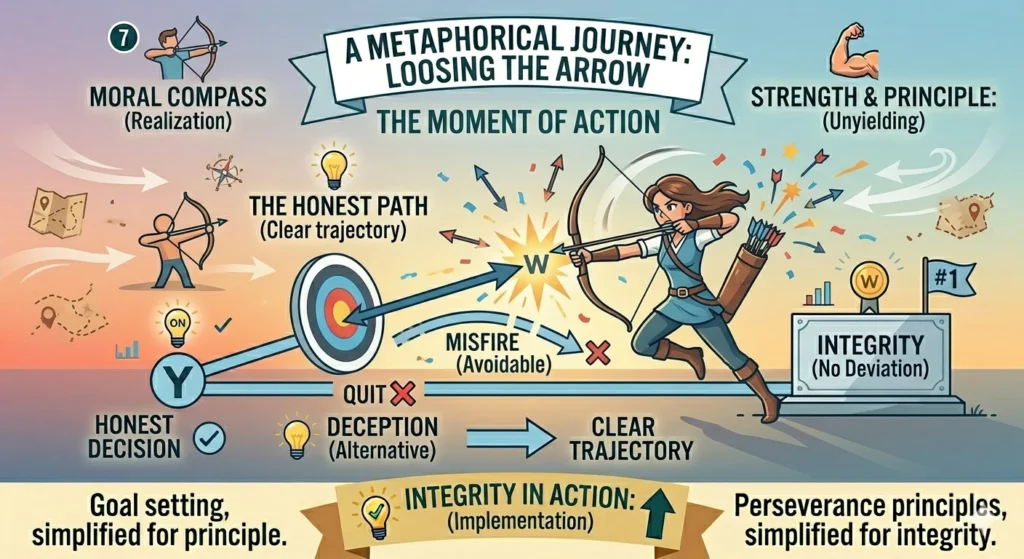
🎯 Loose an Arrow
Word-by-word meaning:
To release an arrow from the bow
Idiomatic / Figurative meaning:
To take action or say something that cannot be taken back
Example sentences:
- Once he shared the news, the arrow was loosed.
- She loosed an arrow with that comment.
Common error:
Confusing loose with lose.
Usage note:
Often used in storytelling or dramatic situations.
🏹 On Target
Word-by-word meaning:
An arrow correctly aimed
Idiomatic / Figurative meaning:
Accurate or correct
Example sentences:
- Your analysis is on target.
- His guess was right on target.
Common error:
Overusing it repeatedly in writing.
Usage note:
Safe for professional and academic English.
🎯 Miss the Mark
Word-by-word meaning:
Fail to hit the target
Idiomatic / Figurative meaning:
Fail to achieve the intended result
Example sentences:
- The joke missed the mark.
- His plan completely missed the mark.
Common error:
Using it only for physical misses.
Usage note:
Often used for opinions and feedback.
🏹 Aim High
Word-by-word meaning:
Aim above the target
Idiomatic / Figurative meaning:
Set ambitious goals
Example sentences:
- Aim high and don’t give up.
- She always aims high in her career.
Common error:
Using without a goal or context.
Usage note:
Motivational and positive tone.
🎯 Right on Target
Word-by-word meaning:
Exactly where the arrow should land
Idiomatic / Figurative meaning:
Perfectly accurate
Example sentences:
- That comment was right on target.
- Your prediction was right on target.
Common error:
Mixing it incorrectly with on point.
Usage note:
Very similar to hit the bull’s-eye.
🏹 Take Aim
Word-by-word meaning:
Prepare to shoot
Idiomatic / Figurative meaning:
Prepare to act or focus on a goal
Example sentences:
- She took aim at improving her skills.
- The company is taking aim at new markets.
Common error:
Using it without preparation context.
Usage note:
Used for planning or intention.
🎯 Shot in the Dark
Word-by-word meaning:
A blind shot
Idiomatic / Figurative meaning:
A random guess
Example sentences:
- It was a shot in the dark.
- Answering without studying is a shot in the dark.
Common error:
Confusing with arrow in the dark (both are similar).
Usage note:
Very common in casual English.
🏹 Set Your Sights On
Word-by-word meaning:
Focus your vision on a target
Idiomatic / Figurative meaning:
Decide to achieve something
Example sentences:
- She set her sights on success.
- He set his sights on a promotion.
Common error:
Using without a clear goal.
Usage note:
Strong determination tone.
🎯 Fire an Arrow
Word-by-word meaning:
Shoot an arrow
Idiomatic / Figurative meaning:
Make a bold attempt
Example sentences:
- He fired an arrow with his proposal.
- She fired an arrow at the competition.
Common error:
Using it too literally.
Usage note:
Best in creative or narrative writing.
🏹 Keep Your Eye on the Target
Word-by-word meaning:
Watch the target closely
Idiomatic / Figurative meaning:
Stay focused on your goal
Example sentences:
- Keep your eye on the target and don’t quit.
- Success comes when you keep your eye on the target.
Common error:
Overusing in repetitive motivation text.
Usage note:
Excellent for advice or coaching.
🎯 Miss Your Shot
Word-by-word meaning:
Fail to shoot correctly
Idiomatic / Figurative meaning:
Lose an opportunity
Example sentences:
- He missed his shot at success.
- Don’t miss your shot—try again.
Common error:
Using it for small mistakes only.
Usage note:
Often emotional or motivational.
🏹 Let Fly
Word-by-word meaning:
Release an arrow suddenly
Idiomatic / Figurative meaning:
Speak or act suddenly
Example sentences:
- He let fly with criticism.
- She let fly without thinking.
Common error:
Using it too formally.
Usage note:
Mostly informal English.
🎯 One Shot Wonder
Word-by-word meaning:
Only one successful shot
Idiomatic / Figurative meaning:
Someone successful only once
Example sentences:
- That singer was a one-shot wonder.
- The product turned out to be a one-shot wonder.
Common error:
Using it positively (it’s usually negative).
Usage note:
Common in media and pop culture.
🏹 Arrow Points Both Ways
Word-by-word meaning:
Direction is not one-sided
Idiomatic / Figurative meaning:
Responsibility belongs to both sides
Example sentences:
- Respect is an arrow that points both ways.
- Trust works both ways.
Common error:
Using it without shared responsibility context.
Usage note:
Useful in discussions and debates.
🎯 Take a Shot
Word-by-word meaning:
Attempt a shot
Idiomatic / Figurative meaning:
Try something risky
Example sentences:
- Take a shot—you might succeed.
- He took a shot at starting a business.
Common error:
Confusing with alcohol meaning.
Usage note:
Encouraging and casual.
🏹 Fire Your Best Shot
Word-by-word meaning:
Shoot with full effort
Idiomatic / Figurative meaning:
Try your hardest
Example sentences:
- Fire your best shot and see what happens.
- She fired her best shot in the interview.
Common error:
Using it aggressively.
Usage note:
Motivational and confident tone.
FAQs About Archer Idioms
Are archer idioms safe for formal English?
Yes, many are used in business, education, and media.
Do archer idioms mean violence?
No, they are purely metaphorical.
Are archer idioms common in exams?
Yes, especially in comprehension and writing.
How can I remember archer idioms easily?
Connect each idiom with a goal or real-life situation.
Conclusion:
Mastering archer idioms helps you express ideas clearly, confidently, and naturally. Practice using one idiom daily in speaking or writing—and soon, your English will be right on target.

Sophie Langford, author at SeekIdiom, explains English idioms with clear meanings, examples, and usage to help learners improve vocabulary and communication.