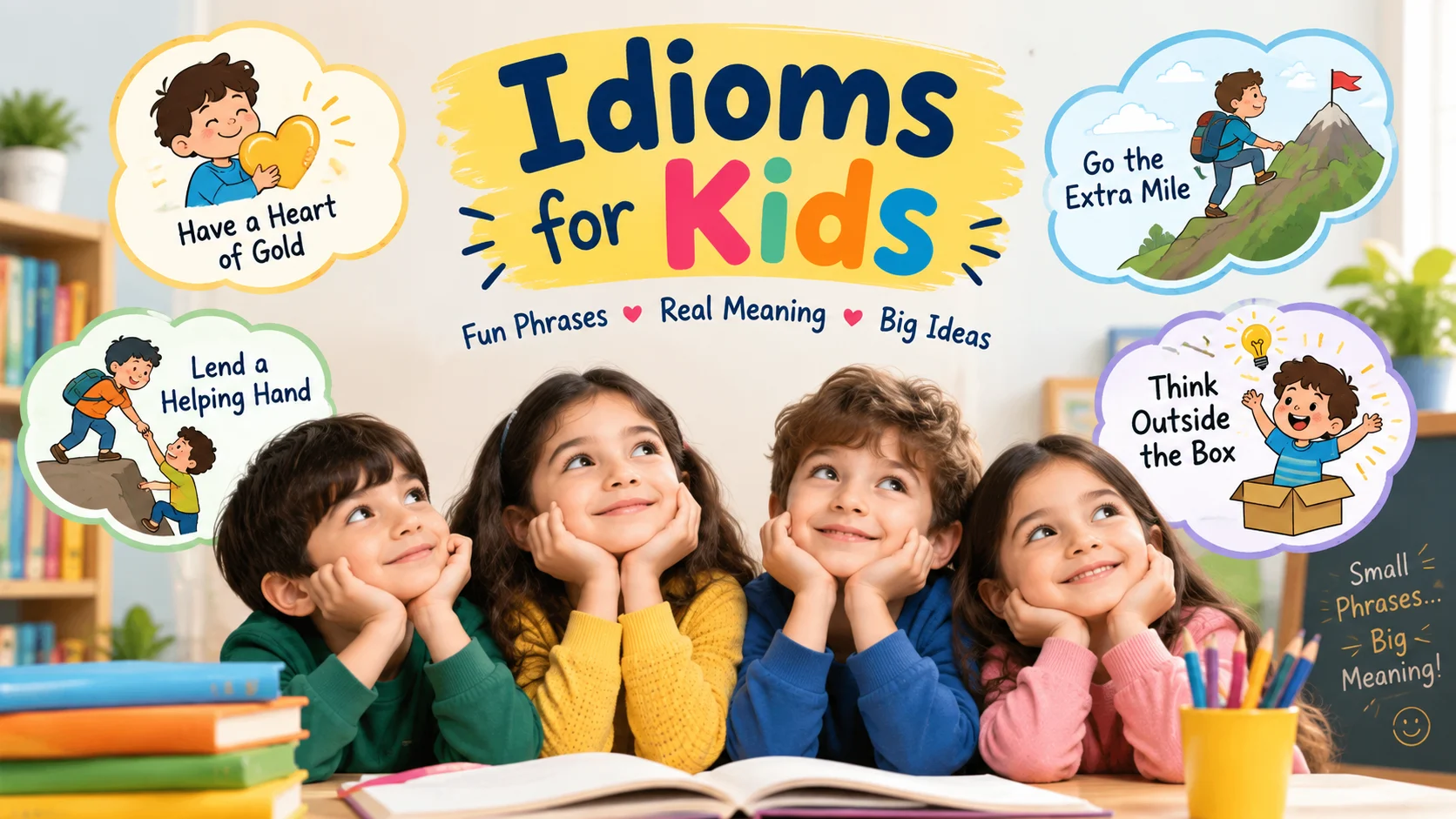
Learning English idioms can be tricky for kids because the words often have a different meaning from what they literally say. Idioms for kids with pictures make these expressions easier to understand because children can connect the words with a simple visual idea.
For example, when kids see a picture of cats and dogs falling from the sky next to “raining cats and dogs,” they can understand that the phrase is meant to be funny and figurative—not literal. This guide introduces 20 English idioms for kids with simple meanings, examples, and kid-friendly usage tips.
Raining Cats and Dogs
Word-by-word meaning: Cats and dogs falling from the sky.
Idiomatic meaning: It is raining very heavily.
Example:
- Take an umbrella because it’s raining cats and dogs!
- We stayed inside because it was raining cats and dogs.
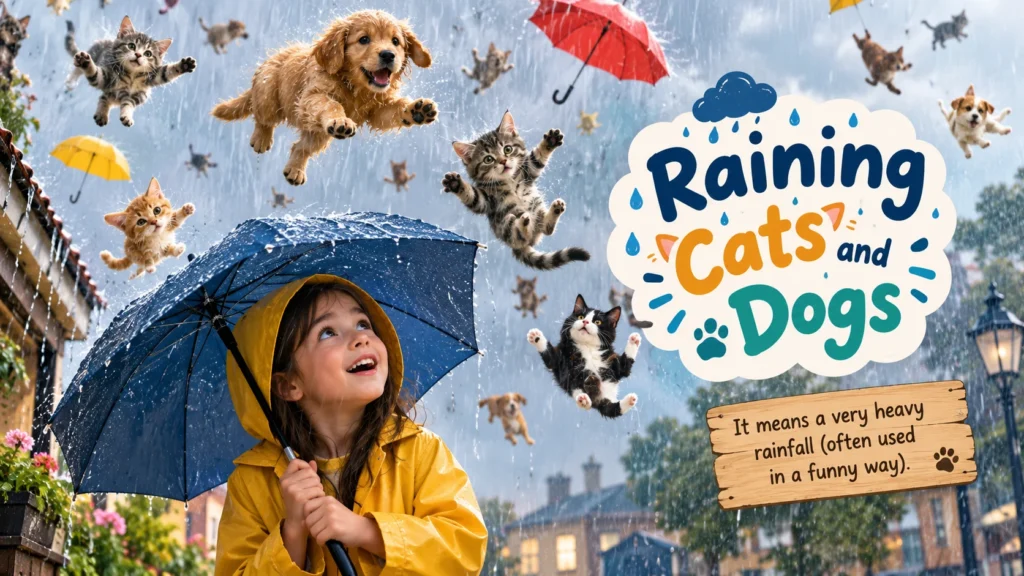
Kid-friendly tip: Imagine a silly picture of cats and dogs falling from the clouds. That funny image helps children remember that the idiom means heavy rain.
Usage note: This is a common and playful idiom for describing very heavy rain.
Break the Ice
Word-by-word meaning: Smash a block of ice.
Idiomatic meaning: To start a conversation or help people feel more comfortable.
Example:
- Mia told a funny joke to break the ice with her new classmates.
- The teacher played a game to break the ice on the first day of school.

Kid-friendly tip: Picture someone literally breaking a huge block of ice and suddenly everyone starts talking.
Usage note: This is useful when people meet for the first time or feel shy.
Piece of Cake
Word-by-word meaning: A slice of cake.
Idiomatic meaning: Something that is very easy to do.
Example:
- The math problem was a piece of cake.
- Don’t worry about the spelling test. It will be a piece of cake!
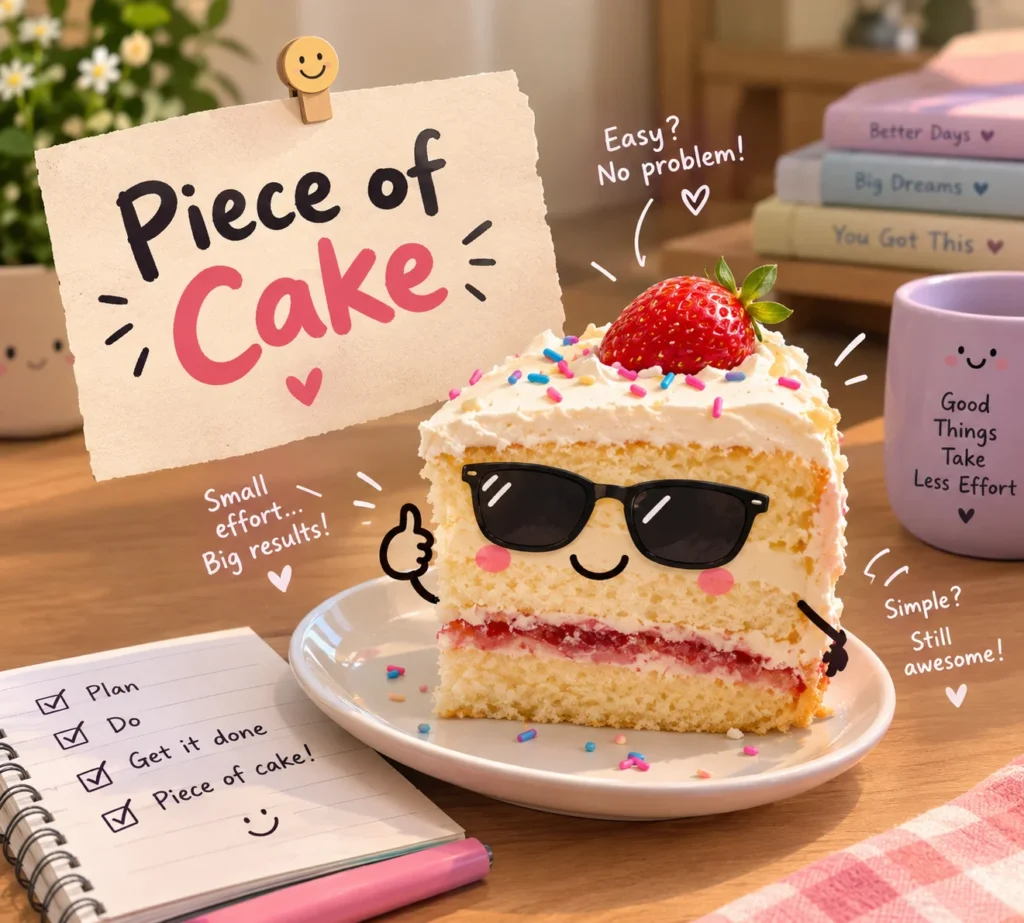
Kid-friendly tip: Imagine finishing an easy homework question and being rewarded with a piece of cake.
Usage note: This is a casual expression often used when someone finds a task easy.
Spill the Beans
Word-by-word meaning: Drop beans from a container.
Idiomatic meaning: To reveal a secret or tell information that was supposed to stay secret.
Example:
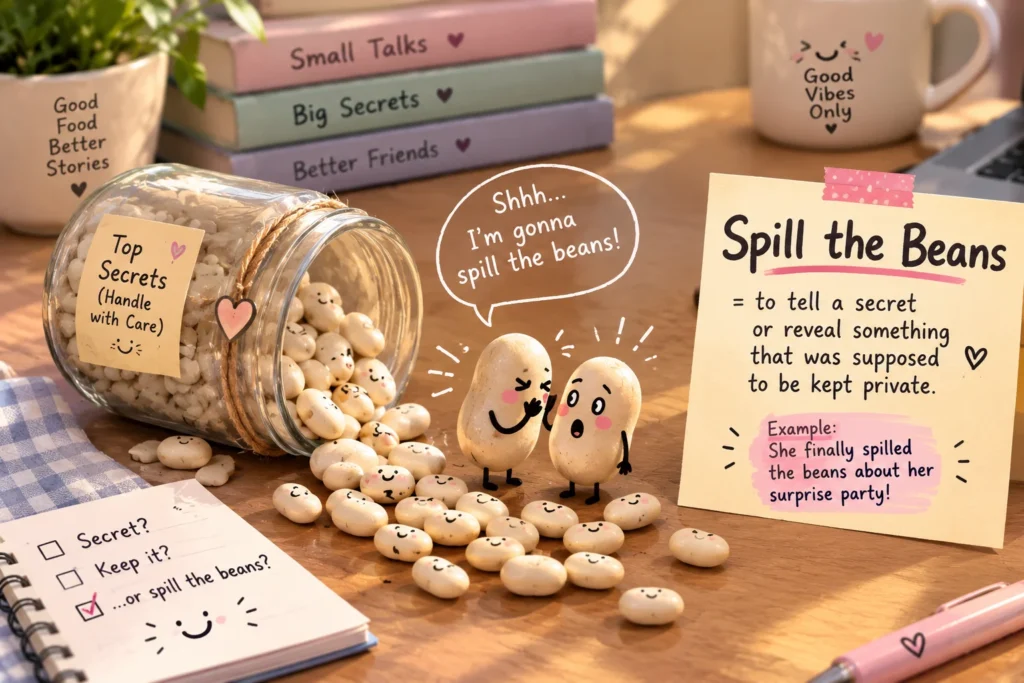
- Lily spilled the beans about the surprise party.
- Don’t spill the beans about my birthday present!
Kid-friendly tip: Imagine someone dropping a bowl of beans and accidentally revealing a hidden message underneath.
Usage note: This is a fun idiom for stories and conversations about secrets.
When Pigs Fly
Word-by-word meaning: Pigs flying through the air.
Idiomatic meaning: Something will probably never happen.
Example:
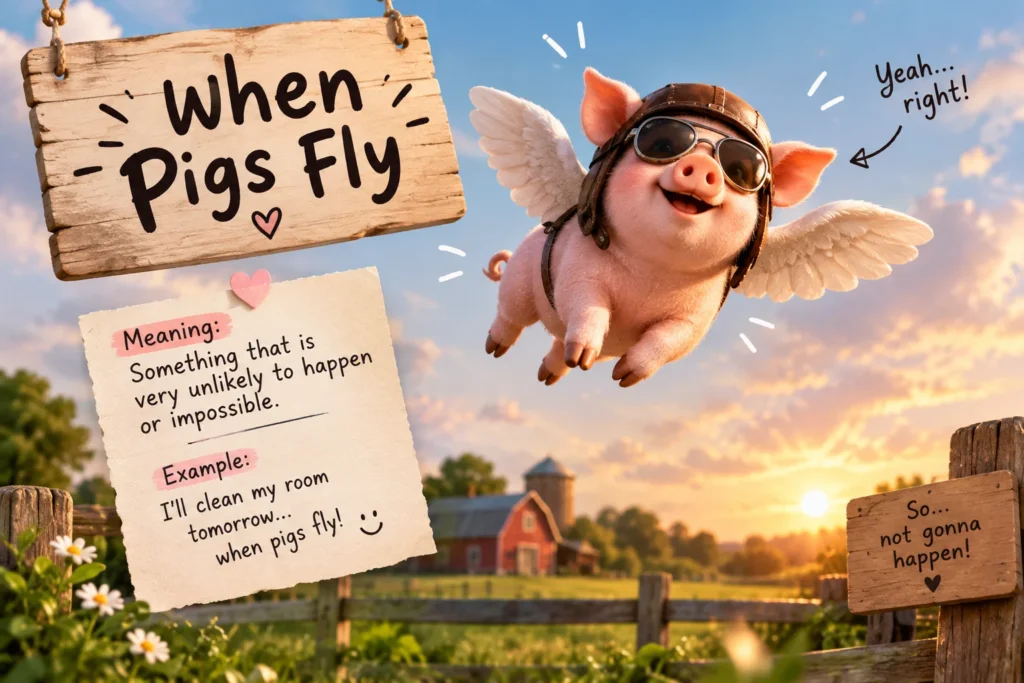
- He said he would clean his room tomorrow—when pigs fly!
- “Will you give me your last cookie?” “Sure, when pigs fly!”
Kid-friendly tip: Picture a pig wearing tiny wings and flying through the sky.
Usage note: This humorous expression is used for something considered extremely unlikely or impossible.
Hit the Sack
Word-by-word meaning: Hit a bag.
Idiomatic meaning: To go to bed or go to sleep.
Example:
- I’m tired. I’m going to hit the sack.
- After the long school trip, we all hit the sack early.
Kid-friendly tip: Imagine a child jumping into a soft sleeping bag at bedtime.
Usage note: This is an informal expression. Children may hear it in casual conversations and stories.
Let the Cat Out of the Bag
Word-by-word meaning: Release a cat from a bag.
Idiomatic meaning: To accidentally reveal a secret.
Example:
- Jake let the cat out of the bag about the surprise party.
- Please don’t let the cat out of the bag before Saturday!
Kid-friendly tip: Imagine a cat jumping out of a bag while everyone discovers a secret.
Usage note: It has a similar meaning to “spill the beans.”
Butterflies in My Stomach
Word-by-word meaning: Butterflies fluttering inside your stomach.
Idiomatic meaning: To feel nervous or excited about something.
Example:
- I had butterflies in my stomach before my school performance.
- She gets butterflies in her stomach before exams.
Kid-friendly tip: Imagine colorful butterflies gently fluttering around inside your tummy when you feel nervous.
Usage note: This is a useful idiom for talking about nervousness and excitement.
Hit the Nail on the Head
Word-by-word meaning: Strike a nail exactly on its head.
Idiomatic meaning: To say or do something exactly right.
Example:
- You hit the nail on the head with that answer!
- Maya hit the nail on the head when she explained the problem.
Kid-friendly tip: Picture someone hitting a nail perfectly with a hammer.
Usage note: This expression is often used to praise someone for getting an answer exactly right.
Under the Weather
Word-by-word meaning: Being beneath the weather.
Idiomatic meaning: Feeling sick or unwell.
Example:
- I’m feeling under the weather today.
- Sam stayed home because he was under the weather.
Kid-friendly tip: Picture a child sitting underneath a gray rain cloud while feeling sick.
Usage note: This is a common everyday expression for feeling physically unwell.
Cool as a Cucumber
Word-by-word meaning: As cool as a cucumber.
Idiomatic meaning: Very calm and relaxed, especially in a stressful situation.
Example:
- Emma was cool as a cucumber during the spelling competition.
- He stayed cool as a cucumber when everyone else was nervous.
Kid-friendly tip: Picture a calm cucumber wearing sunglasses while everyone around it is rushing around.
Usage note: This humorous comparison can help children remember the meaning of staying calm.
Break a Leg
Word-by-word meaning: Injure or break a leg.
Idiomatic meaning: Good luck!
Example:
- Break a leg in your school play!
- “I’m going on stage now.” “Break a leg!”
Kid-friendly tip: Explain that this phrase does not mean someone actually wants you to hurt yourself. It is a traditional way of wishing someone good luck before a performance.
Usage note: You will often hear it before plays, performances, competitions, or other events.
A Fish Out of Water
Word-by-word meaning: A fish that is outside the water.
Idiomatic meaning: Feeling uncomfortable or out of place in an unfamiliar situation.
Example:
- I felt like a fish out of water at my new school.
- He felt like a fish out of water at the formal event.
Kid-friendly tip: Picture a little fish sitting outside its pond, wondering where it belongs.
Usage note: This is useful when describing someone who feels uncomfortable in a new environment.
Barking Up the Wrong Tree
Word-by-word meaning: A dog barking at the wrong tree.
Idiomatic meaning: Looking for an answer in the wrong place or blaming the wrong person.
Example:
- If you think I broke the toy, you’re barking up the wrong tree.
- We were barking up the wrong tree when we searched the classroom.
Kid-friendly tip: Imagine a dog barking at an empty tree while the squirrel has already run somewhere else.
Usage note: This is a humorous way to say that someone has misunderstood a situation.
Cost an Arm and a Leg
Word-by-word meaning: Paying with an arm and a leg.
Idiomatic meaning: Something is extremely expensive.
Example:
- That new video game cost an arm and a leg.
- The tickets cost an arm and a leg.
Kid-friendly tip: The phrase is an exaggeration. Nobody is actually paying with body parts.
Usage note: This is an informal expression for something that costs a lot of money.
Cry Over Spilled Milk
Word-by-word meaning: Cry because milk has been spilled.
Idiomatic meaning: To keep worrying about something that has already happened and cannot be changed.
Example:
- You made a mistake, but there’s no reason to cry over spilled milk.
- We missed the bus, so let’s not cry over spilled milk. We can take the next one.
Kid-friendly tip: Imagine spilling a glass of milk and then learning that cleaning it up and moving on is better than crying about it.
Usage note: This expression teaches children about accepting mistakes and moving forward.
The Early Bird Catches the Worm
Word-by-word meaning: An early bird gets the worm.
Idiomatic meaning: People who act early often have a better chance of success.
Example:
- I arrived early and got the best seat—the early bird catches the worm!
- Finish your project early. Remember, the early bird catches the worm.
Kid-friendly tip: Picture a bird waking up early and finding breakfast before the other birds.
Usage note: This is a proverb rather than a strict idiom, but it is a useful expression for teaching children about preparation and taking opportunities.
Hit the Books
Word-by-word meaning: Strike the books.
Idiomatic meaning: To study hard.
Example:
- My exam is tomorrow, so I need to hit the books.
- It’s time to hit the books and finish our homework.
Kid-friendly tip: Imagine a student opening a pile of books with a determined smile.
Usage note: This is an informal expression commonly used by students.
Kill Two Birds with One Stone
Word-by-word meaning: Solve two problems by using one stone.
Idiomatic meaning: To accomplish two things with one action.
Example:
- I killed two birds with one stone by walking to school and exercising at the same time.
- We can kill two birds with one stone by cleaning the room while organizing our books.
Kid-friendly tip: For young children, it may be better to explain the figurative meaning without focusing on the literal image of harming animals.
Usage note: This is a common idiom, but educators may prefer the alternative “achieve two things at once” when teaching younger children.
Back to Square One
Word-by-word meaning: Return to the first square.
Idiomatic meaning: To start again from the beginning after a plan or attempt has failed.
Example:
- Our science project didn’t work, so we’re back to square one.
- We lost the puzzle pieces and had to go back to square one.
Kid-friendly tip: Imagine a board game where you have to return to the first square and start again.
Usage note: This expression works especially well when talking about school projects, games, experiments, and problem-solving.
Common Idioms for Kids and Their Meanings
| Idiom | Simple Meaning |
|---|---|
| Raining cats and dogs | Raining very heavily |
| Break the ice | Start a conversation |
| Piece of cake | Very easy |
| Spill the beans | Reveal a secret |
| When pigs fly | Something very unlikely to happen |
| Hit the sack | Go to bed |
| Let the cat out of the bag | Reveal a secret |
| Butterflies in my stomach | Feel nervous or excited |
| Hit the nail on the head | Get something exactly right |
| Under the weather | Feel sick |
| Cool as a cucumber | Stay very calm |
| Break a leg | Good luck |
| A fish out of water | Feel out of place |
| Barking up the wrong tree | Be mistaken about something |
| Cost an arm and a leg | Be very expensive |
| Cry over spilled milk | Worry about something that cannot be changed |
| The early bird catches the worm | Acting early can help |
| Hit the books | Study hard |
| Kill two birds with one stone | Accomplish two things at once |
| Back to square one | Start over |
What Is an Idiom for Kids?
An idiom for kids is a phrase whose real meaning is different from the literal meaning of its individual words.
For example:
“It’s raining cats and dogs.”
A child who hears this for the first time might imagine cats and dogs falling from the sky. The actual meaning is simply:
It is raining very heavily.
Pictures, stories, and examples make these unusual phrases easier for children to understand.
Idioms With Pictures for Kids
Idioms with pictures can make figurative language much easier to learn. A good picture should show both the funny literal image and help connect it to the real meaning.
For example:
- Piece of cake → Show a child looking happy because an easy math problem is finished beside a piece of cake.
- Butterflies in my stomach → Show a child getting ready for a school performance with imaginary butterflies around their stomach.
- When pigs fly → Show a cartoon-style pig flying through the sky while someone talks about something impossible.
- Hit the books → Show a student studying with an open book and school supplies.
- A fish out of water → Show a fish outside a pond looking confused.
This approach turns abstract language into something children can see and remember.
Fun Idioms for Kids
Some expressions are especially memorable because their literal meanings create funny pictures.
Raining Cats and Dogs
Children can imagine a completely silly rainy day filled with cats and dogs.
When Pigs Fly
A flying pig makes the idea of “never” easy to remember.
Have Two Left Feet
This humorous expression can be used when someone is awkward at dancing.
Piece of Cake
The connection between an easy task and a delicious cake makes this idiom easy to remember.
Barking Up the Wrong Tree
A dog barking at the wrong tree creates a funny visual for making a mistake about something.
Visual humor is one reason funny idioms with pictures can work particularly well for younger learners.
Easy Idioms for Kids by Grade Level
Idioms for 2nd Graders
For younger children, start with short and familiar expressions such as:
- Piece of cake
- Break the ice
- Hit the books
- Hit the sack
- Break a leg
- When pigs fly
Use simple pictures and one-sentence examples.
Idioms for Second Graders: Learning Tip
Instead of asking children to memorize definitions, ask them to:
- Look at the picture.
- Guess the literal meaning.
- Learn the figurative meaning.
- Read an example sentence.
- Draw their own picture.
This makes idioms for second graders more interactive.
Idioms for Fourth Graders
Older elementary students can explore expressions with more complex figurative meanings, such as:
- Hit the nail on the head
- Barking up the wrong tree
- Cry over spilled milk
- Back to square one
- Cost an arm and a leg
- Kill two birds with one stone
At this level, students can also write their own sentences using each expression.
How Pictures Help Kids Learn Idioms
Pictures can help children understand an idiom in three simple steps:
Literal image → Figurative meaning → Real-life example
For instance:
“Under the weather”
Picture: A child sitting under a rain cloud.
Meaning: Feeling sick.
Example: “I’m under the weather today.”
This method helps turn unfamiliar picture idioms into memorable vocabulary.
Common Mistakes When Learning Idioms
Taking the Words Literally
Children may think “raining cats and dogs” means animals are actually falling from the sky.
Explain the figurative meaning clearly after showing the funny literal image.
Using Only the Literal Meaning
The purpose of an idiom is its figurative meaning, so children should learn both meanings.
Using an Idiom in the Wrong Situation
For example, “hit the books” is appropriate for studying, but not for eating lunch.
Learning Too Many at Once
Start with a small group of expressions. Once children understand those, introduce more.
How Parents and Teachers Can Teach Idioms With Pictures
Here are some simple activities for teaching idioms for kids with meaning:
Draw the Literal Meaning
Ask children to draw exactly what the words seem to say.
For “when pigs fly,” they might draw a pig with wings.
Then explain the figurative meaning.
Create Idiom Flashcards
Put the idiom on one side and the meaning with a picture on the other.
Make an Idiom of the Day
Choose one expression each day and use it in a sentence.
For example:
Idiom of the day: Piece of cake
Meaning: Very easy
Sentence: “The spelling quiz was a piece of cake.”
Write Your Own Examples
After learning an idiom, ask children to create a sentence about their own lives.
Make an Idiom Picture Book
Children can choose five expressions, draw pictures for each one, and write a simple example underneath.
This turns idioms in pictures into an engaging classroom or home-learning activity.
FAQs About Idioms for Kids
What are idioms for kids?
Idioms are expressions that have a special figurative meaning that is different from the literal meaning of the words. For example, “piece of cake” means something is very easy.
Why are pictures useful for teaching idioms?
Pictures make abstract expressions more concrete. They can help children connect an unusual phrase with its figurative meaning and remember it more easily.
What are some easy idioms for kids?
Some easy choices include “piece of cake,” “hit the books,” “hit the sack,” “break the ice,” “break a leg,” and “when pigs fly.”
What is a simple definition of an idiom for kids?
An idiom is a phrase that means something different from what its words literally say.
What are common idioms for kids?
Common examples include “raining cats and dogs,” “piece of cake,” “spill the beans,” “break the ice,” “hit the books,” and “under the weather.”
How can kids learn idioms?
Kids can learn idioms through pictures, stories, games, flashcards, classroom activities, and simple example sentences.
Conclusion
Learning English idioms becomes much easier when children can see, understand, and use each expression. Idioms for kids with pictures turn unusual phrases into memorable lessons by connecting figurative language with simple visual examples.
Start with easy expressions such as “piece of cake,” “break the ice,” “hit the books,” and “raining cats and dogs.” Then encourage children to draw their own idiom pictures, create flashcards, and write simple sentences.
The goal isn’t just to memorize a list of phrases. It’s to help children understand what an idiom means, when to use it, and why English speakers use it. With pictures and practice, even confusing figurative expressions can become fun and easy to remember.

Hazel Monroe, author at SeekIdiom, explains English idioms through simple meanings and examples, helping learners improve vocabulary and everyday usage.