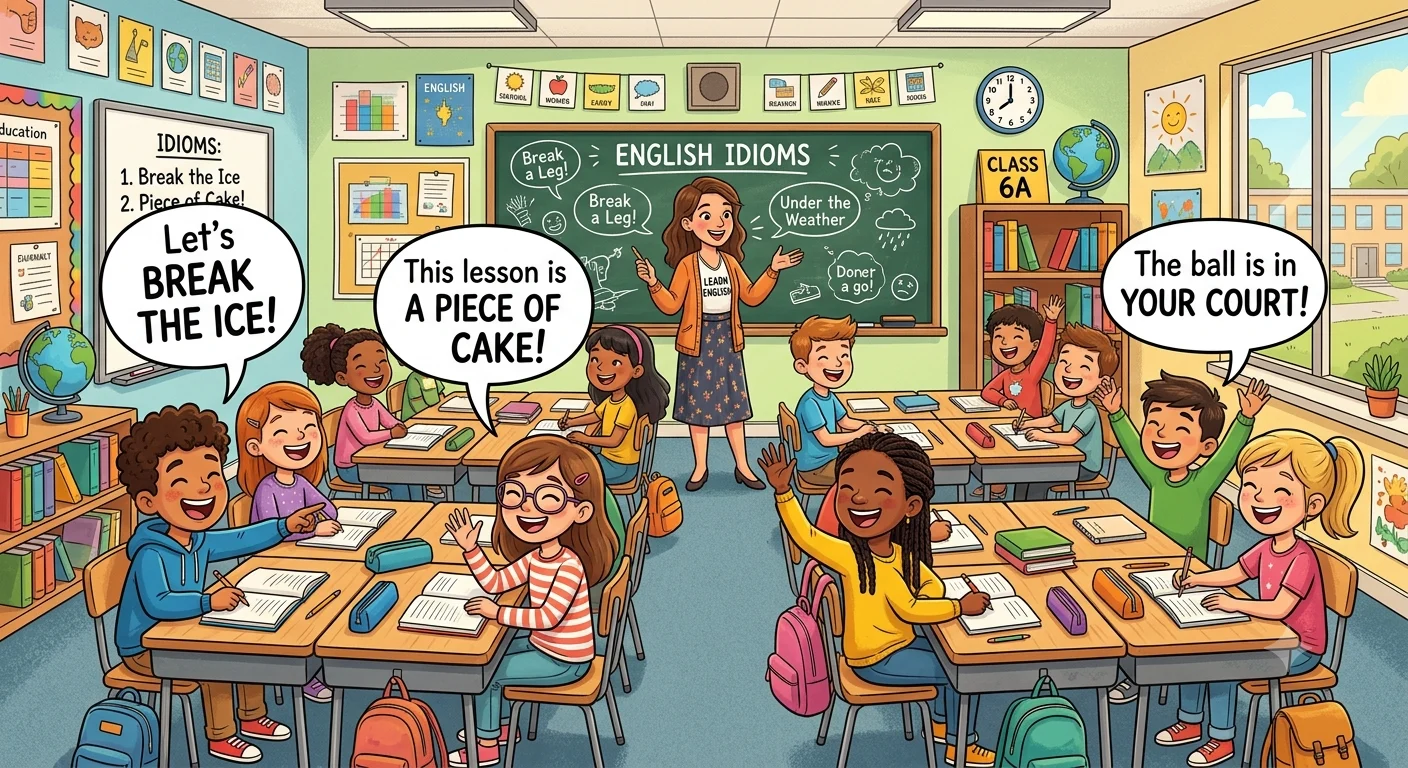
Idioms are like secret codes that make English fun! For 6th graders, learning idioms can transform simple sentences into creative and colorful expressions. Imagine telling your friends “hit the books” instead of just saying “study”—it makes you sound smart and playful. In this guide, we explore 20 famous idioms for 6th graders, complete with meanings, examples, common errors, and tips for proper use.
Break the Ice
Word-by-Word Meaning
- Break: To smash or separate
- Ice: Frozen water
Idiomatic/Figurative Meaning
- To start a conversation or activity in a friendly way, especially in awkward situations.
Example Sentences
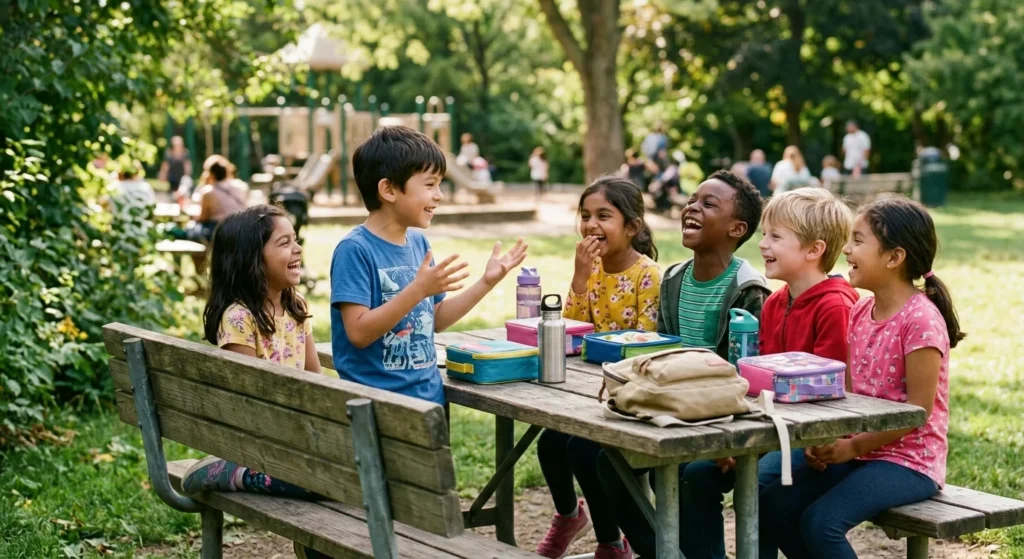
- “I told a joke to break the ice at the new school.”
- “She asked about my hobbies to break the ice.”
Common Error
- Using it literally as breaking frozen water instead of a social situation.
Usage Note
- Perfect when meeting new people, starting group activities, or making strangers comfortable.
A Piece of Cake
Word-by-Word Meaning
- Piece: A portion
- Cake: Sweet dessert
Idiomatic/Figurative Meaning
- Something very easy to do.
Example Sentences
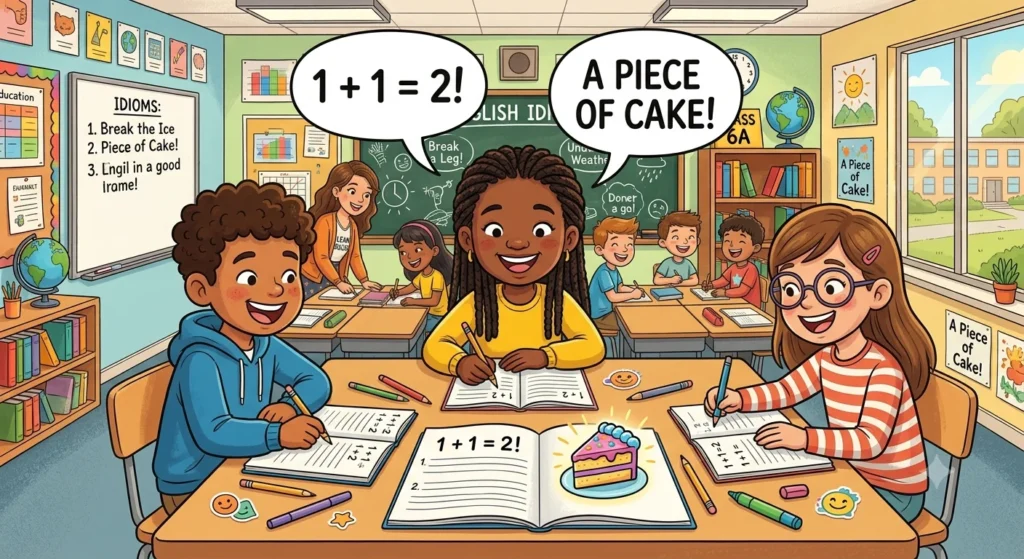
- “This math problem is a piece of cake.”
- “Cleaning my room was a piece of cake after lunch.”
Common Error
- Confusing it with literal cake or dessert.
Usage Note
- Casual expression used for easy tasks or simple achievements.
Hit the Sack
Word-by-Word Meaning
- Hit: To touch or strike
- Sack: Bag (used here as bed or pillow)
Idiomatic/Figurative Meaning
- To go to sleep.

Example Sentences
- “I am so tired, I’m going to hit the sack.”
- “After the long trip, she hit the sack immediately.”
Common Error
- Thinking it literally means to hit a bag.
Usage Note
- Informal; commonly used in casual conversation or texting.
Let the Cat Out of the Bag
Word-by-Word Meaning
- Let: Allow
- Cat: A feline
- Bag: A container
Idiomatic/Figurative Meaning
- To reveal a secret, often by mistake.
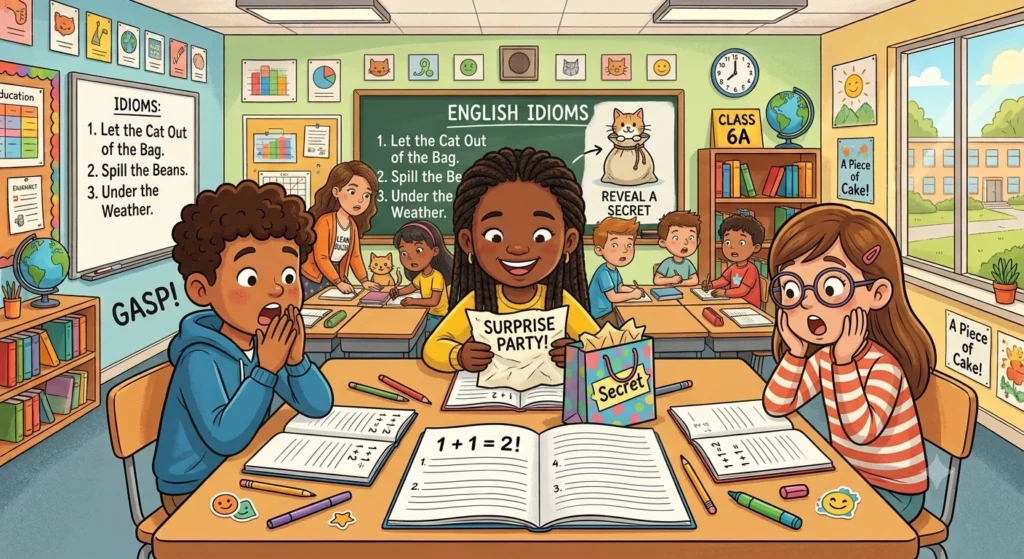
Example Sentences
- “He let the cat out of the bag about the surprise party.”
- “Don’t let the cat out of the bag!”
Common Error
- Thinking it literally involves a cat and a bag.
Usage Note
- Useful in storytelling or when discussing surprises or secrets.
Under the Weather
Word-by-Word Meaning
- Under: Below
- Weather: Atmospheric conditions
Idiomatic/Figurative Meaning
- Feeling unwell or sick.

Example Sentences
- “I felt under the weather, so I stayed home.”
- “She’s under the weather today and can’t attend school.”
Common Error
- Taking it as literal weather conditions.
Usage Note
- Commonly used to describe mild illness; polite and conversational.
When Pigs Fly
Word-by-Word Meaning
- Pigs: Farm animals
- Fly: Move through the air
Idiomatic/Figurative Meaning
- Something that will never happen.
Example Sentences
- “I’ll clean my room when pigs fly!”
- “He said he’ll finish homework early—yeah, when pigs fly.”
Common Error
- Thinking pigs can literally fly.
Usage Note
- Humorous or sarcastic expression for impossible events.
Spill the Beans
Word-by-Word Meaning
- Spill: Drop accidentally
- Beans: Legumes
Idiomatic/Figurative Meaning
- To reveal a secret.
Example Sentences
- “She spilled the beans about the field trip.”
- “Don’t spill the beans about my surprise.”
Common Error
- Misinterpreting it literally as dropping food.
Usage Note
- Informal; perfect for storytelling or gossip scenarios.
Cost an Arm and a Leg
Word-by-Word Meaning
- Cost: Price
- Arm and a leg: Body parts
Idiomatic/Figurative Meaning
- Something very expensive.
Example Sentences
- “That new bike costs an arm and a leg.”
- “The concert tickets cost an arm and a leg.”
Common Error
- Thinking it refers to literal body parts.
Usage Note
- Dramatic expression to emphasize high cost; informal.
Hit the Books
Word-by-Word Meaning
- Hit: Strike
- Books: Reading materials
Idiomatic/Figurative Meaning
- To study hard.
Example Sentences
- “I need to hit the books for tomorrow’s test.”
- “She hit the books all weekend.”
Common Error
- Taking it literally as striking books.
Usage Note
- Common among students; informal but widely understood.
76+ Teaching English Idioms for Speaking and Writing Skills 🗣️
Barking Up the Wrong Tree
Word-by-Word Meaning
- Barking: Dog sound
- Wrong tree: Incorrect tree
Idiomatic/Figurative Meaning
- Accusing or blaming the wrong person.
Example Sentences
- “If you think I did it, you’re barking up the wrong tree.”
- “He’s barking up the wrong tree about the missing pencil.”
Common Error
- Literal interpretation as dogs climbing trees.
Usage Note
- Humorously points out misunderstandings or mistakes.
Break a Leg
Word-by-Word Meaning
- Break: To separate
- Leg: Limb
Idiomatic/Figurative Meaning
- Wishing someone good luck.
Example Sentences
- “Break a leg in your play tonight!”
- “You’ll do great—break a leg!”
Common Error
- Thinking it is an actual wish to harm.
Usage Note
- Commonly used in theater, exams, or performances.
Piece of the Pie
Word-by-Word Meaning
- Piece: Portion
- Pie: Dessert
Idiomatic/Figurative Meaning
- A share in something valuable or profitable.
Example Sentences
- “I want a piece of the pie from this project.”
- “Everyone got a piece of the pie.”
Common Error
- Taking it literally as food.
Usage Note
- Commonly used in business or teamwork contexts.
Bite the Bullet
Word-by-Word Meaning
- Bite: Use teeth
- Bullet: Ammunition
Idiomatic/Figurative Meaning
- To face a difficult or unpleasant situation bravely.
Example Sentences
- “I’ll bite the bullet and finish my chores.”
- “She bit the bullet and apologized.”
Common Error
- Misinterpreting literally as biting ammunition.
Usage Note
- Encourages courage or acceptance of tough tasks.
On Cloud Nine
Word-by-Word Meaning
- Cloud: Floating vapor
- Nine: Number
Idiomatic/Figurative Meaning
- Feeling extremely happy.
Example Sentences
- “I was on cloud nine after winning the game.”
- “She’s on cloud nine about her birthday party.”
Common Error
- Thinking it involves literally being in the sky.
Usage Note
- Expresses strong joy or excitement.
Cry Over Spilled Milk
Word-by-Word Meaning
- Cry: Shed tears
- Spilled milk: Milk that fell
Idiomatic/Figurative Meaning
- Worrying about past mistakes that cannot be changed.
Example Sentences
- “Don’t cry over spilled milk; just try again.”
- “He learned from his error and didn’t cry over spilled milk.”
Common Error
- Taking it literally as milk on the floor.
Usage Note
- Encourages moving on rather than dwelling on mistakes.
The Ball is in Your Court
Word-by-Word Meaning
- Ball: Game object
- Court: Playing field
Idiomatic/Figurative Meaning
- It’s your turn to make a decision or take action.
Example Sentences
- “I’ve done my part; the ball is in your court now.”
- “The teacher asked me first, now the ball is in my court.”
Common Error
- Thinking it involves sports literally.
Usage Note
- Commonly used in decision-making or responsibility contexts.
Hit the Nail on the Head
Word-by-Word Meaning
- Hit: Strike
- Nail: Metal object
- Head: Top
Idiomatic/Figurative Meaning
- To describe something accurately or say exactly the right thing.
Example Sentences
- “You hit the nail on the head with your answer.”
- “She hit the nail on the head about the problem.”
Common Error
- Literal interpretation of hitting a nail.
Usage Note
- Often used in discussions, analysis, or problem-solving.
In Hot Water
Word-by-Word Meaning
- Hot: High temperature
- Water: Liquid
Idiomatic/Figurative Meaning
- Being in trouble.
Example Sentences
- “I’m in hot water for missing homework.”
- “He was in hot water with his parents.”
Common Error
- Thinking it refers to actual water.
Usage Note
- Informal; great for storytelling about mistakes or consequences.
Let Sleeping Dogs Lie
Word-by-Word Meaning
- Let: Allow
- Sleeping dogs: Resting pets
- Lie: Rest
Idiomatic/Figurative Meaning
- Avoid restarting old conflicts or problems.
Example Sentences
- “Don’t bring up old arguments; let sleeping dogs lie.”
- “She let sleeping dogs lie to keep the peace.”
Common Error
- Literal interpretation as dogs.
Usage Note
- Advises avoiding unnecessary arguments or conflicts.
Through Thick and Thin
Word-by-Word Meaning
- Thick: Dense
- Thin: Not dense
Idiomatic/Figurative Meaning
- Supporting someone in good times and bad.
Example Sentences
- “My best friend stayed with me through thick and thin.”
- “They remained loyal through thick and thin.”
Common Error
- Confusing with literal objects being thick or thin.
Usage Note
- Common in friendship or family contexts to show loyalty.
FAQs About Idioms for 6th Graders
Q1: Why are idioms important for 6th graders?
A: Idioms make English colorful, expressive, and help students understand real-life conversations.
Q2: How can students remember idioms easily?
A: Practice using them in sentences, create flashcards, and link idioms to stories or visuals.
Q3: Can idioms be used in writing?
A: Yes! Especially in essays, stories, or creative writing to make language lively.
Q4: Are idioms the same in all English-speaking countries?
A: Most are common, but some idioms differ depending on culture or region.
Q5: How many idioms should I learn at once?
A: Start with 2–3 per week and gradually increase to build confidence.
Conclusion
Idioms are fun, magical tools that make your English shine! Start practicing these 20 famous idioms for 6th graders in sentences, stories, or daily conversations. The more you use them, the more confident and creative your English will become. Remember: idioms are not just words—they’re a way to express yourself uniquely!

Adrian Wells, author at SeekIdiom, shares easy explanations of English idioms with examples to help learners expand vocabulary and speak more confidently.