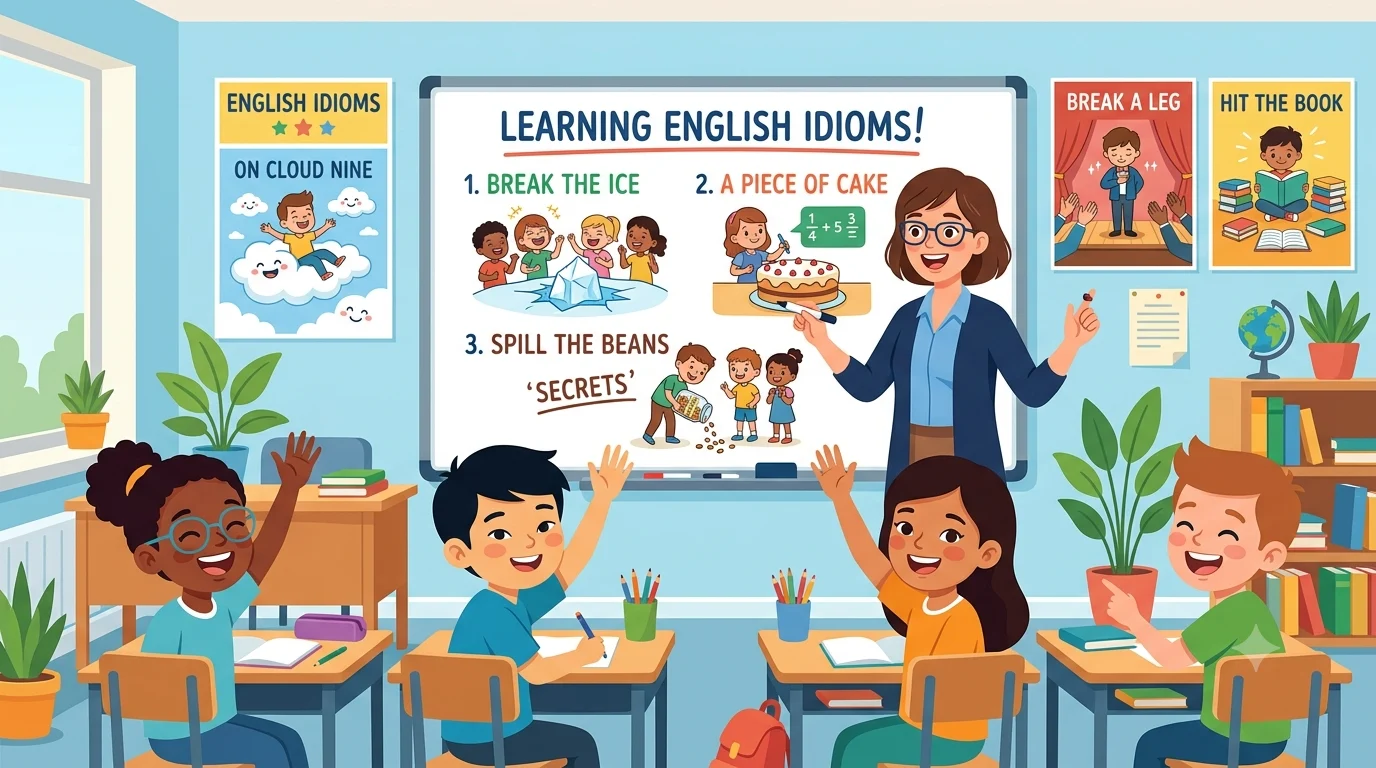
Teaching English idioms can be challenging because learners often understand every individual word but completely miss the intended meaning. Imagine telling a student to “break the ice,” only to have them glance around the room looking for actual ice! That’s exactly why teaching English idioms requires simple explanations, real-life examples, and engaging practice activities.
In this guide, you’ll discover 20 of the most common English idioms, complete with meanings, examples, common mistakes, and teaching tips to help students remember and use them naturally in everyday conversations.
Why Teaching English Idioms Matters
Idioms are everywhere in English. Native speakers use them naturally, making them an essential part of becoming fluent.
You’ll frequently encounter idioms in:
- 🎬 Movies and TV shows
- 🗣️ Everyday conversations
- 📚 English novels and newspapers
- 🎓 IELTS, TOEFL, CSS, and other English proficiency exams
- 💼 Workplace communication
Benefits of Learning English Idioms
| Benefit | Why It Matters |
|---|---|
| Better Fluency | Speak more naturally like native speakers |
| Improved Listening | Understand movies, podcasts, and conversations |
| Stronger Vocabulary | Learn expressions beyond literal meanings |
| Cultural Understanding | Discover how English speakers communicate |
| Better Exam Performance | Recognize idioms in reading and listening tests |
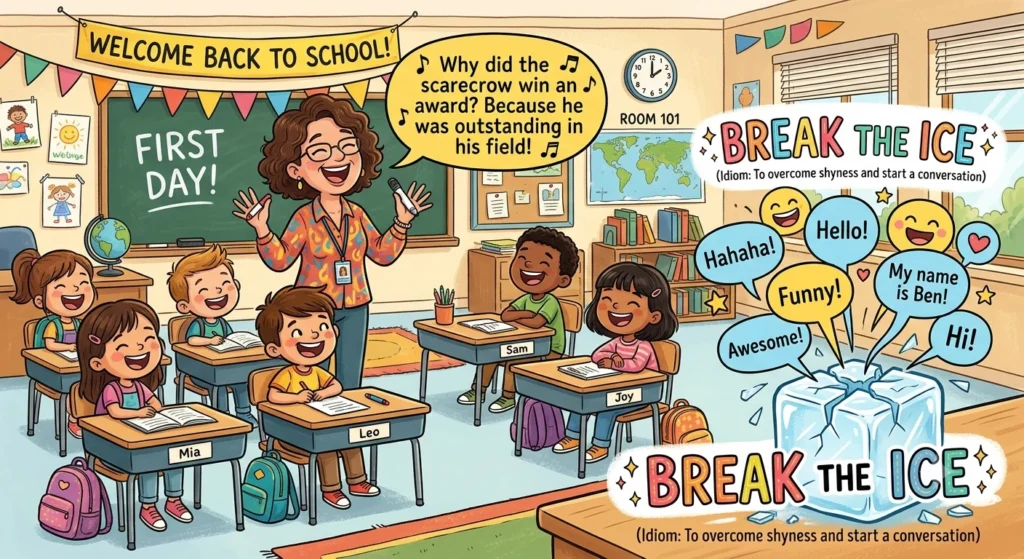
Break the Ice
Word-by-Word Meaning
Break + Ice
Idiomatic Meaning
To start a conversation or make people feel comfortable in a new or awkward situation.
Example Sentence
- The teacher told a funny story to break the ice on the first day of class.
- Playing an icebreaker game helped everyone break the ice.
Common Error
❌ He broke the ice in his glass.
Usage Note
Use this idiom in social gatherings, classrooms, meetings, or interviews.
A Piece of Cake
Word-by-Word Meaning
A slice of cake
Idiomatic Meaning
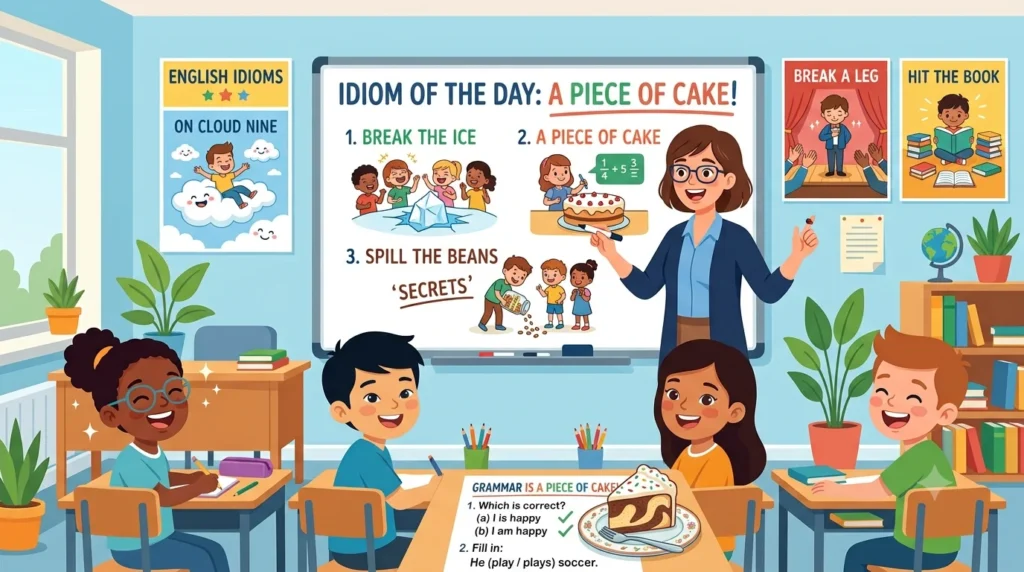
Something that is very easy to do.
Example Sentence
- The vocabulary quiz was a piece of cake.
- After practicing daily, pronunciation became a piece of cake.
Common Error
Thinking it only refers to dessert.
Usage Note
Common in casual English.
Once in a Blue Moon
Word-by-Word Meaning
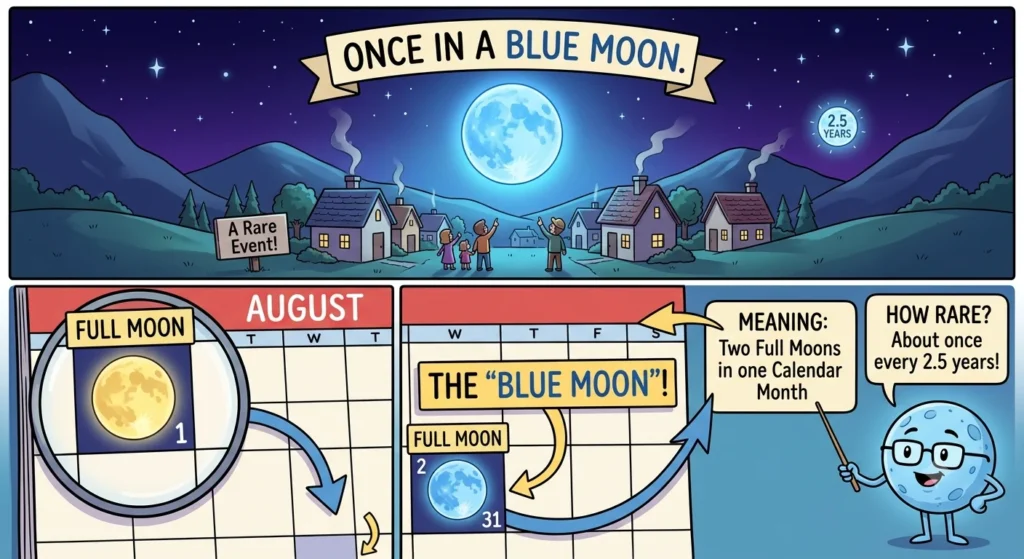
A rare blue moon
Idiomatic Meaning
Something that happens very rarely.
Example Sentence
- I eat fast food once in a blue moon.
- She visits her hometown once in a blue moon.
Common Error
Using it to describe future events.
Usage Note
Used to describe frequency.
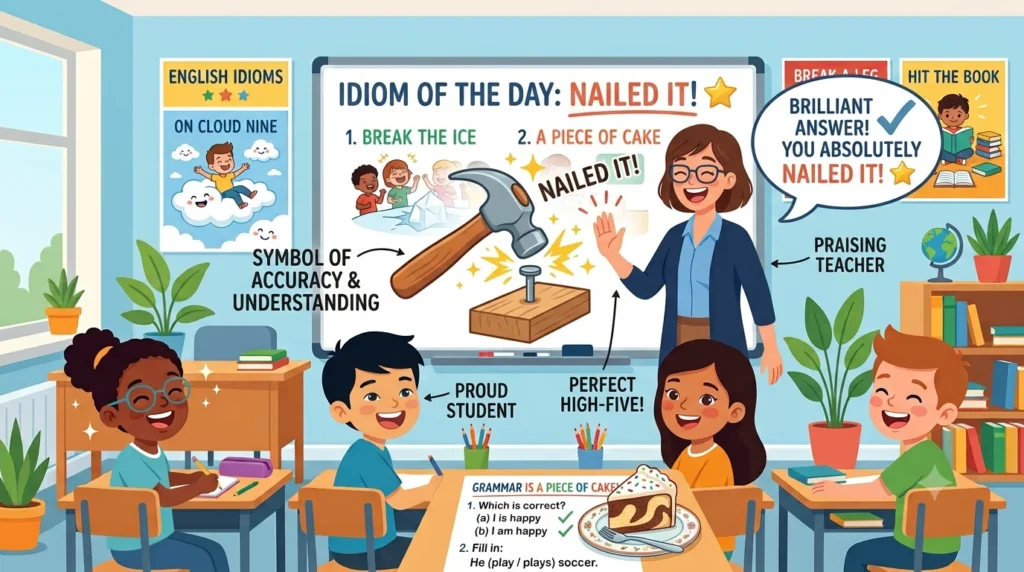
Hit the Nail on the Head
Word-by-Word Meaning
Strike a nail perfectly.
Idiomatic Meaning
To say something exactly right.
Example Sentence
- You hit the nail on the head with your explanation.
- Her answer hit the nail on the head.
Common Error
Using it for construction work.
Usage Note
Excellent for praising accurate answers.
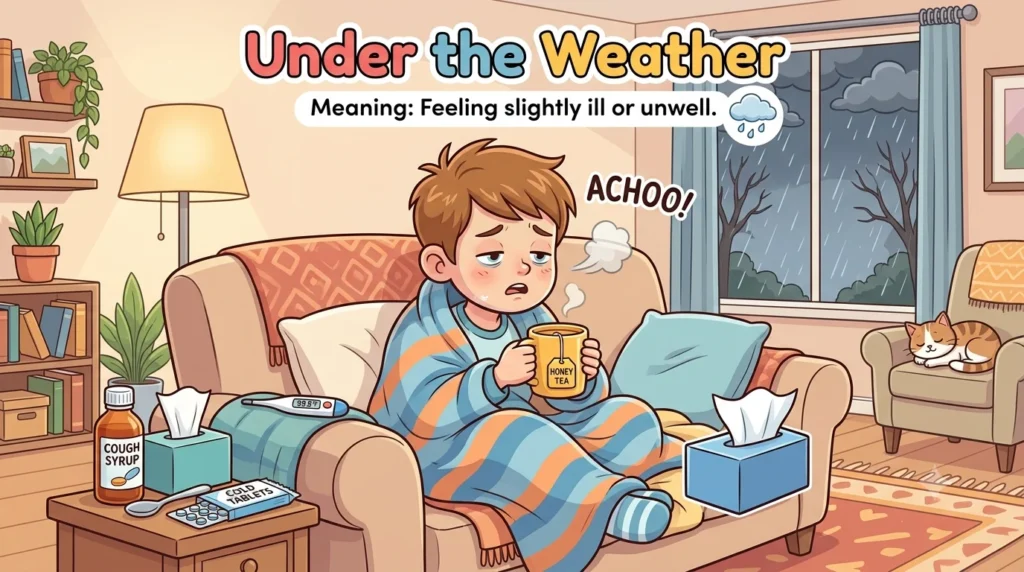
Under the Weather
Word-by-Word Meaning
Below the weather
Idiomatic Meaning
Feeling slightly sick.
Example Sentence
- I’m feeling under the weather today.
- She stayed home because she was under the weather.
Common Error
Thinking it refers to weather conditions.
Usage Note
Common in informal conversations.
Spill the Beans
Word-by-Word Meaning
Drop beans
Idiomatic Meaning
Reveal a secret.
Example Sentence
- He accidentally spilled the beans about the surprise party.
Common Error
Using it literally.
Usage Note
Frequently used in everyday English.
Cost an Arm and a Leg
Word-by-Word Meaning
Very expensive body parts
Idiomatic Meaning
Extremely expensive.
Example Sentence
- That laptop cost an arm and a leg.
Common Error
Thinking it refers to physical injury.
Usage Note
An exaggeration used humorously.
Beat Around the Bush
Word-by-Word Meaning
Hit bushes
Idiomatic Meaning
Avoid talking about the main issue.
Example Sentence
- Stop beating around the bush and answer the question.
Common Error
Using it as positive communication.
Usage Note
Often used in advice.
Let the Cat Out of the Bag
Word-by-Word Meaning
Release a cat
Idiomatic Meaning
Accidentally reveal a secret.
Example Sentence
- She let the cat out of the bag about the wedding.
Common Error
Confusing it with animal-related expressions.
Usage Note
Very similar to “spill the beans.”
Burn the Midnight Oil
Word-by-Word Meaning
Use oil late at night
Idiomatic Meaning
Study or work late into the night.
Example Sentence
- Students burned the midnight oil before the exam.
Common Error
Associating it with fire.
Usage Note
Common in academic settings.
On Cloud Nine
Word-by-Word Meaning
On the ninth cloud
Idiomatic Meaning
Extremely happy.
Example Sentence
- She was on cloud nine after getting the scholarship.
Common Error
Thinking it refers to weather.
Usage Note
Expresses great joy.
Pull Someone’s Leg
Word-by-Word Meaning
Pull a person’s leg
Idiomatic Meaning
To joke or tease someone.
Example Sentence
- Relax! I’m just pulling your leg.
Common Error
Taking it literally.
Usage Note
Friendly and humorous.
In Hot Water
Word-by-Word Meaning
Inside hot water
Idiomatic Meaning
In trouble.
Example Sentence
- He is in hot water for missing the deadline.
Common Error
Thinking it refers to taking a bath.
Usage Note
Used in workplaces and schools.
The Ball Is in Your Court
Word-by-Word Meaning
The ball is on your side.
Idiomatic Meaning
It’s your turn to make a decision.
Example Sentence
- I’ve done my part. The ball is in your court now.
Common Error
Thinking it’s only about sports.
Usage Note
Very common in professional English.
Kill Two Birds with One Stone
Word-by-Word Meaning
Hit two birds
Idiomatic Meaning
Achieve two goals with one action.
Example Sentence
- Walking to work kills two birds with one stone because it saves money and improves fitness.
Common Error
Taking it literally.
Usage Note
Useful when discussing efficiency.
Bite the Bullet
Word-by-Word Meaning
Bite ammunition
Idiomatic Meaning
Face a difficult situation bravely.
Example Sentence
- She bit the bullet and apologized.
Common Error
Connecting it with violence.
Usage Note
Encourages courage.
Back to the Drawing Board
Word-by-Word Meaning
Return to planning
Idiomatic Meaning
Start over after failure.
Example Sentence
- The experiment failed, so it’s back to the drawing board.
Common Error
Using it before trying.
Usage Note
Common in business and education.
Cry Over Spilled Milk
Word-by-Word Meaning
Cry because milk spilled
Idiomatic Meaning
Don’t worry about something that cannot be changed.
Example Sentence
- Don’t cry over spilled milk. Just move forward.
Common Error
Using it for actual milk.
Usage Note
Used to comfort someone.
Take It with a Grain of Salt
Word-by-Word Meaning
Add a little salt
Idiomatic Meaning
Don’t completely believe something.
Example Sentence
- Take online reviews with a grain of salt.
Common Error
Thinking it refers to cooking.
Usage Note
Encourages critical thinking.
Actions Speak Louder Than Words
Word-by-Word Meaning
Actions are louder
Idiomatic Meaning
What people do matters more than what they say.
Example Sentence
- He makes many promises, but actions speak louder than words.
Common Error
Using it only for criticism.
Usage Note
Suitable in motivational and educational contexts.
Best Tips for Teaching English Idioms Effectively
To help students remember idioms more easily, try these classroom strategies:
- 📖 Teach idioms through short stories.
- 🎭 Use role-play and conversations.
- 🖼️ Add illustrations or flashcards.
- 🎬 Show idioms in movie clips.
- ✍️ Ask students to create their own example sentences.
- 🎮 Turn idiom practice into classroom games and quizzes.
- 📱 Encourage learners to notice idioms in social media, podcasts, and YouTube videos.
These methods make learning more interactive and memorable.
Common Mistakes Students Make with English Idioms
- Translating idioms word for word.
- Using idioms in inappropriate situations.
- Mixing two different idioms together.
- Changing important words within an idiom.
- Overusing idioms in formal writing.
Encourage learners to understand the meaning first before trying to use an idiom in conversation.
Frequently Asked Questions (FAQs)
1. Why are English idioms difficult for learners?
Because idioms have figurative meanings that cannot usually be understood by translating each word individually.
2. How can teachers teach English idioms effectively?
Use storytelling, pictures, role-play, videos, and real-life conversations so students can understand idioms in context.
3. Should beginners learn English idioms?
Yes. Start with common, everyday idioms that students are likely to hear in conversations, movies, and classrooms.
4. Are English idioms used in formal writing?
Some idioms appear in professional communication, but many are better suited for informal speaking and casual writing.
5. How many idioms should students learn at one time?
Teaching 5–10 idioms per lesson helps students remember and practice them without feeling overwhelmed.
Conclusion
Teaching English idioms doesn’t have to be difficult. When learners encounter idioms through stories, conversations, visuals, and practical examples, they begin to understand English the way native speakers use it every day. Rather than memorizing long lists, encourage students to use new idioms in speaking, writing, and classroom activities to build lasting confidence.
Start with just three idioms this week, practice them in real conversations, and gradually add more. With consistent practice, idioms will become a natural part of your students’ English vocabulary.

Sophie Langford, author at SeekIdiom, explains English idioms with clear meanings, examples, and usage to help learners improve vocabulary and communication.