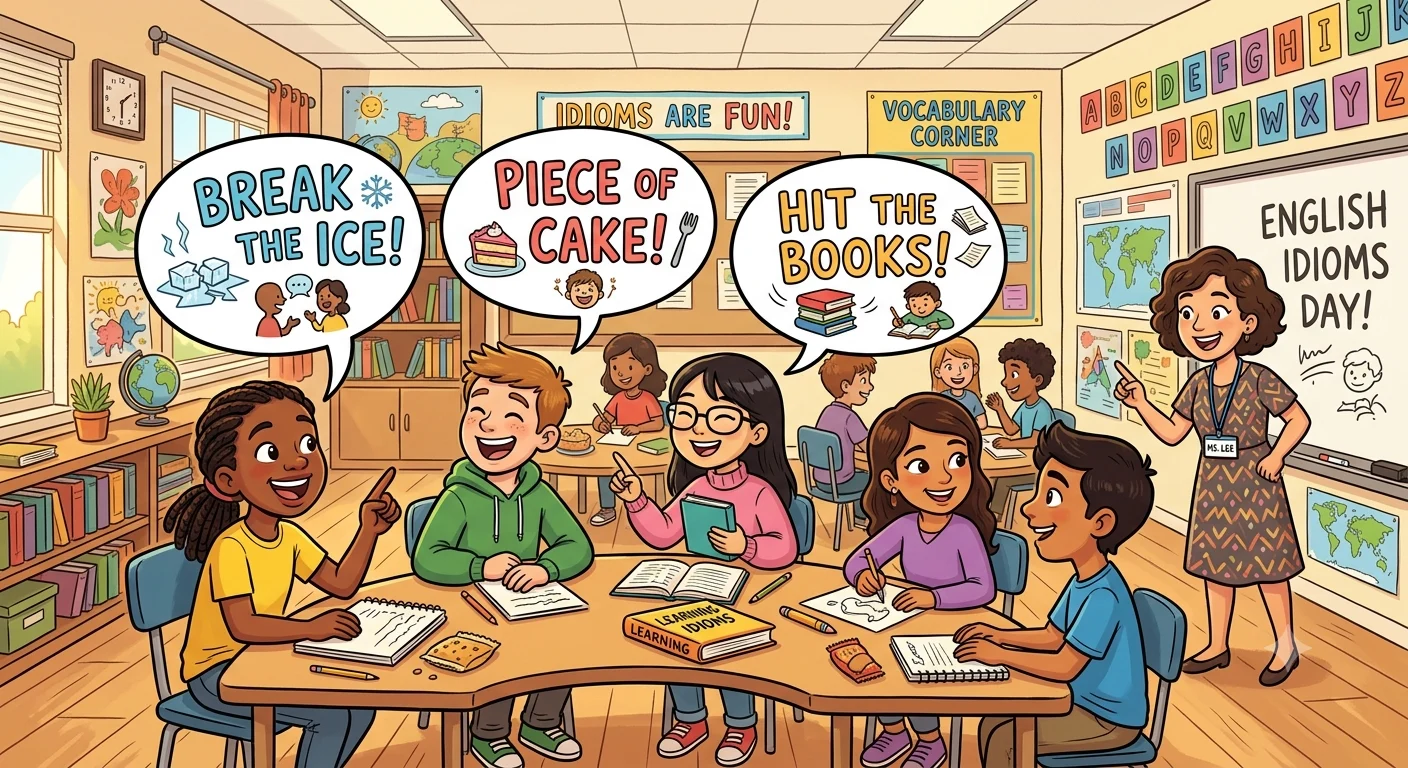
Ever feel confused when someone says, “Don’t cry over spilled milk”? Middle school idioms can be tricky—but once you learn them, they make English fun, expressive, and memorable. In this guide, we’ll explore 20 famous middle school idioms, complete with meanings, examples, and tips to avoid mistakes.
Break the Ice
Word-by-Word Meaning
Break + Ice = To smash frozen water.
Idiomatic/ Figurative Meaning
To start a conversation or make people feel comfortable in a social situation.
Example Sentences
- I told a funny story to break the ice at the new student orientation.
- She broke the ice by asking everyone about their hobbies.

Common Error
Saying “start the ice” instead of “break the ice.”
Usage Note
Best used in social or group settings, such as classrooms, clubs, or meetings.
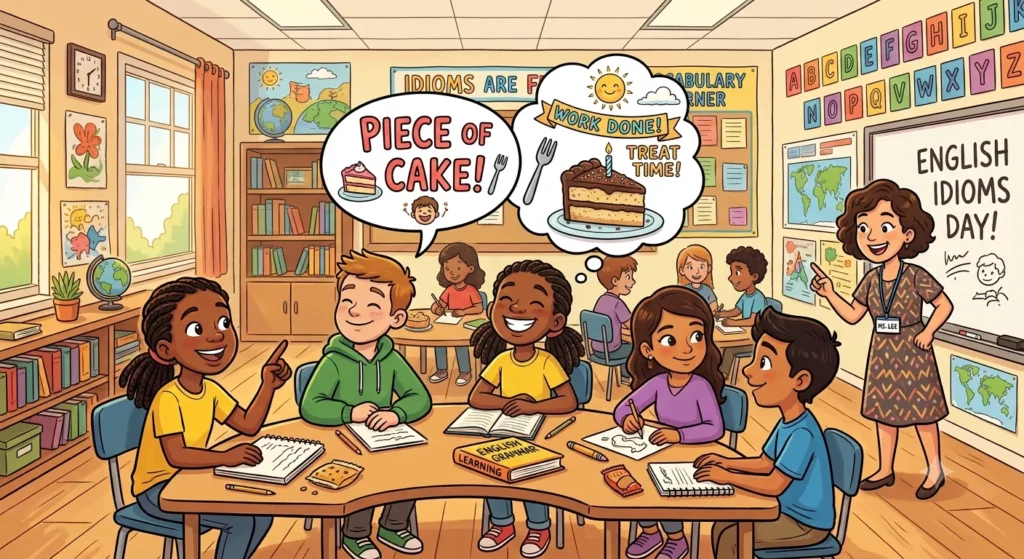
Piece of Cake
Word-by-Word Meaning
Piece + of + Cake = A slice of dessert.
Idiomatic Meaning
Something very easy to do.
Example Sentences
- That math test was a piece of cake!
- Learning this new app is a piece of cake once you try.
Common Error
Saying “part of cake” instead of “piece of cake.”
Usage Note
Used in informal conversations; conveys simplicity.
Hit the Books
Word-by-Word Meaning
Hit + the + Books = Literally strike books.
Idiomatic Meaning
To study hard.
Example Sentences
- I need to hit the books before the science exam.
- She hit the books all weekend for her history test.

Common Error
Using it to mean “start reading casually.”
Usage Note
Refers to serious study sessions, mainly in school or college.
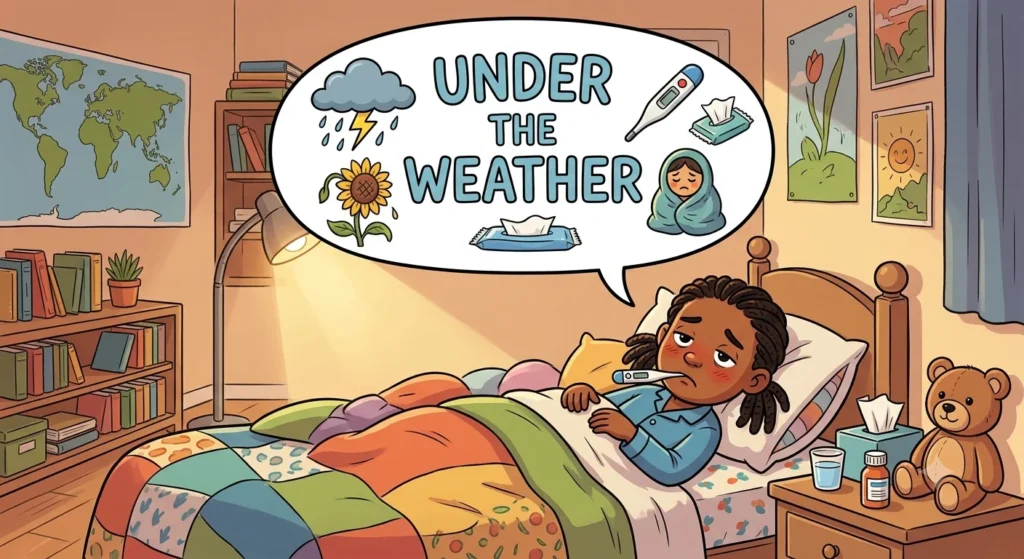
Under the Weather
Word-by-Word Meaning
Under + the + Weather = Literally below the weather.
Idiomatic Meaning
Feeling sick or unwell.
Example Sentences
- I felt under the weather and stayed home from school.
- He’s under the weather today, so he won’t attend class.
Common Error
Using it literally as “below the weather.”
Usage Note
Refers only to health or mood, not actual weather.
Spill the Beans
Word-by-Word Meaning
Spill + the + Beans = To drop actual beans.
Idiomatic Meaning
To reveal a secret.
Example Sentences
- She spilled the beans about the surprise party.
- Don’t spill the beans about the test answers!

Common Error
Saying “drop the beans” instead of “spill the beans.”
Usage Note
Casual idiom often used among friends; emphasizes sharing secrets.
Cost an Arm and a Leg
Word-by-Word Meaning
Cost + an + Arm + and + a + Leg = Extremely expensive body parts.
Idiomatic Meaning
Something very expensive.
Example Sentences
- That new backpack costs an arm and a leg.
- Buying concert tickets cost me an arm and a leg!
Common Error
Saying “cost a leg” or “cost an arm” without the full phrase.
Usage Note
Informal context; emphasizes high price.
Kill Two Birds with One Stone
Word-by-Word Meaning
Kill + Two + Birds + with + One + Stone = Hit two birds at once with a single stone.
Idiomatic Meaning
Accomplish two tasks at the same time.
Example Sentences
- By studying on the bus, I killed two birds with one stone—reviewing notes and commuting.
- She killed two birds with one stone by finishing homework while practicing piano.
Common Error
Using “kill birds with stone” without specifying numbers.
Usage Note
Casual idiom; avoid in sensitive or literal contexts.
Let the Cat Out of the Bag
Word-by-Word Meaning
Let + the + Cat + Out + of + the + Bag = Release a hidden cat.
Idiomatic Meaning
Accidentally reveal a secret.
Example Sentences
- I let the cat out of the bag about the class trip by mistake.
- Don’t let the cat out of the bag about the surprise gift!
Common Error
Confusing it with “spill the beans” (slightly different emphasis).
Usage Note
Highlights accidental disclosure; often used with surprises.
Bite the Bullet
Word-by-Word Meaning
Bite + the + Bullet = Literally bite a bullet.
Idiomatic Meaning
Face a difficult situation bravely.
Example Sentences
- I didn’t want to apologize, but I bit the bullet and said sorry.
- She bit the bullet and presented her project to the class.
Common Error
Thinking it means avoiding something painful.
Usage Note
Encourages courage and acceptance of challenges.
Break a Leg
Word-by-Word Meaning
Break + a + Leg = Literally injure a leg.
Idiomatic Meaning
Good luck, especially before a performance.
Example Sentences
- Break a leg in your school play tonight!
- She told him to break a leg before the speech.
Common Error
Taking it literally as harmful advice.
Usage Note
Supportive idiom used in theatrical or performance contexts.
On Cloud Nine
Word-by-Word Meaning
On + Cloud + Nine = Literally floating on a cloud.
Idiomatic Meaning
Feeling extremely happy.
Example Sentences
- He was on cloud nine after winning the spelling bee.
- I was on cloud nine when my team won the match.
Common Error
Using “on cloud seven” (incorrect number).
Usage Note
Expresses joy and excitement; informal.
A Hot Potato
Word-by-Word Meaning
A + Hot + Potato = Literally a very warm potato.
Idiomatic Meaning
A controversial or difficult issue.
Example Sentences
- The homework schedule became a hot potato among students.
- That topic is a hot potato in our debate class.
Common Error
Using literally instead of figuratively.
Usage Note
Refers to sensitive topics that are hard to handle.
Barking Up the Wrong Tree
Word-by-Word Meaning
Barking + Up + the + Wrong + Tree = Dog barking at the wrong tree.
Idiomatic Meaning
Making a wrong assumption.
Example Sentences
- You’re barking up the wrong tree if you think I took your pencil.
- He was barking up the wrong tree blaming her for the mistake.
Common Error
Using “bark wrong tree” without prepositions.
Usage Note
Used to politely correct someone’s misunderstanding.
Hit the Nail on the Head
Word-by-Word Meaning
Hit + the + Nail + on + the + Head = Literally strike a nail precisely.
Idiomatic Meaning
Be exactly correct.
Example Sentences
- You hit the nail on the head when explaining the science problem.
- Her comment about teamwork hit the nail on the head.
Common Error
Saying “hit nail head” without “on the.”
Usage Note
Common in school discussions and essays.
When Pigs Fly
Word-by-Word Meaning
When + Pigs + Fly = Pigs become airborne.
Idiomatic Meaning
Something impossible or extremely unlikely.
Example Sentences
- I’ll clean my room when pigs fly!
- He said he’ll do extra homework when pigs fly.
Common Error
Used literally instead of humorously.
Usage Note
Expresses disbelief or sarcasm; informal.
The Ball is in Your Court
Word-by-Word Meaning
The + Ball + is + in + Your + Court = The ball is physically in your side of the court.
Idiomatic Meaning
It’s your decision or responsibility.
Example Sentences
- I’ve done my part; now the ball is in your court.
- The teacher told him, “The ball is in your court now.”
Common Error
Taking it literally in sports context.
Usage Note
Used in decision-making situations.
Cut to the Chase
Word-by-Word Meaning
Cut + to + the + Chase = Move directly to the final scene in a movie.
Idiomatic Meaning
Skip unnecessary details.
Example Sentences
- Let’s cut to the chase—what’s the final answer?
- She cut to the chase during the debate.
Common Error
Saying “cut the chase” instead of “cut to the chase.”
Usage Note
Informal; used to save time.
Elephant in the Room
Word-by-Word Meaning
Elephant + in + the + Room = A huge elephant occupying space.
Idiomatic Meaning
An obvious problem being ignored.
Example Sentences
- The broken projector was the elephant in the room during class.
- Everyone avoided the elephant in the room about homework.
Common Error
Literal interpretation instead of figurative.
Usage Note
Used to point out unspoken issues tactfully.
Cry Over Spilled Milk
Word-by-Word Meaning
Cry + Over + Spilled + Milk = Be sad about milk that fell.
Idiomatic Meaning
Don’t worry about past mistakes.
Example Sentences
- It’s just one question wrong; don’t cry over spilled milk.
- We missed the bus, but there’s no point crying over spilled milk.
Common Error
Using “spill the milk” as the idiom.
Usage Note
Encourages moving on from mistakes; informal.
Actions Speak Louder Than Words
Word-by-Word Meaning
Actions + Speak + Louder + Than + Words = What you do is louder than what you say.
Idiomatic Meaning
What you do is more important than what you say.
Example Sentences
- Helping others shows you care—actions speak louder than words.
- He promised to help, but actions speak louder than words.
Common Error
Saying “words speak louder than actions” (opposite meaning).
Usage Note
Universal; can be used formally and informally.
FAQs About Middle School Idioms
Q1: Why learn middle school idioms?
A: Idioms improve English fluency, comprehension, and make conversations fun.
Q2: How can students remember idioms quickly?
A: Use flashcards, daily practice, storytelling, or classroom games.
Q3: Can idioms be used in essays?
A: Yes, choose neutral or appropriate idioms to enhance writing.
Q4: Are idioms the same in all English-speaking countries?
A: Some idioms differ; always check context before using.
Q5: How do I avoid mistakes with idioms?
A: Learn correct phrasing, check examples, and practice regularly.
Conclusion
Middle school idioms are like secret keys to sounding smart, witty, and confident in English. Start using one idiom a day, in class discussions or casual conversations, and soon you’ll naturally sprinkle them into your speech and writing. The more you practice, the easier it becomes!

Adrian Wells, author at SeekIdiom, shares easy explanations of English idioms with examples to help learners expand vocabulary and speak more confidently.