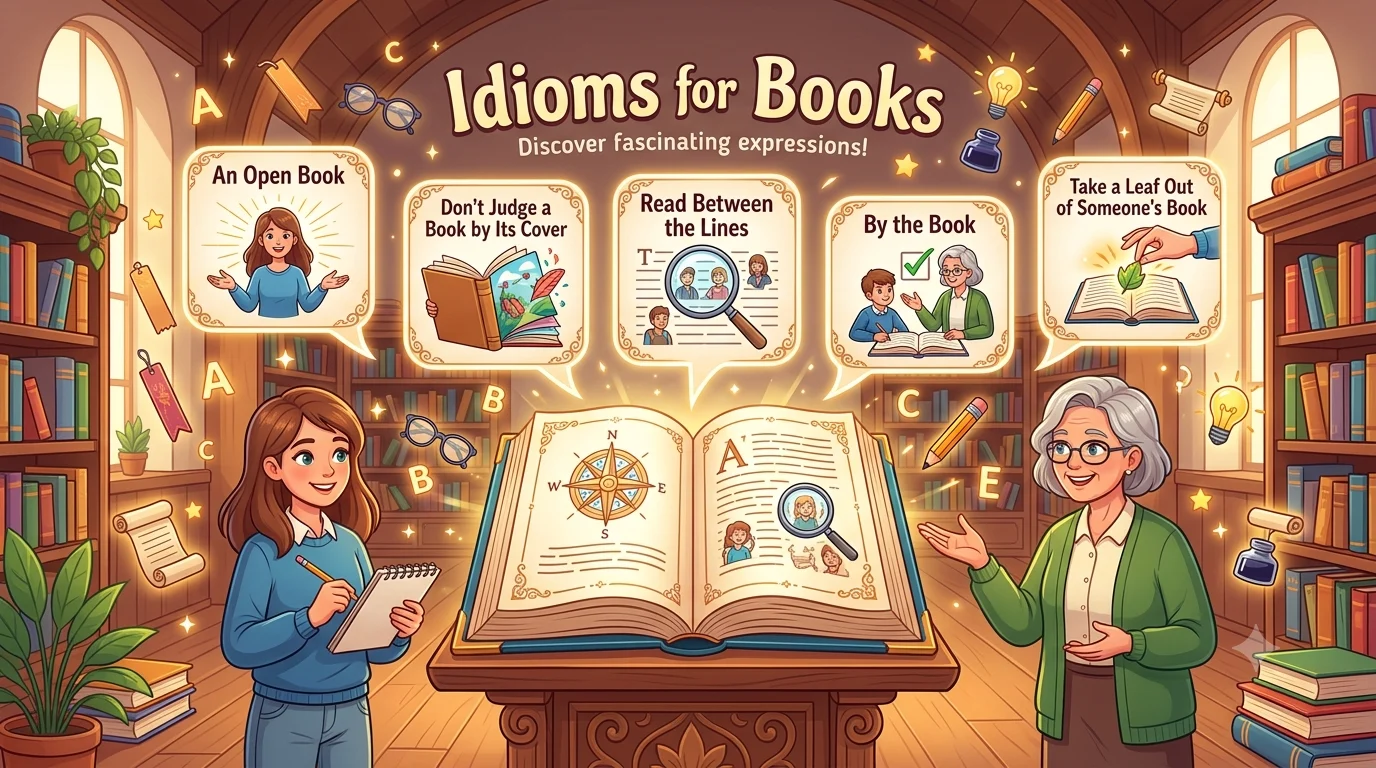
Books shape how we think, speak, and express ideas—and English reflects that beautifully.
This complete guide to idioms for books explains the most famous book-related expressions with simple meanings and real-life examples, so you can use them confidently in speaking and writing.
If you love reading or learning English, this article is written for you.
Why Learn Idioms for Books?
Idioms for books are commonly used in:
- Daily conversations
- Academic writing
- Literature discussions
- Exams and interviews
Understanding these idioms helps you sound fluent, natural, and expressive.
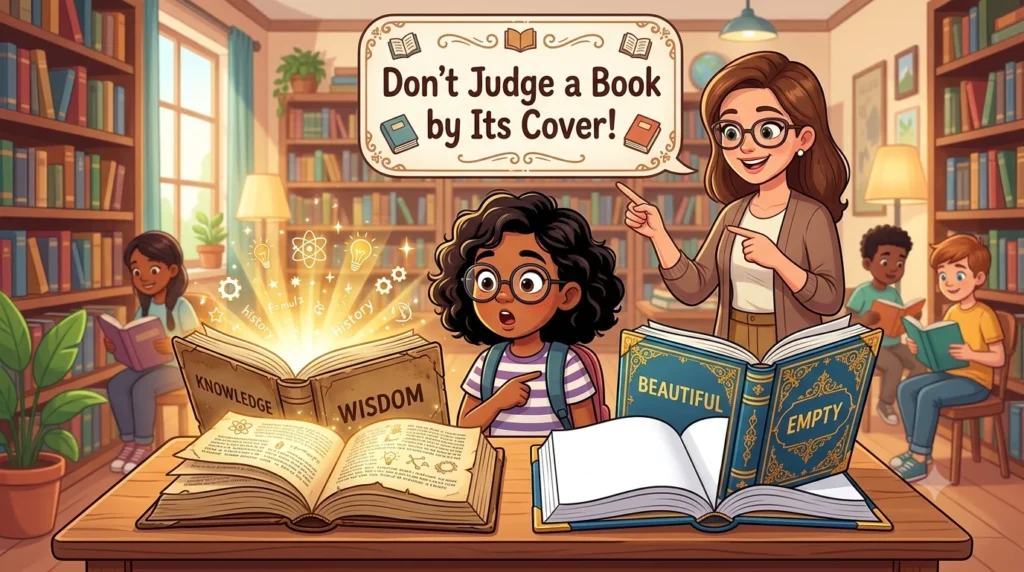
Don’t Judge a Book by Its Cover
Word-by-word meaning:
Do not decide the value of a book only by its outer cover.
Idiomatic / figurative meaning:
Do not judge a person or thing by appearance alone.
Example sentences:
- She seems shy, but don’t judge a book by its cover.
- That movie looked boring, but it was amazing—never judge a book by its cover.
Common error:
❌ Using it only for books, not people or situations.
Usage note:
Used as advice or moral lesson.
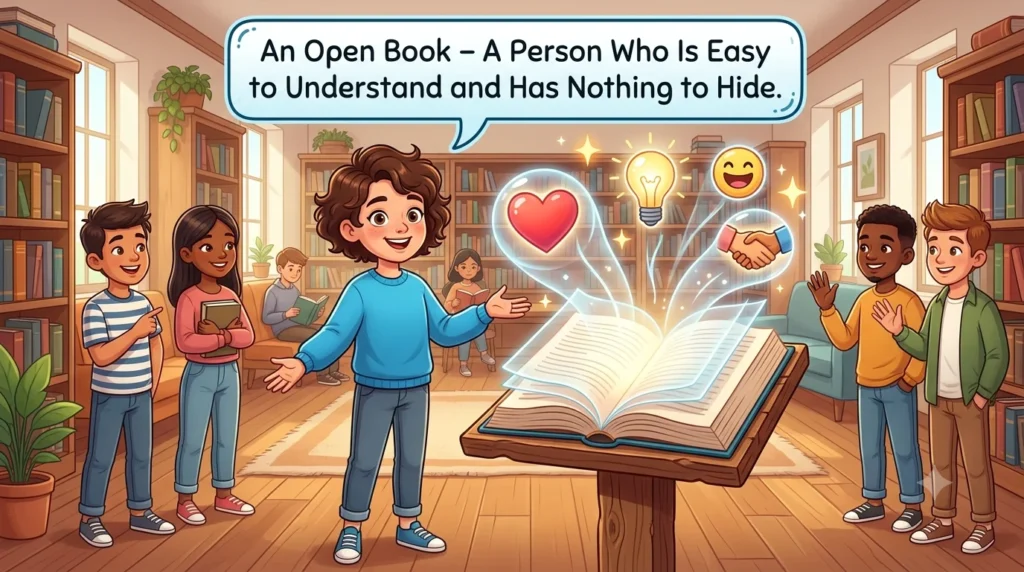
An Open Book
Word-by-word meaning:
A book that is open and easy to read.
Idiomatic / figurative meaning:
A person who is honest and easy to understand.
Example sentences:
- He’s an open book; he shares everything.
- Her feelings are an open book.
Common error:
❌ Using it for objects instead of people.
Usage note:
Describes personality or transparency.
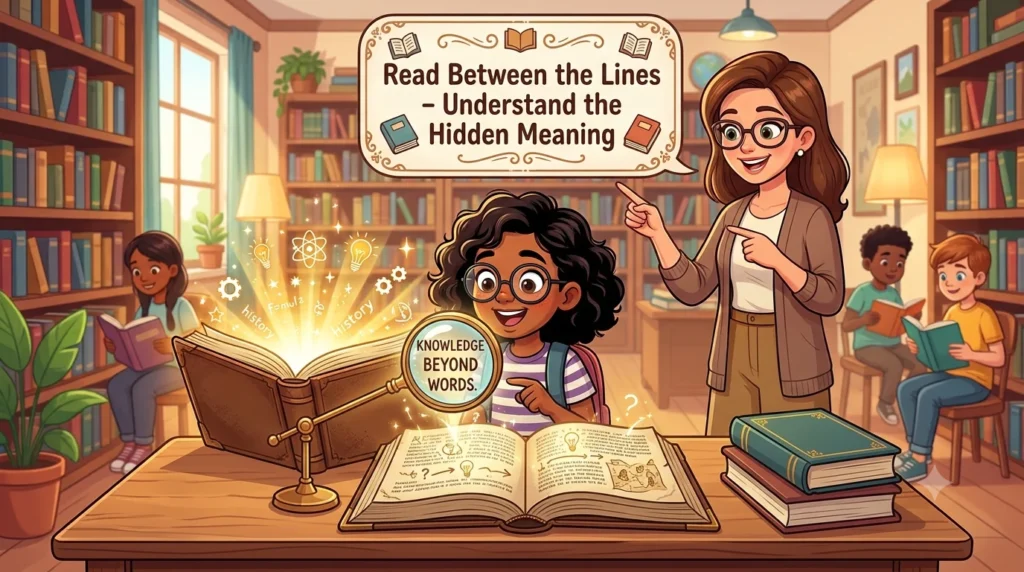
Read Between the Lines
Word-by-word meaning:
Read the space between written lines.
Idiomatic / figurative meaning:
Understand the hidden or indirect meaning.
Example sentences:
- Read between the lines of his message.
- The report sounds positive, but read between the lines.
Common error:
❌ Taking statements too literally.
Usage note:
Very common in exams, analysis, and discussions.
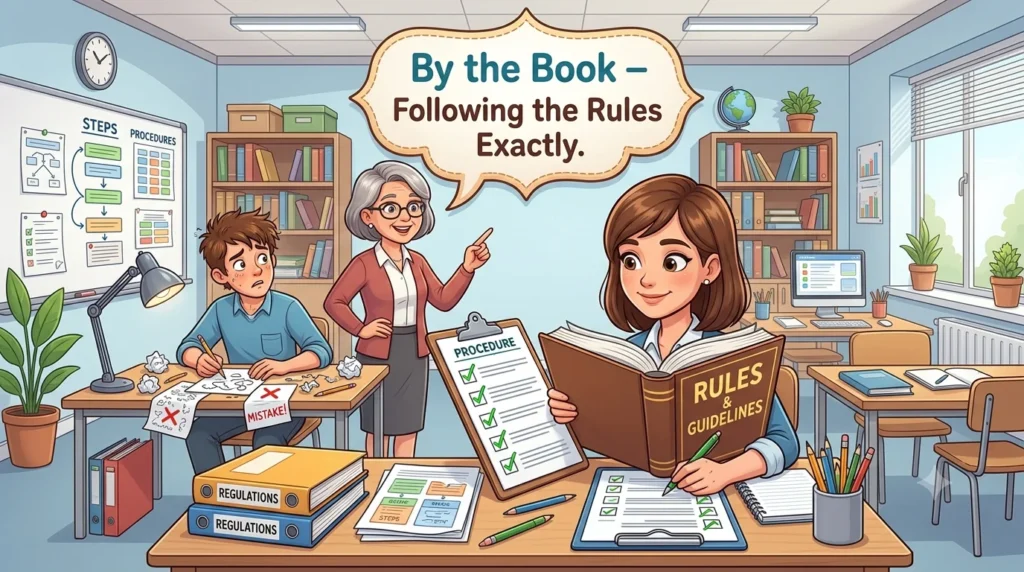
By the Book
Word-by-word meaning:
Following rules written in a book.
Idiomatic / figurative meaning:
Doing something strictly according to rules.
Example sentences:
- The officer works by the book.
- She follows procedures by the book.
Common error:
❌ Using it for casual situations.
Usage note:
Often used in formal or official contexts.
In Someone’s Good Books
Word-by-word meaning:
Being listed positively in someone’s records.
Idiomatic / figurative meaning:
Being liked or approved by someone.
Example sentences:
- He’s in the teacher’s good books.
- Hard work keeps you in your boss’s good books.
Common error:
❌ Confusing it with academic grades.
Usage note:
Informal and conversational.
In Someone’s Bad Books
Word-by-word meaning:
Being recorded negatively.
Idiomatic / figurative meaning:
Being disliked or disapproved of.
Example sentences:
- He’s in her bad books after lying.
- Missing deadlines put him in the boss’s bad books.
Common error:
❌ Using it in very formal writing.
Usage note:
Opposite of good books.
Bookworm
Word-by-word meaning:
A worm that eats books.
Idiomatic / figurative meaning:
A person who loves reading.
Example sentences:
- She’s a total bookworm.
- Bookworms enjoy libraries.
Common error:
❌ Thinking it’s an insult.
Usage note:
Friendly and positive term.
Throw the Book at Someone
Word-by-word meaning:
Throw a book at a person.
Idiomatic / figurative meaning:
Punish someone very severely.
Example sentences:
- The judge threw the book at the criminal.
- They threw the book at him for cheating.
Common error:
❌ Taking it literally.
Usage note:
Legal or serious situations.
Cook the Books
Word-by-word meaning:
Prepare books dishonestly.
Idiomatic / figurative meaning:
Falsify financial records.
Example sentences:
- The company was caught cooking the books.
- He went to jail for cooking the books.
Common error:
❌ Using it for cooking or food.
Usage note:
Business and finance context.
Close the Book on Something
Word-by-word meaning:
Shut the book completely.
Idiomatic / figurative meaning:
End something permanently.
Example sentences:
- Let’s close the book on the past.
- The case is closed; the book is shut.
Common error:
❌ Using it for temporary endings.
Usage note:
Final decisions or endings.
One for the Books
Word-by-word meaning:
Worth recording in a book.
Idiomatic / figurative meaning:
Something memorable or remarkable.
Example sentences:
- That match was one for the books.
- Her performance was one for the books.
Common error:
❌ Using it for ordinary events.
Usage note:
Positive emphasis.
Read Someone Like a Book
Word-by-word meaning:
Read a person like written text.
Idiomatic / figurative meaning:
Understand someone easily.
Example sentences:
- I can read him like a book.
- She read my emotions like a book.
Common error:
❌ Using it for objects.
Usage note:
Used in emotional contexts.
A Closed Book
Word-by-word meaning:
A book that cannot be read.
Idiomatic / figurative meaning:
Something hard to understand.
Example sentences:
- Mathematics is a closed book to me.
- That topic is a closed book for beginners.
Common error:
❌ Confusing with open book.
Usage note:
Common in education.
Take a Leaf Out of Someone’s Book
Word-by-word meaning:
Take a page from someone’s book.
Idiomatic / figurative meaning:
Imitate someone’s good example.
Example sentences:
- Take a leaf out of her book and study daily.
- He took a leaf out of his mentor’s book.
Common error:
❌ Using “page” instead of “leaf” (both acceptable, but leaf is traditional).
Usage note:
Advice or encouragement.
The Oldest Trick in the Book
Word-by-word meaning:
A trick written long ago.
Idiomatic / figurative meaning:
A very common or overused trick.
Example sentences:
- That excuse is the oldest trick in the book.
- He tried the oldest trick in the book.
Common error:
❌ Using it for new ideas.
Usage note:
Often humorous or sarcastic.
Write the Book on Something
Word-by-word meaning:
Write a complete book on a topic.
Idiomatic / figurative meaning:
Be an expert in something.
Example sentences:
- She could write the book on psychology.
- He wrote the book on leadership.
Common error:
❌ Taking it literally.
Usage note:
Praise or admiration.
Book Smart
Word-by-word meaning:
Smart because of books.
Idiomatic / figurative meaning:
Knowledgeable through study, not experience.
Example sentences:
- He’s book smart but lacks experience.
- Book-smart students need practical skills.
Common error:
❌ Assuming it’s always negative.
Usage note:
Neutral to slightly critical.
In Black and White
Word-by-word meaning:
Written clearly in black ink.
Idiomatic / figurative meaning:
Clearly written or stated.
Example sentences:
- The rules are in black and white.
- It’s written in black and white.
Common error:
❌ Using it for opinions.
Usage note:
Documents and rules.
Balance the Books
Word-by-word meaning:
Make book accounts equal.
Idiomatic / figurative meaning:
Make finances correct.
Example sentences:
- The accountant balanced the books.
- We must balance the books this year.
Common error:
❌ Using it for personal diaries.
Usage note:
Finance and business English.
By the Same Token
Word-by-word meaning:
By the same sign or symbol.
Idiomatic / figurative meaning:
For the same reason.
Example sentences:
- Reading improves focus; by the same token, it improves memory.
- She’s kind; by the same token, she’s patient.
Common error:
❌ Using it without logical connection.
Usage note:
Formal and academic tone.
❓ FAQs About Idioms for Books
1. What are idioms for books?
They are expressions related to books with figurative meanings.
2. Are these idioms useful for exams?
Yes, especially in essays, comprehension, and speaking tests.
3. Can beginners learn book idioms?
Yes, start with common ones like bookworm and open book.
4. Are book idioms formal or informal?
Both—usage depends on context.
5. How can I practice these idioms?
Use them in sentences, stories, or daily conversation.
🌟 Conclusion
Learning idioms for books opens a new chapter in your English journey.
Practice a few daily, use them naturally, and soon your language skills will be one for the books 📚✨.

Adrian Wells, author at SeekIdiom, shares easy explanations of English idioms with examples to help learners expand vocabulary and speak more confidently.