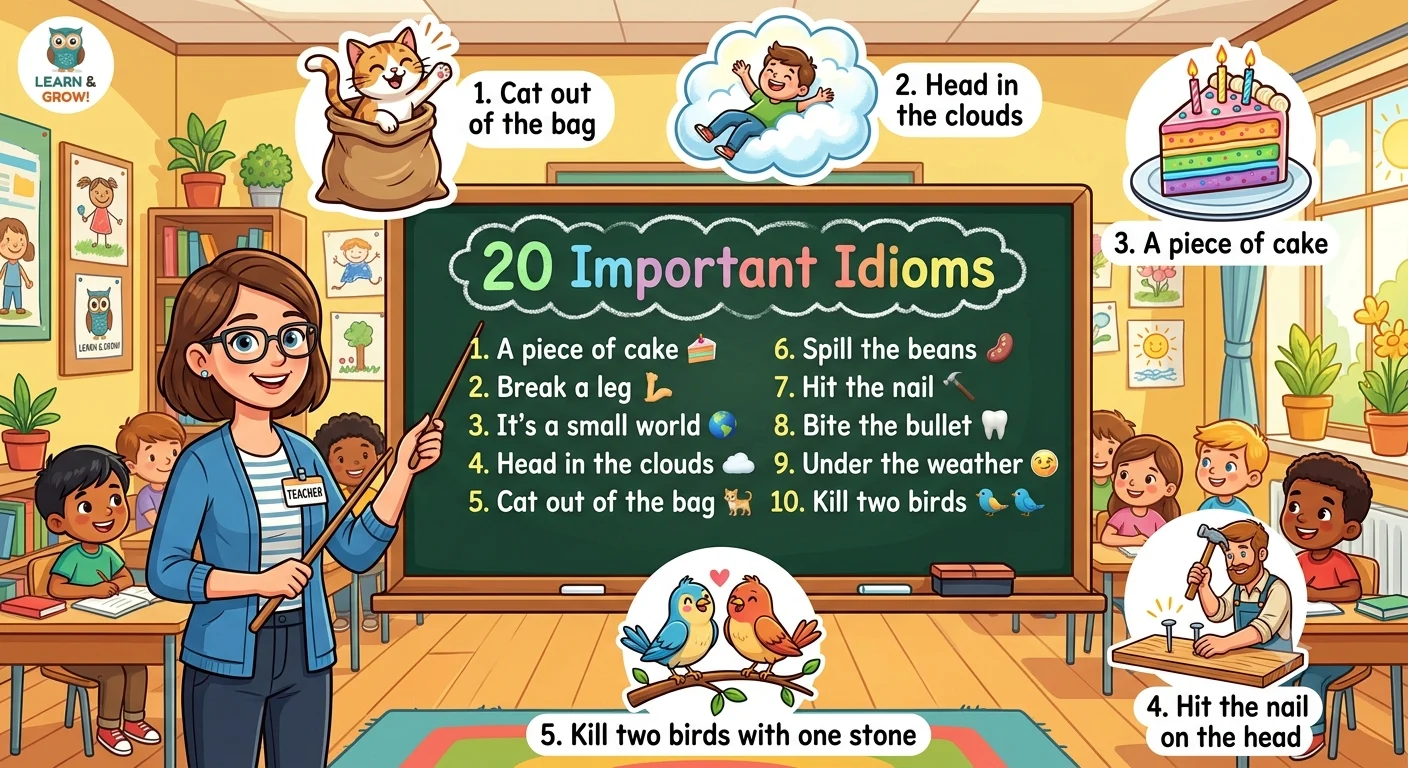
Idioms are the secret sauce of fluent English. Imagine trying to express excitement by saying, “I am extremely happy” every time—boring, right? Using idioms like “on cloud nine” instantly makes your speech lively and natural. In this guide, we’ll explore 20 important idioms, their meanings, examples, and common usage mistakes so you can start speaking English like a native.
Break the Ice
Word-by-Word Meaning
Break = destroy; Ice = frozen water
Idiomatic/Figurative Meaning
To initiate conversation in a social setting and make people comfortable.

Example Sentences
- She told a funny story to break the ice at the meeting.
- I tried to break the ice with a joke, and everyone laughed.
Common Error
Don’t use literally; “break the ice” is rarely about actual ice.
Usage Note
Use in professional and casual settings when starting a conversation.
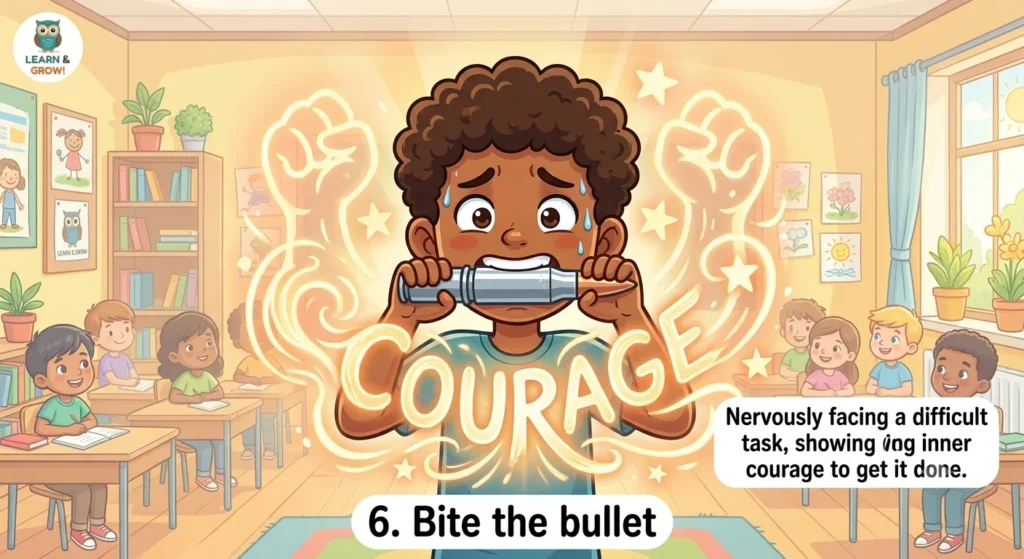
Bite the Bullet
Word-by-Word Meaning
Bite = use teeth; Bullet = ammunition
Idiomatic/Figurative Meaning
To face a difficult or unpleasant situation bravely.
Example Sentences
- I didn’t want to apologize, but I had to bite the bullet.
- She bit the bullet and started her presentation despite being nervous.
Common Error
Not “bite a bullet” – always singular.
Usage Note
Often used when one must endure pain, fear, or discomfort.
Piece of Cake
Word-by-Word Meaning
Piece = part; Cake = dessert
Idiomatic/Figurative Meaning
Something very easy to do.

Example Sentences
- The exam was a piece of cake.
- Don’t worry about the project; it’s a piece of cake.
Common Error
Avoid using for things that are difficult—idiom loses its meaning.
Usage Note
Informal; great for casual conversations.
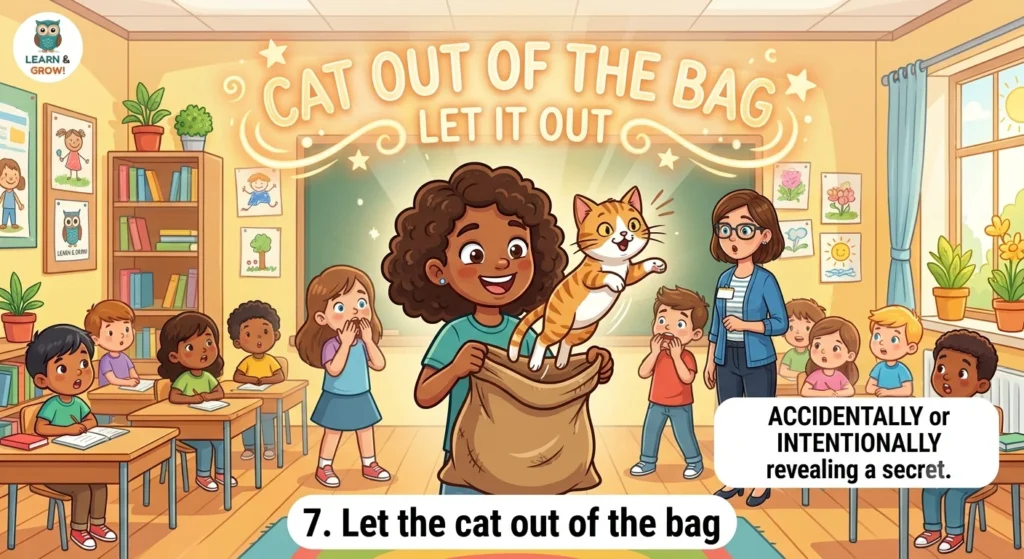
Let the Cat Out of the Bag
Word-by-Word Meaning
Let = allow; Cat = animal; Bag = container
Idiomatic/Figurative Meaning
To reveal a secret accidentally or intentionally.
Example Sentences
- He let the cat out of the bag about the surprise party.
- Don’t let the cat out of the bag before the meeting.
Common Error
Misused as literally letting an animal out—never literal.
Usage Note
Used in social or professional contexts when talking about secrets.
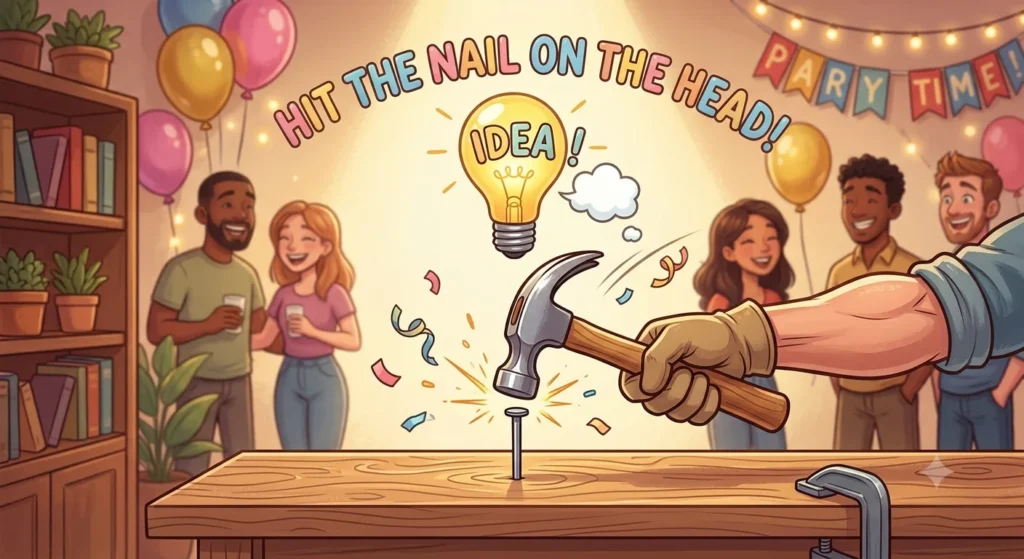
Hit the Nail on the Head
Word-by-Word Meaning
Hit = strike; Nail = fastener; Head = top
Idiomatic/Figurative Meaning
To describe something exactly right; to be precise.
Example Sentences
- You hit the nail on the head with your analysis.
- She hit the nail on the head when she said communication was key.
Common Error
Don’t say “hit the nail in the head” – preposition changes meaning.
Usage Note
Common in discussions, presentations, and problem-solving contexts.
When Pigs Fly
Word-by-Word Meaning
When = at the time; Pigs = animal; Fly = move through air
Idiomatic/Figurative Meaning
Something that will never happen.
Example Sentences
- I’ll clean my room when pigs fly.
- He’ll apologize? Yeah, when pigs fly.
Usage Note
Informal, humorous idiom.
Kill Two Birds with One Stone
Word-by-Word Meaning
Kill = end life; Birds = animals; Stone = rock
Idiomatic/Figurative Meaning
To accomplish two tasks with one effort.
Example Sentences
- By reading while commuting, I kill two birds with one stone.
- The new software helps us kill two birds with one stone: save time and reduce errors.
Usage Note
Avoid literal interpretation; use metaphorically.
Under the Weather
Word-by-Word Meaning
Under = beneath; Weather = atmospheric conditions
Idiomatic/Figurative Meaning
Feeling ill or sick.
Example Sentences
- I’m feeling under the weather today, so I’ll stay home.
- She was under the weather last week.
Usage Note
Casual, often used in everyday conversations.
The Ball is in Your Court
Word-by-Word Meaning
Ball = sports object; Court = playing area
Idiomatic/Figurative Meaning
It’s your responsibility to make the next decision or take action.
Example Sentences
- I’ve done my part; now the ball is in your court.
- The proposal is ready; the ball is in your court.
Usage Note
Common in business and personal decision-making contexts.
Barking Up the Wrong Tree
Word-by-Word Meaning
Barking = dog sound; Wrong tree = incorrect tree
Idiomatic/Figurative Meaning
Accusing or blaming the wrong person; pursuing the wrong idea.
Example Sentences
- If you think I’m guilty, you’re barking up the wrong tree.
- She’s barking up the wrong tree by asking me for help.
Usage Note
Informal; often used in disagreements or corrections.
A Blessing in Disguise
Word-by-Word Meaning
Blessing = good thing; Disguise = hiding
Idiomatic/Figurative Meaning
Something that seems bad but turns out good.
Example Sentences
- Losing that job was a blessing in disguise.
- The rain was a blessing in disguise, saving us from the heat.
Add Fuel to the Fire
Word-by-Word Meaning
Add = put more; Fuel = combustible; Fire = flames
Idiomatic/Figurative Meaning
To worsen a bad situation.
Example Sentences
- His rude comments only added fuel to the fire.
- Don’t argue now; it’ll add fuel to the fire.
Cost an Arm and a Leg
Word-by-Word Meaning
Cost = require payment; Arm and Leg = body parts
Idiomatic/Figurative Meaning
Very expensive.
Example Sentences
- That designer bag cost an arm and a leg.
- Traveling abroad costs an arm and a leg these days.
Cry Over Spilled Milk
Word-by-Word Meaning
Cry = weep; Spilled milk = milk on the floor
Idiomatic/Figurative Meaning
To worry about something that cannot be changed.
Example Sentences
- Don’t cry over spilled milk; focus on solutions.
- She was crying over spilled milk after losing the game.
Devil’s Advocate
Word-by-Word Meaning
Devil = evil being; Advocate = supporter
Idiomatic/Figurative Meaning
To argue against a point for the sake of discussion.
Example Sentences
- I played devil’s advocate to explore all options.
- Sometimes it’s good to be devil’s advocate in debates.
Hit the Sack
Word-by-Word Meaning
Hit = strike; Sack = bed
Idiomatic/Figurative Meaning
To go to sleep.
Example Sentences
- I’m exhausted; time to hit the sack.
- After the trip, he hit the sack immediately.
In Hot Water
Word-by-Word Meaning
In = inside; Hot water = heated H2O
Idiomatic/Figurative Meaning
In trouble or facing difficulties.
Example Sentences
- He found himself in hot water for missing the deadline.
- I’m in hot water after forgetting her birthday.
Jump on the Bandwagon
Word-by-Word Meaning
Jump = leap; Bandwagon = wagon with band
Idiomatic/Figurative Meaning
To follow a trend or popular activity.
Example Sentences
- Many brands jump on the bandwagon of eco-friendly products.
- Don’t jump on the bandwagon without understanding it.
Burn the Midnight Oil
Word-by-Word Meaning
Burn = consume; Midnight = 12 AM; Oil = fuel
Idiomatic/Figurative Meaning
To work late at night.
Example Sentences
- She burned the midnight oil to finish the project.
- I have to burn the midnight oil for exams.
On Cloud Nine
Word-by-Word Meaning
Cloud = atmospheric mass; Nine = number
Idiomatic/Figurative Meaning
Extremely happy or delighted.
Example Sentences
- He was on cloud nine after getting the promotion.
- She’s been on cloud nine since the engagement.
FAQs About Important Idioms
Q1: How can I remember idioms easily?
A: Use them in daily conversations, write sentences, or make flashcards.
Q2: Can idioms be used in formal writing?
A: Some idioms are suitable for essays or articles, but avoid overly casual ones.
Q3: Are idioms same in all English-speaking countries?
A: Most are universal, but some vary by region (UK vs. US).
Q4: How do I avoid misusing idioms?
A: Learn their figurative meanings and example sentences carefully.
Q5: How many idioms should I learn at a time?
A: Focus on 5–10 idioms per week for effective retention.
Conclusion
Idioms are more than just phrases—they bring life, color, and authenticity to your English. Start using these 20 important idioms in daily conversations, and watch your communication skills soar. Practice, experiment, and don’t be afraid to make mistakes—every attempt brings mastery closer!

Sophie Langford, author at SeekIdiom, explains English idioms with clear meanings, examples, and usage to help learners improve vocabulary and communication.