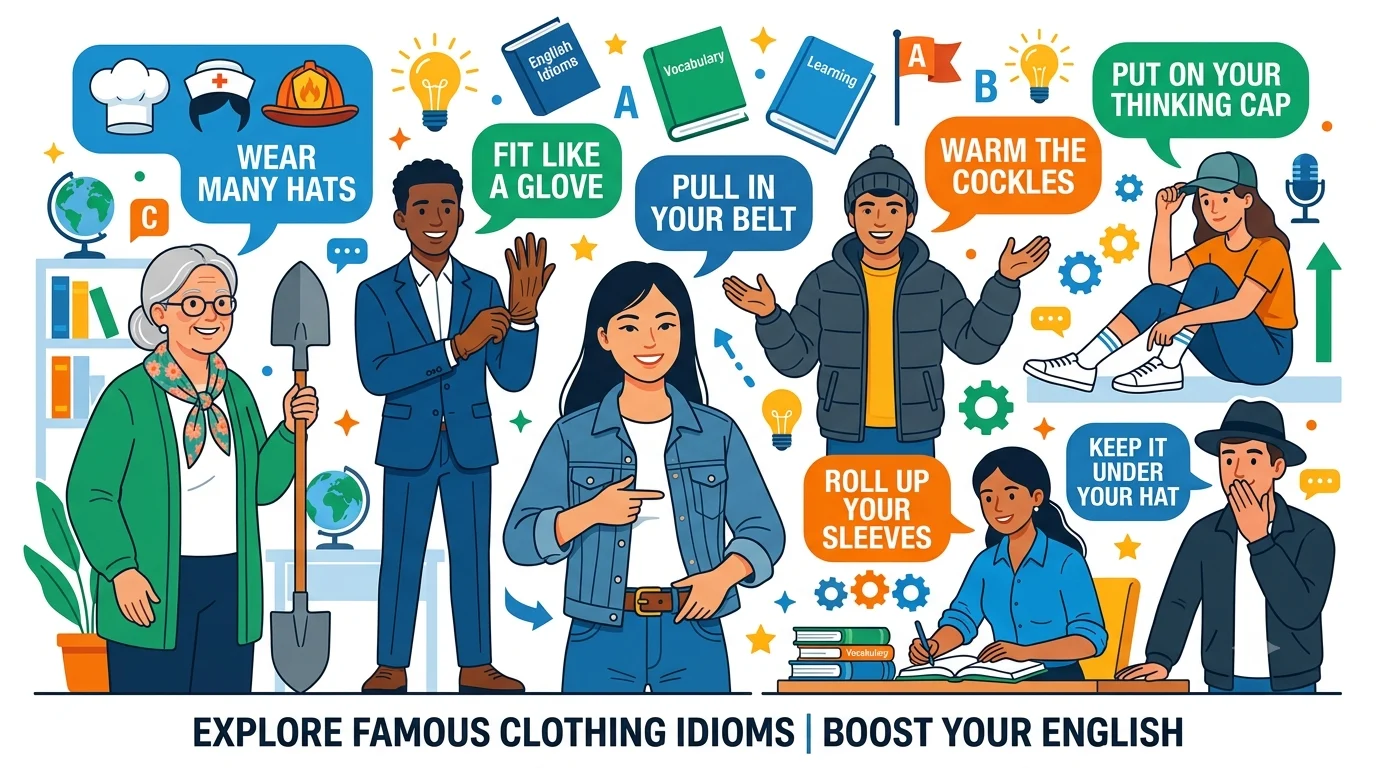
Have you ever heard someone say “fit like a glove” or “roll up your sleeves” and wondered what they really meant? Clothing-related idioms are some of the most common expressions in English, and understanding them can make everyday conversations, movies, books, and workplace discussions much easier to follow.
Imagine your friend saying, “It’s time to roll up our sleeves,” before starting a group project. They aren’t talking about clothes—they’re encouraging everyone to work hard. That’s the magic of idioms! In this guide, you’ll learn the 20 most popular clothing-related idioms, their meanings, examples, common mistakes, and practical tips for using them naturally.
What Are Clothing-Related Idioms?
Clothing-related idioms are expressions that use clothing or fashion items to communicate ideas that are different from their literal meanings. Instead of referring to actual clothes, they describe emotions, situations, behaviors, personalities, or experiences.
For example:
- Wear many hats = Have multiple responsibilities.
- Keep it under your hat = Keep something secret.
- Pull up your socks = Improve your effort.
These idioms make English more colorful, expressive, and engaging.
Why Clothing-Related Idioms Matter in English
Learning these idioms helps you communicate like a native speaker. They appear in daily conversations, TV shows, business meetings, books, and social media.
Benefits of Learning Clothing Idioms
- Improve speaking fluency
- Understand native speakers better
- Sound more natural in conversations
- Expand your English vocabulary
- Express ideas in a creative way
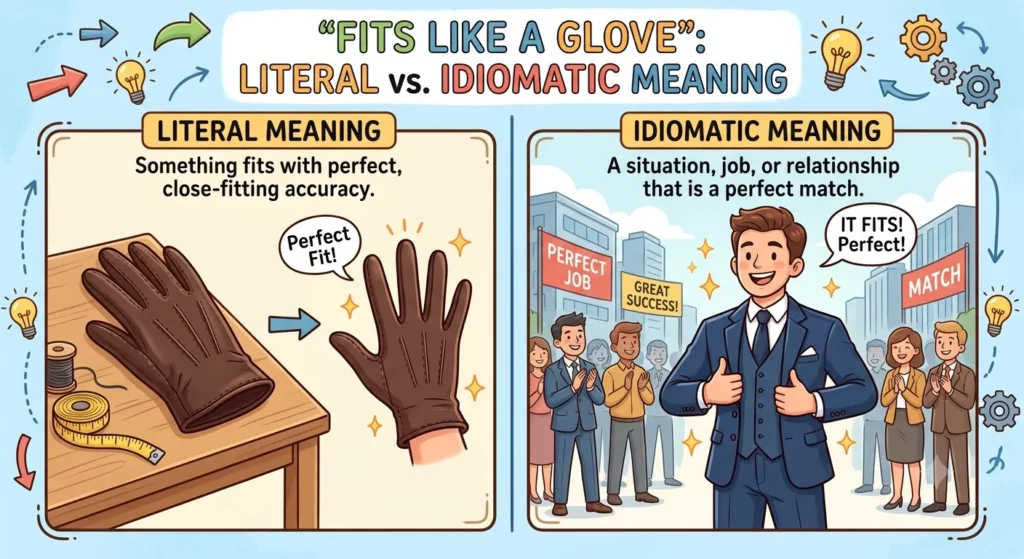
1. Fit Like a Glove
Word-by-word meaning: Fits perfectly, like a glove on a hand.
Idiomatic meaning: Something suits or fits perfectly.
Example sentences:
- This dress fits like a glove.
- His new job fits him like a glove.
Common error:
Using it only for physical clothing.
Usage note:
It can describe clothes, jobs, roles, relationships, or situations that are an excellent match.
2. Roll Up Your Sleeves
Word-by-word meaning: Pull your sleeves upward.
Idiomatic meaning: Prepare to work hard.
Example sentences:
- Let’s roll up our sleeves and finish the project.
- It’s time to roll up our sleeves and solve this problem.

Common error:
Thinking it’s only about clothing.
Usage note:
Very common in workplaces, schools, and motivational speeches.
3. Wear Many Hats
Word-by-word meaning: Wear several different hats.
Idiomatic meaning: Have many responsibilities or roles.
Example sentences:
- As a small business owner, she wears many hats.
- Parents often wear many hats every day.

Common error:
Interpreting it as wearing actual hats.
Usage note:
Frequently used in business and leadership contexts.
4. Tighten Your Belt
Word-by-word meaning: Make your belt tighter.
Idiomatic meaning: Reduce spending because money is limited.
Example sentences:

- We need to tighten our belts this month.
- Many families tightened their belts during the recession.
Common error:
Using it to describe dieting or weight loss.
Usage note:
Used almost exclusively for financial situations.
5. Under One’s Belt
Word-by-word meaning: Under the belt.
Idiomatic meaning: Having experience or an achievement completed.
Example sentences:
- She has ten years of teaching under her belt.
- With several successful projects under his belt, he felt confident.

Common error:
Confusing it with below the belt.
Usage note:
Usually refers to skills, accomplishments, or experience.
6. Below the Belt
Word-by-word meaning: Below the waist.
Idiomatic meaning: Unfair, insulting, or offensive.
Example sentences:
- That criticism was below the belt.
- His joke was really below the belt.
Common error:
Mixing it up with sports terminology.
Usage note:
Often used during disagreements or debates.
7. Put Yourself in Someone’s Shoes
Word-by-word meaning: Wear another person’s shoes.
Idiomatic meaning: Imagine how another person feels.
Example sentences:
- Try putting yourself in her shoes.
- Put yourself in his shoes before judging him.
Common error:
Saying on someone’s shoes.
Usage note:
Perfect for showing empathy and understanding.
8. Fill Someone’s Shoes
Word-by-word meaning: Wear another person’s shoes.
Idiomatic meaning: Successfully replace someone.
Example sentences:
- It’ll be difficult to fill her shoes.
- No one can truly fill his shoes.
Common error:
Confusing it with the previous idiom.
Usage note:
Usually used after someone retires or leaves an important role.
9. Dressed to Kill
Word-by-word meaning: Extremely well dressed.
Idiomatic meaning: Looking exceptionally stylish.
Example sentences:
- She was dressed to kill at the party.
- Everyone was dressed to kill for the awards ceremony.
Common error:
Assuming it has anything to do with violence.
Usage note:
A compliment about someone’s appearance.
10. Button Up
Word-by-word meaning: Fasten the buttons.
Idiomatic meaning: Finish something carefully or stay quiet.
Example sentences:
- Let’s button up the report before sending it.
- Button up until the meeting is over.
Common error:
Thinking it only refers to clothing.
Usage note:
Common in informal American English.
11. Straighten Up Your Act
Word-by-word meaning: Improve your posture or appearance.
Idiomatic meaning: Improve your behavior.
Example sentences:
- You need to straighten up your act.
- He finally straightened up his act after college.
Common error:
Taking it literally.
Usage note:
Usually given as advice or criticism.
12. At the Drop of a Hat
Word-by-word meaning: The moment a hat drops.
Idiomatic meaning: Immediately or without hesitation.
Example sentences:
- I’d help you at the drop of a hat.
- She would travel at the drop of a hat.
Common error:
Adding unnecessary words.
Usage note:
Common in casual conversations.
13. Old Hat
Word-by-word meaning: An old hat.
Idiomatic meaning: Something outdated or no longer interesting.
Example sentences:
- That marketing strategy is old hat.
- DVDs are old hat for many people.
Common error:
Using it to describe an elderly person.
Usage note:
Informal expression.
14. Wear Your Heart on Your Sleeve
Word-by-word meaning: Heart displayed on your sleeve.
Idiomatic meaning: Show emotions openly.
Example sentences:
- She wears her heart on her sleeve.
- He’s never afraid to show how he feels.
Common error:
Using the wrong preposition.
Usage note:
Describes honest and emotional personalities.
15. Keep It Under Your Hat
Word-by-word meaning: Hide something under a hat.
Idiomatic meaning: Keep a secret.
Example sentences:
- Keep this under your hat.
- I’ll tell you, but keep it under your hat.
Common error:
Mixing it with under one’s belt.
Usage note:
Friendly, informal English.
16. Pull Up Your Socks
Word-by-word meaning: Pull your socks higher.
Idiomatic meaning: Improve your effort or performance.
Example sentences:
- Pull up your socks and study harder.
- The team needs to pull up its socks.
Common error:
Using only the literal meaning.
Usage note:
Very common in British English.
17. Suit Yourself
Word-by-word meaning: Wear what suits you.
Idiomatic meaning: Do whatever you want.
Example sentences:
- If you don’t want to come, suit yourself.
- Suit yourself—it’s your decision.
Common error:
Thinking it’s about clothing.
Usage note:
Can sound polite or slightly sarcastic depending on tone.
18. Cloak-and-Dagger
Word-by-word meaning: Wearing cloaks and carrying daggers.
Idiomatic meaning: Secretive or mysterious behavior.
Example sentences:
- Their negotiations were very cloak-and-dagger.
- It sounded like a cloak-and-dagger operation.
Common error:
Using it for ordinary private conversations.
Usage note:
Often used in politics, crime, or spy stories.
19. In Someone’s Pocket
Word-by-word meaning: Inside someone’s pocket.
Idiomatic meaning: Completely under someone’s control.
Example sentences:
- The official had several companies in his pocket.
- They claimed the judge was in the politician’s pocket.
Common error:
Interpreting it literally.
Usage note:
Often used when discussing influence, corruption, or power.
20. The Shoe Is on the Other Foot
Word-by-word meaning: Shoes have been switched.
Idiomatic meaning: The situation has completely reversed.
Example sentences:
- Now the shoe is on the other foot.
- After years of teaching, he became the student—the shoe was on the other foot.
Common error:
Saying the shoe is on the other leg.
Usage note:
Common in storytelling and discussions about changing circumstances.
Quick Reference Table
| Idiom | Meaning |
|---|---|
| Fit Like a Glove | Perfect fit |
| Roll Up Your Sleeves | Start working hard |
| Wear Many Hats | Have multiple roles |
| Tighten Your Belt | Spend less money |
| Under One’s Belt | Have experience |
| Below the Belt | Unfair or offensive |
| Put Yourself in Someone’s Shoes | Show empathy |
| Fill Someone’s Shoes | Replace someone |
| Dressed to Kill | Look extremely stylish |
| Button Up | Finish or stay quiet |
| Straighten Up Your Act | Improve behavior |
| At the Drop of a Hat | Immediately |
| Old Hat | Outdated |
| Wear Your Heart on Your Sleeve | Show emotions openly |
| Keep It Under Your Hat | Keep a secret |
| Pull Up Your Socks | Try harder |
| Suit Yourself | Do what you want |
| Cloak-and-Dagger | Secretive |
| In Someone’s Pocket | Under someone’s control |
| The Shoe Is on the Other Foot | Situation reversed |
Tips to Remember Clothing-Related Idioms
Learning idioms doesn’t have to be difficult. Try these simple techniques:
- Use one new idiom in conversation every day.
- Create your own example sentences.
- Watch English TV shows and listen for idioms.
- Group idioms by theme, such as clothing, food, or animals.
- Practice with flashcards or language-learning apps.
- Imagine a funny mental picture for each idiom to make it easier to remember.
Frequently Asked Questions
What are clothing-related idioms?
Clothing-related idioms are expressions that use clothing items symbolically rather than literally. Their meanings are different from the actual words used.
Are clothing-related idioms common in everyday English?
Yes. Native English speakers use them regularly in conversations, workplaces, movies, books, and online communication.
Can English learners use idioms in exams?
Absolutely. Using idioms correctly can improve your speaking and writing scores, but they should sound natural and fit the context.
Are clothing idioms the same in every English-speaking country?
Many are shared worldwide, but some are more common in British English or American English.
What’s the best way to remember idioms?
Practice using them in real conversations, connect them to personal experiences, and review them regularly through reading, listening, and speaking.
Conclusion
Mastering clothing-related idioms is one of the easiest ways to make your English sound more natural and confident. These expressions appear in everyday conversations, business meetings, books, movies, and social media, so learning them gives you a real advantage.
Instead of trying to memorize all 20 at once, choose three or four idioms this week and use them in your own conversations. The more you practice, the more naturally they’ll become part of your vocabulary. Before long, these expressions will fit like a glove, helping you communicate with greater confidence and fluency.

Adrian Wells, author at SeekIdiom, shares easy explanations of English idioms with examples to help learners expand vocabulary and speak more confidently.