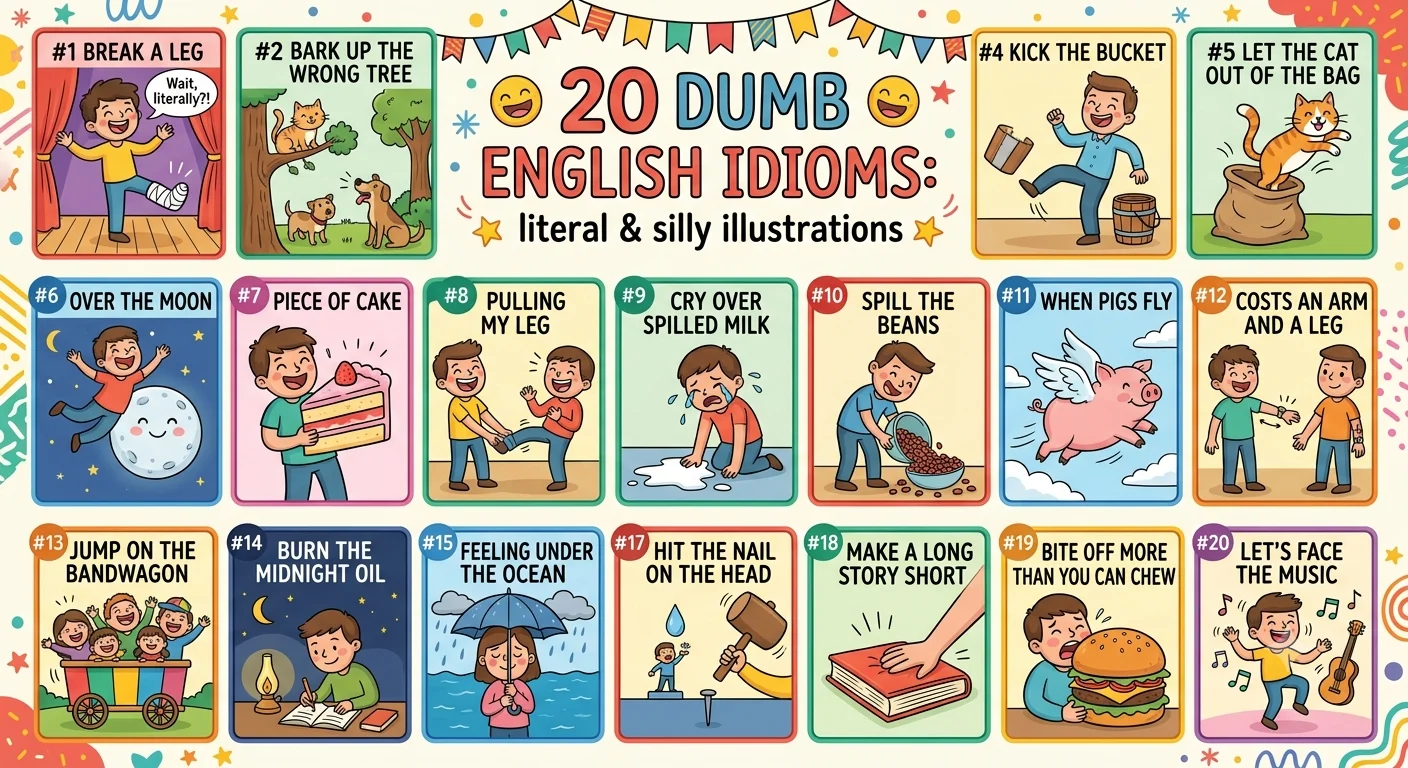
Ever heard someone say, “It’s raining cats and dogs” and wondered, “What does that even mean?” Dumb idioms like this make learning English confusing—but also hilarious! In this post, we’ll explore 20 dumb idioms, break down their literal and figurative meanings, give examples, highlight common errors, and share usage tips. By the end, you’ll use them naturally in conversations.
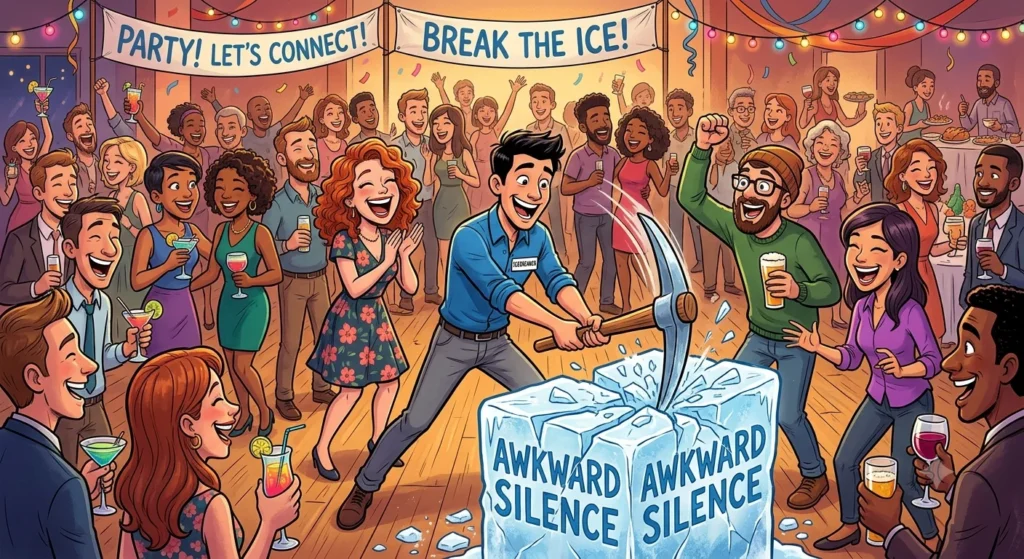
Break the Ice
Word-by-word Meaning
Break = destroy, Ice = frozen water
Idiomatic/Figurative Meaning
To initiate conversation and ease tension in social settings.
Example Sentences
- I told a funny story to break the ice at the party.
- A joke can help break the ice during meetings.
Common Error
Using literally as breaking ice physically in social contexts.
Usage Note
Often used in professional or casual social settings.
Supporting Image Prompt: Cartoon of someone literally breaking ice at a party while people laugh and talk.
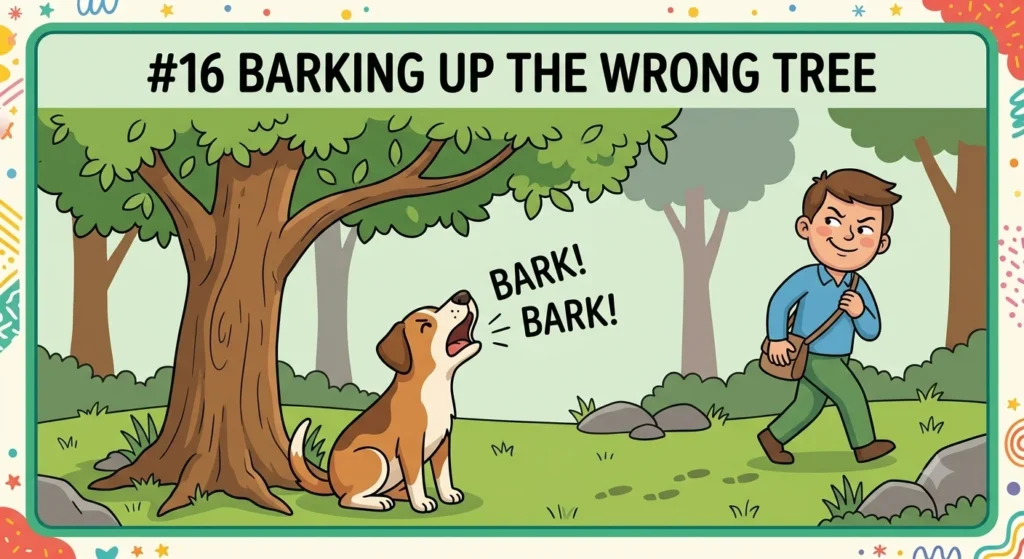
Barking Up the Wrong Tree
Word-by-word Meaning
Barking = dog sound, Wrong tree = mistaken tree
Idiomatic/Figurative Meaning
Blaming the wrong person or pursuing a mistaken idea.
Example Sentences
- If you think I’m responsible for the error, you’re barking up the wrong tree.
- He was barking up the wrong tree by asking for a raise now.
Common Error
Confusing with general mistakes – it specifically refers to blaming or pursuing incorrectly.
Usage Note
Common in casual and professional English.
Supporting Image Prompt: Dog barking at a tree while the “guilty” person walks away unnoticed.
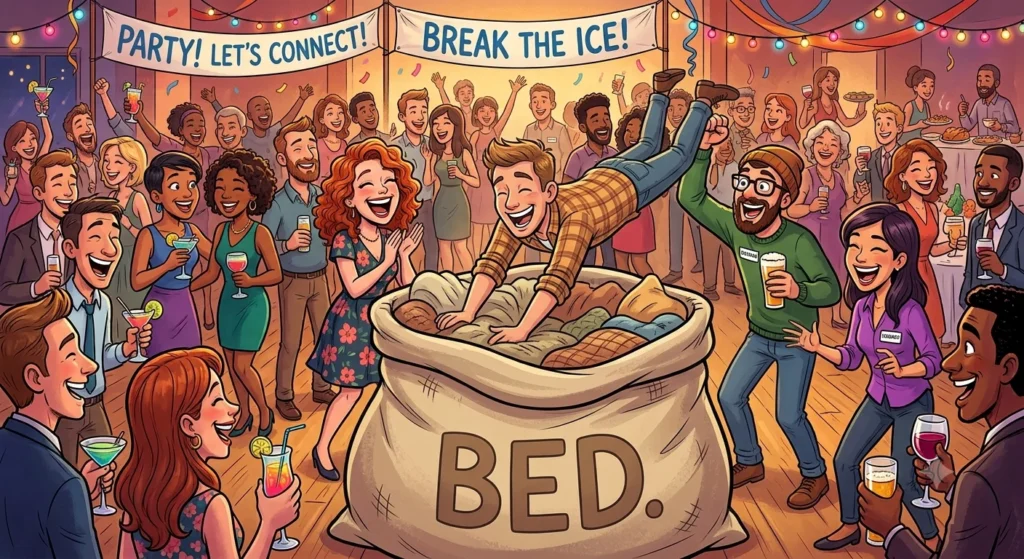
Hit the Sack
Word-by-word Meaning
Hit = strike, Sack = bed/bag
Idiomatic/Figurative Meaning
To go to bed or sleep.
Example Sentences
- I’m exhausted; time to hit the sack.
- After the long journey, she hit the sack immediately.
Common Error
Literally striking a sack instead of going to sleep.
Usage Note
Informal; used in casual conversation.
Supporting Image Prompt: Cartoon of someone diving happily into a huge sack labeled “BED.”
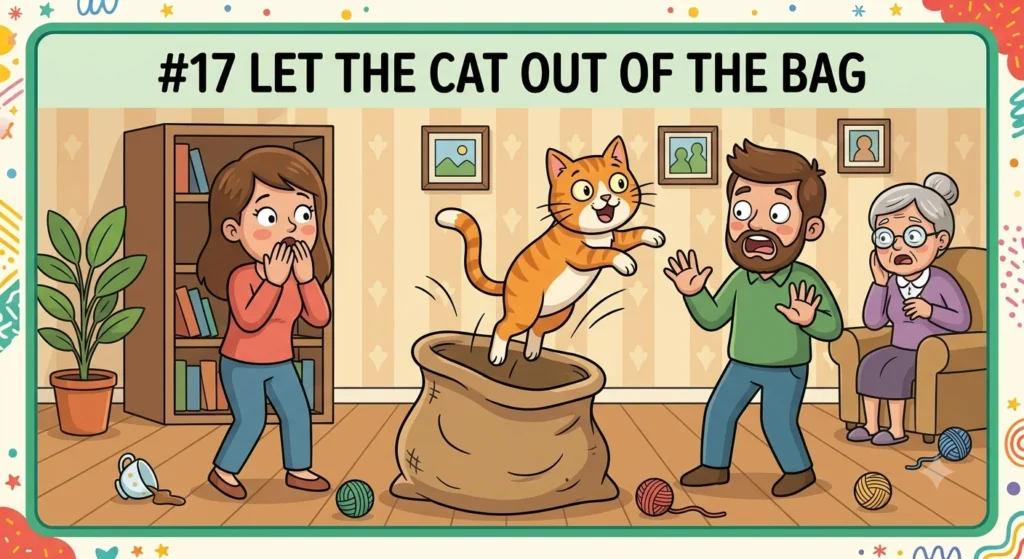
Let the Cat Out of the Bag
Word-by-word Meaning
Let = release, Cat = feline, Bag = container
Idiomatic/Figurative Meaning
Reveal a secret unintentionally.
Example Sentences
- He let the cat out of the bag about the surprise party.
- Don’t let the cat out of the bag or she’ll find out.
Common Error
Confusing with revealing on purpose; it often implies accidental disclosure.
Usage Note
Perfect for casual and storytelling contexts.
Supporting Image Prompt: Cartoon of a cat popping out of a shopping bag, surprising everyone.
Kick the Bucket
Word-by-word Meaning
Kick = strike, Bucket = container
Idiomatic/Figurative Meaning
A humorous or euphemistic way of saying someone died.
Example Sentences
- The old farmer finally kicked the bucket.
- He joked about kicking the bucket after winning the lottery.
Common Error
Taking it literally; it’s a metaphor for death.
Usage Note
Casual, often used humorously. Avoid in serious contexts.
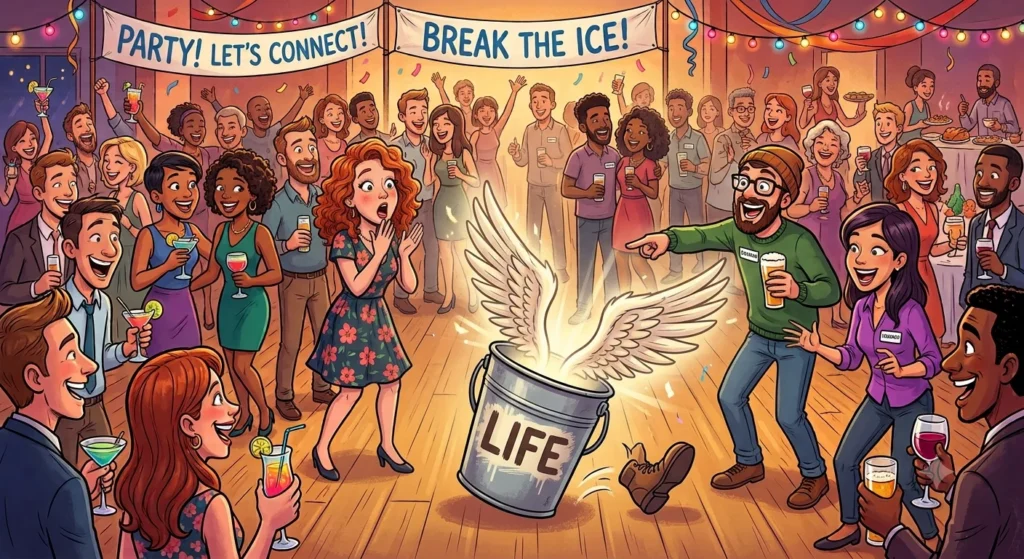
Supporting Image Prompt: Cartoon of a character gently tapping a bucket labeled “Life” while angel wings appear.
Piece of Cake
Word-by-word Meaning
Piece = portion, Cake = dessert
Idiomatic/Figurative Meaning
Something very easy to do.
Example Sentences
- The test was a piece of cake.
- Cooking pasta is a piece of cake once you try it.
Common Error
Confusing with eating an actual cake.
Usage Note
Informal; widely used in daily English.
Spill the Beans
Word-by-word Meaning
Spill = drop, Beans = legumes
Idiomatic/Figurative Meaning
To reveal secret information.
Example Sentences
- She spilled the beans about the new project.
- Don’t spill the beans before the announcement.
Common Error
Used literally – just spilling food.
Usage Note
Common in storytelling and gossip context.
Under the Weather
Word-by-word Meaning
Under = beneath, Weather = atmospheric conditions
Idiomatic/Figurative Meaning
Feeling sick or unwell.
Example Sentences
- I’m feeling under the weather today.
- She skipped school because she was under the weather.
Common Error
Assuming it means literally standing under rain.
Usage Note
Informal and polite way to express illness.
Once in a Blue Moon
Word-by-word Meaning
Once = one time, Blue Moon = rare lunar event
Idiomatic/Figurative Meaning
Something that happens very rarely.
Example Sentences
- We go out for dinner once in a blue moon.
- His visits are once in a blue moon.
Common Error
Misinterpreting as literally referring to the moon.
Usage Note
Good for storytelling or emphasizing rarity.
Bite the Bullet
Word-by-word Meaning
Bite = use teeth, Bullet = ammunition
Idiomatic/Figurative Meaning
To endure a painful or difficult situation bravely.
Example Sentences
- I had to bite the bullet and finish the report.
- She bit the bullet and apologized for her mistake.
Common Error
Thinking it involves literal bullets; metaphor for courage.
Usage Note
Used in formal and informal contexts.
Cut Corners
Word-by-word Meaning
Cut = reduce, Corners = edges
Idiomatic/Figurative Meaning
To do something poorly or cheaply to save time or money.
Example Sentences
- Don’t cut corners on your homework.
- They cut corners when building the house, and it collapsed.
Common Error
Thinking it refers to literally trimming corners.
Usage Note
Casual or professional context; warns against low-quality shortcuts.
Hit the Nail on the Head
Word-by-word Meaning
Hit = strike, Nail = metal pin, Head = top
Idiomatic/Figurative Meaning
To describe exactly what is causing a problem or situation.
Example Sentences
- You hit the nail on the head with that solution.
- Her analysis hit the nail on the head.
Common Error
Literal thinking – hitting an actual nail.
Usage Note
Common in professional and informal discussions.
Back to Square One
Word-by-word Meaning
Back = return, Square one = starting point
Idiomatic/Figurative Meaning
Return to the beginning after a failed attempt.
Example Sentences
- The project failed, so we’re back to square one.
- We tried a new approach, but ended up back to square one.
Common Error
Confusing with moving backward slightly; it implies restarting completely.
Usage Note
Informal and work-related scenarios.
Cost an Arm and a Leg
Word-by-word Meaning
Cost = price, Arm = limb, Leg = limb
Idiomatic/Figurative Meaning
Very expensive.
Example Sentences
- That car costs an arm and a leg.
- The repair bill cost me an arm and a leg.
Common Error
Literal interpretation; it’s metaphorical.
Usage Note
Informal, used to exaggerate cost.
Cry Over Spilled Milk
Word-by-word Meaning
Cry = weep, Spilled milk = liquid on floor
Idiomatic/Figurative Meaning
Regret something that cannot be undone.
Example Sentences
- Don’t cry over spilled milk; move on.
- She regretted missing the train but realized crying over spilled milk won’t help.
Common Error
Literal thinking – crying over actual milk.
Usage Note
Encourages focusing on solutions, not regrets.
Add Fuel to the Fire
Word-by-word Meaning
Add = put more, Fuel = combustible material, Fire = flames
Idiomatic/Figurative Meaning
To make a bad situation worse.
Example Sentences
- His comment added fuel to the fire.
- Don’t add fuel to the fire during the argument.
Common Error
Literal interpretation – adding wood or petrol to a fire.
Usage Note
Used in disputes or conflicts.
Burning the Midnight Oil
Word-by-word Meaning
Burning = light up, Midnight oil = lamp oil at night
Idiomatic/Figurative Meaning
Working late into the night.
Example Sentences
- I’ve been burning the midnight oil to finish my project.
- She burned the midnight oil studying for exams.
Common Error
Literal – burning actual oil is rare today.
Usage Note
Common in both informal and formal writing.
The Ball is in Your Court
Word-by-word Meaning
Ball = game object, Court = playing area
Idiomatic/Figurative Meaning
It’s your turn to make a decision or act.
Example Sentences
- I’ve done my part; now the ball is in your court.
- Negotiations continue, but the ball is in their court.
Common Error
Confusing with sports literally; it’s metaphorical.
Usage Note
Common in professional, negotiation, and informal contexts.
Elephant in the Room
Word-by-word Meaning
Elephant = large animal, Room = space
Idiomatic/Figurative Meaning
An obvious problem or issue that everyone ignores.
Example Sentences
- The budget cuts are the elephant in the room.
- They discussed everything except the elephant in the room.
Common Error
Thinking it involves a literal elephant.
Usage Note
Used to point out unspoken but obvious issues.
Throw in the Towel
Word-by-word Meaning
Throw = toss, Towel = cloth for wiping
Idiomatic/Figurative Meaning
To give up or admit defeat.
Example Sentences
- After failing the test twice, he threw in the towel.
- Don’t throw in the towel yet; you can still succeed.
Common Error
Literal – tossing a towel in a bathroom context.
Usage Note
Used in challenges, sports, and work contexts.
FAQs About Dumb Idioms
Q1: Why are some idioms called “dumb”?
They are called dumb because their literal meanings are silly or confusing compared to their figurative meanings.
Q2: Can I use dumb idioms in professional writing?
Some, like “hit the nail on the head,” are fine; many are better suited for casual conversations.
Q3: How can I memorize idioms easily?
Use stories, images, or real-life examples to link literal and figurative meanings.
Q4: Do all English speakers use these idioms?
Many are widely used in English-speaking countries, though usage can vary by region.
Q5: Will using idioms improve my English?
Yes! Idioms make your speech more natural and expressive.
Conclusion
Dumb idioms may seem strange at first, but they make English fun, colorful, and expressive. Start with a few idioms, practice them in daily conversation, and gradually master all 20. Laugh at their literal meanings, and watch your fluency and confidence soar!

Julian Mercer, author at SeekIdiom, writes clear explanations of English idioms with examples to help learners improve vocabulary and communication skills.