Ever found yourself in a pickle during an awkward moment or tricky situation? 🤔
Pickle idioms are fun, vivid English expressions that describe confusion, trouble, or tight spots—often using food imagery to make language memorable.
In this guide, you’ll learn the 20 most famous pickle idioms, explained simply with examples, common mistakes, and usage tips so you can use them naturally in real life.
Why Are Pickle Idioms So Popular in English?
Pickles represent something preserved, sour, or complicated, which makes them perfect metaphors for difficult situations. Native speakers love these idioms because they:
- Sound informal and expressive
- Add humor to serious situations
- Make conversations more engaging
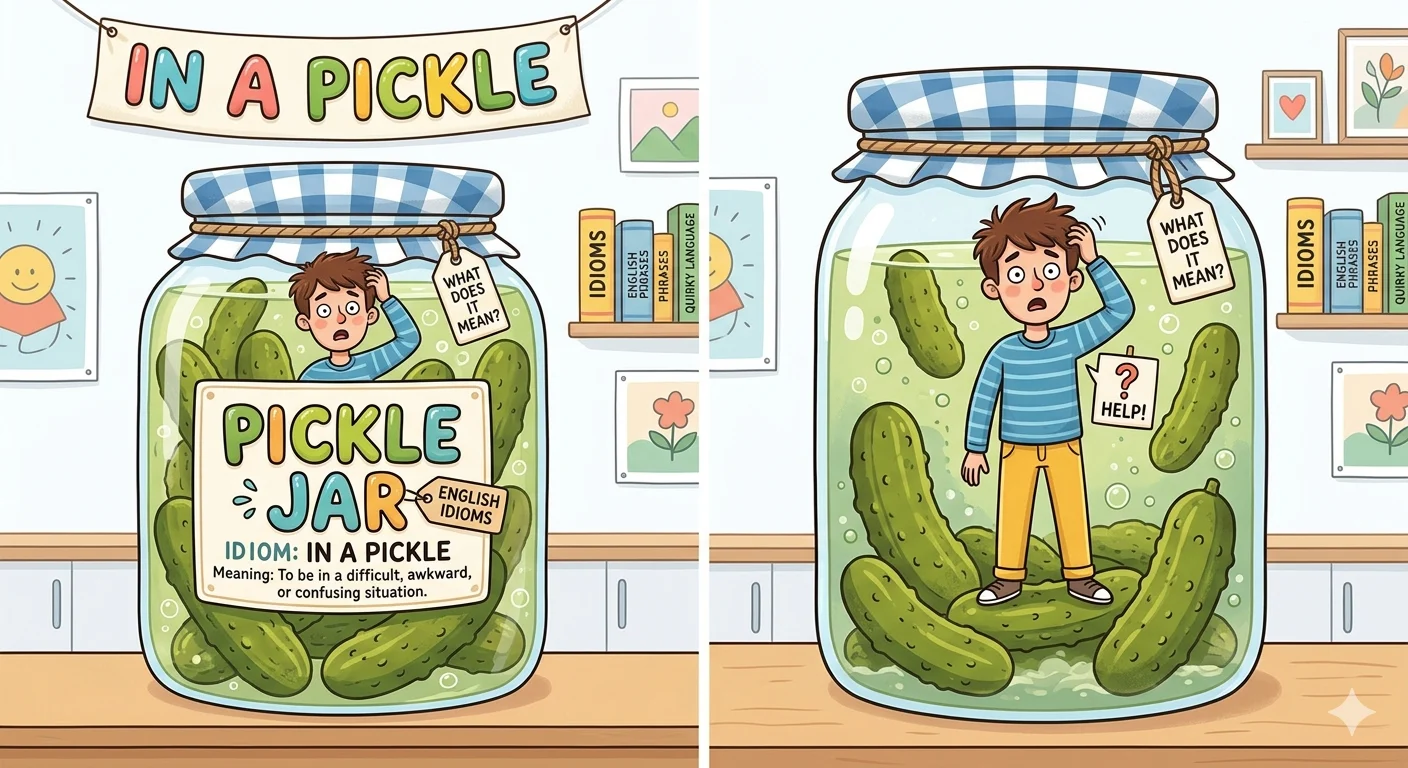
In a Pickle
Word-by-word meaning: Inside a jar of pickles
Idiomatic meaning: In a difficult or awkward situation
Example sentences:
- I’m in a pickle—I lost my wallet before the interview.
- She was in a pickle when her phone died mid-journey.
Common error: ❌ in pickle
Usage note: Always use “in a pickle”, not without a.
Get Someone Out of a Pickle
Word-by-word meaning: Remove someone from pickles
Idiomatic meaning: Help someone solve a problem
Example sentences:
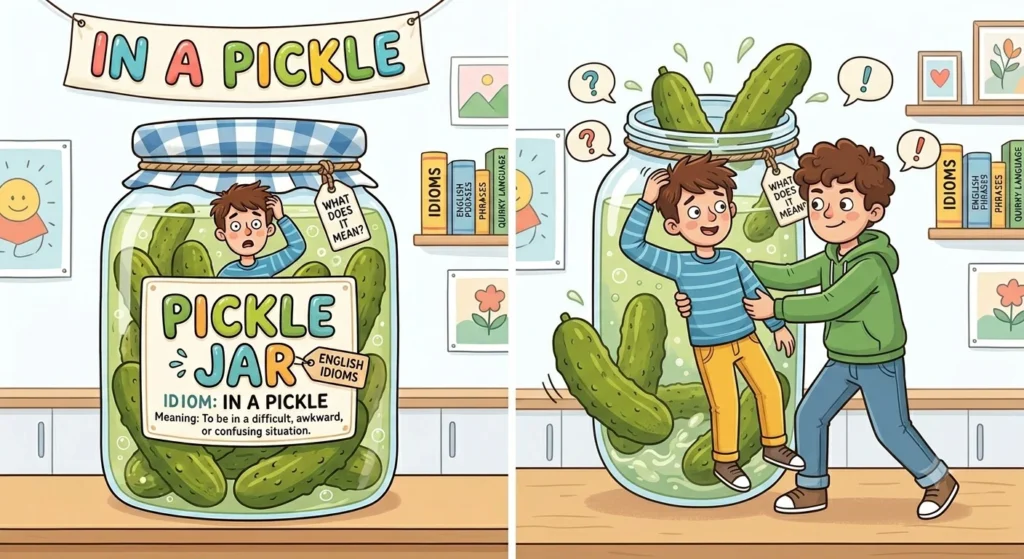
- He got me out of a pickle by lending money.
- Thanks for getting me out of that pickle!
Common error: Using it for minor favors
Usage note: Best for real problems, not small tasks.
Be in a Fine Pickle
Word-by-word meaning: In a “good” pickle (ironical)
Idiomatic meaning: In serious trouble (sarcastic)
Example sentences:
- Now we’re in a fine pickle—no backup plan!
- She forgot the deadline and landed in a fine pickle.
Common error: Taking “fine” literally
Usage note: Often used sarcastically.
Leave Someone in a Pickle
Word-by-word meaning: Leave someone stuck
Idiomatic meaning: Abandon someone in trouble
Example sentences:
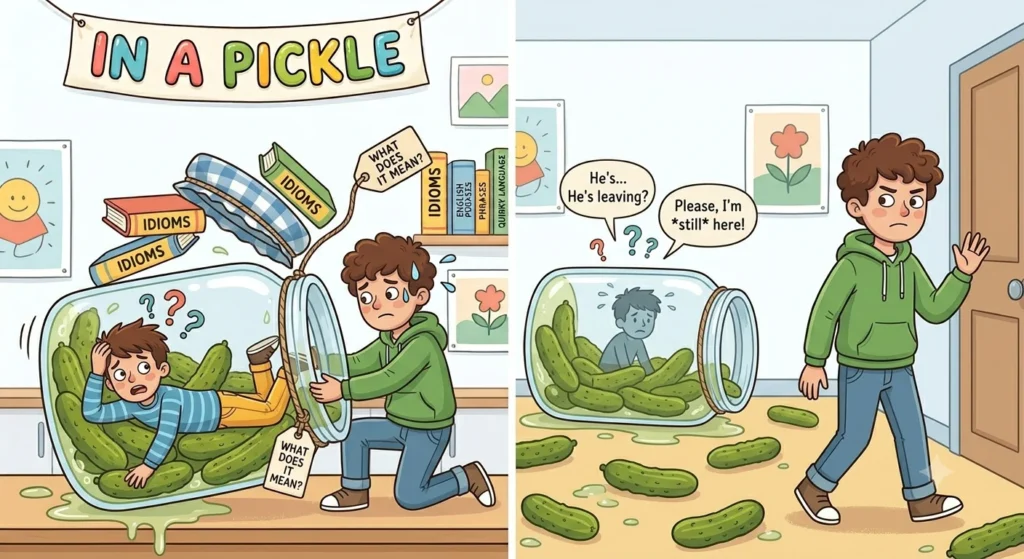
- He quit the project and left us in a pickle.
- Don’t leave your teammate in a pickle.
Common error: Using it unintentionally
Usage note: Implies responsibility or blame.
A Real Pickle
Word-by-word meaning: A genuine pickle
Idiomatic meaning: A very serious problem
Example sentences:
- Missing the passport is a real pickle.
- This budget issue is a real pickle.
Common error: Overusing for small issues
Usage note: Stronger than in a pickle.
Quite a Pickle
Word-by-word meaning: A noticeable pickle
Idiomatic meaning: A complicated situation
Example sentences:
- We’re in quite a pickle with this schedule.
- That decision put her in quite a pickle.
Common error: Forgetting “quite”
Usage note: Adds emphasis.
Pickle Jar Situation
Word-by-word meaning: Being stuck in a jar
Idiomatic meaning: Feeling trapped with no clear exit
Example sentences:
- That job felt like a pickle jar situation.
- I was stuck in a pickle jar situation financially.
Common error: Assuming it’s formal
Usage note: Informal and conversational.
Pickle-Brained
Word-by-word meaning: Brain like a pickle
Idiomatic meaning: Confused or not thinking clearly
Example sentences:
- I was pickle-brained after the long exam.
- Don’t mind him—he’s pickle-brained today.
Common error: Using in formal writing
Usage note: Casual and humorous.
Pickle of a Problem
Word-by-word meaning: A pickle-shaped problem
Idiomatic meaning: A tricky issue
Example sentences:
- This assignment is a pickle of a problem.
- Fixing this error is a pickle of a problem.
Common error: Mixing word order
Usage note: Rare but expressive.
In Deep Pickle
Word-by-word meaning: Deep inside pickles
Idiomatic meaning: In serious trouble
Example sentences:
- He’s in deep pickle with his boss.
- They’re in deep pickle after the loss.
Common error: Missing article
Usage note: Informal emphasis.
Pickled Situation
Word-by-word meaning: Preserved situation
Idiomatic meaning: Complicated and stuck
Example sentences:
- The negotiation became a pickled situation.
- It’s a pickled situation now.
Common error: Confusing with food context
Usage note: Less common, informal.
Pickle Trouble
Word-by-word meaning: Trouble involving pickles
Idiomatic meaning: Ongoing problems
Example sentences:
- He’s been in pickle trouble all week.
- That deal caused pickle trouble.
Common error: Overgeneralizing
Usage note: Casual speech only.
Pickle Mess
Word-by-word meaning: A messy pickle
Idiomatic meaning: A chaotic situation
Example sentences:
- The event turned into a pickle mess.
- This project is a pickle mess.
Common error: Using formally
Usage note: Very informal.
Pickle Jam
Word-by-word meaning: Jam of pickles
Idiomatic meaning: Tight or stuck situation
Example sentences:
- We’re in a pickle jam financially.
- Traffic put us in a pickle jam.
Common error: Literal interpretation
Usage note: Rare, playful.
Pickle Crisis
Word-by-word meaning: Crisis with pickles
Idiomatic meaning: Sudden big problem
Example sentences:
- A data loss caused a pickle crisis.
- They faced a pickle crisis overnight.
Common error: Using without context
Usage note: Adds drama.
Pickle Moment
Word-by-word meaning: Moment involving pickles
Idiomatic meaning: Awkward or difficult moment
Example sentences:
- That question created a pickle moment.
- It was a pickle moment for everyone.
Common error: Overuse
Usage note: Storytelling friendly.
Pickle Fix
Word-by-word meaning: Fixing a pickle
Idiomatic meaning: Solution to a problem
Example sentences:
- This plan is our pickle fix.
- She found a quick pickle fix.
Common error: Mixing with quick fix
Usage note: Informal alternative.
Pickle Puzzle
Word-by-word meaning: A puzzle made of pickles
Idiomatic meaning: Confusing situation
Example sentences:
- The rules turned into a pickle puzzle.
- Life sometimes feels like a pickle puzzle.
Common error: Using academically
Usage note: Creative expression.
Pickle Predicament
Word-by-word meaning: Difficult pickle situation
Idiomatic meaning: Serious dilemma
Example sentences:
- He’s in a pickle predicament at work.
- That choice led to a pickle predicament.
Common error: Redundancy
Usage note: Strong emphasis.
Pickle Problem
Word-by-word meaning: A problem involving pickles
Idiomatic meaning: Tricky issue
Example sentences:
- Budget cuts are a pickle problem.
- This is a classic pickle problem.
Common error: Overusing as a phrase
Usage note: Casual speech.
Frequently Asked Questions About Pickle Idioms
What does “in a pickle” mean?
It means being in a difficult, awkward, or confusing situation.
Are pickle idioms formal or informal?
Most pickle idioms are informal and used in daily conversation.
Can I use pickle idioms in exams?
Yes, but only in creative or informal writing, not academic essays.
Why does English use food idioms so often?
Food makes language relatable, visual, and easier to remember.
Are pickle idioms common in American or British English?
They are used in both, especially conversational English.
Conclusion: Start Using Pickle Idioms Today 🥒
Pickle idioms add color, emotion, and personality to your English. The more you practice them in sentences, the more natural they’ll feel. Try using one pickle idiom a day in conversation or writing—and soon, you won’t be in a pickle about idioms anymore!

Sophie Langford, author at SeekIdiom, explains English idioms with clear meanings, examples, and usage to help learners improve vocabulary and communication.