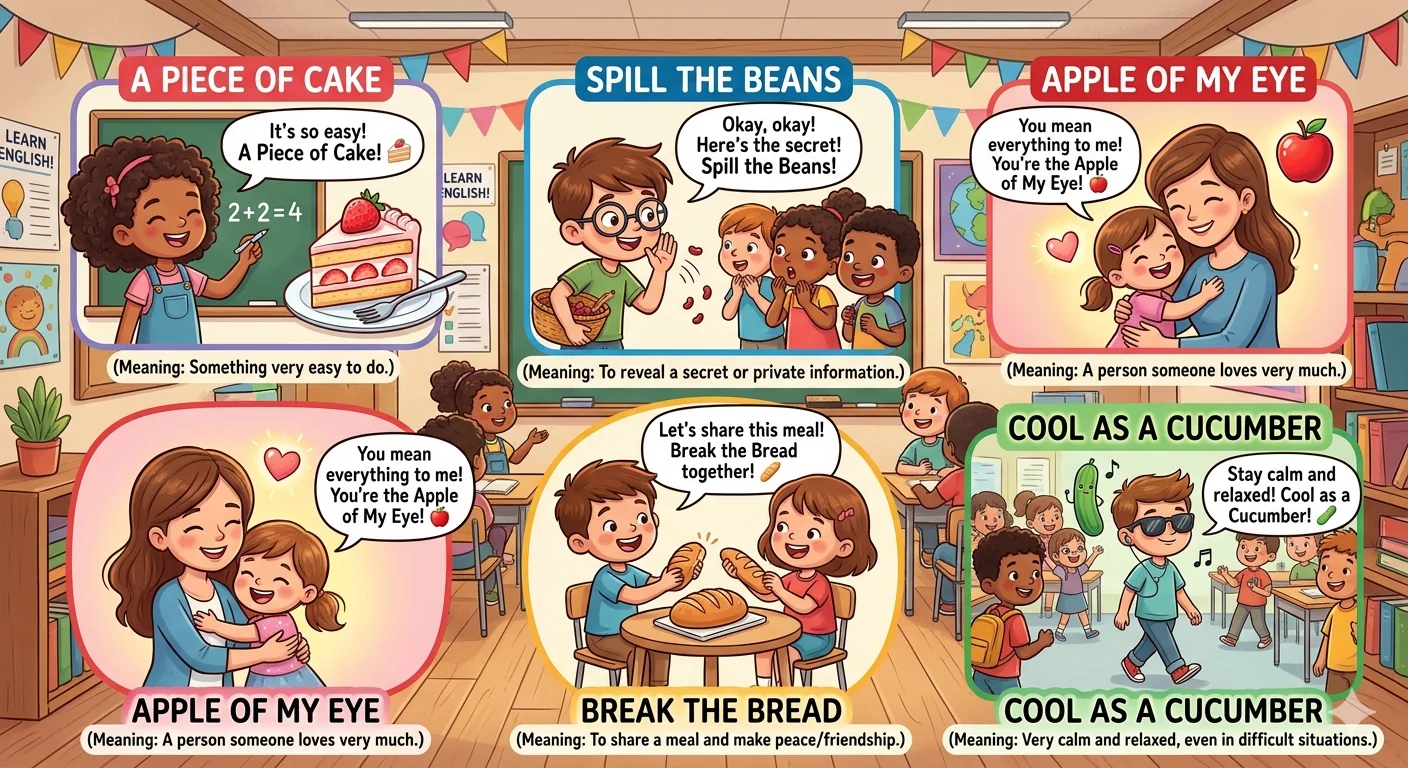
Have you ever heard someone say “that’s a piece of cake” and wondered why cake is involved? 🍰
Idioms of foods are common expressions that use food words to express feelings, situations, and ideas in everyday English—often without any real food involved!
In this guide, you’ll learn the 20 most famous food idioms, their meanings, examples, and common mistakes so you can use them confidently.
Why Idioms of Foods Are Important in English
Food is universal, so it’s no surprise that English uses it creatively. Learning idioms of foods helps you:
- Sound more natural and fluent
- Understand movies, books, and conversations
- Express emotions in a fun, memorable way
Piece of Cake
Word-by-word meaning: A slice of cake
Idiomatic meaning: Something very easy
Example sentence:

The exam was a piece of cake for her.
Common error: Using it for difficult tasks
Usage note: Informal; very common in spoken English
Spill the Beans
Word-by-word meaning: Drop beans accidentally
Idiomatic meaning: Reveal a secret
Example sentence:

He spilled the beans about the surprise party.
Common error: Using it for accidental physical actions
Usage note: Often used with secrets or surprises
Butter Someone Up
Word-by-word meaning: Cover someone with butter
Idiomatic meaning: Flatter someone to get a favor
Example sentence:

She buttered up her boss before asking for leave.
Common error: Confusing it with genuine praise
Usage note: Slightly negative tone
A Tough Nut to Crack
Word-by-word meaning: A hard nut
Idiomatic meaning: A difficult problem or person
Example sentence:

This math question is a tough nut to crack.
Common error: Using it for simple problems
Usage note: Neutral; problem-solving contexts
Full of Beans
Word-by-word meaning: Filled with beans
Idiomatic meaning: Energetic and lively
Example sentence:

The kids were full of beans after the picnic.
Common error: Using it for food situations
Usage note: Informal and positive
Cry Over Spilled Milk
Word-by-word meaning: Crying after milk spills
Idiomatic meaning: Worrying about past mistakes
Example sentence:
Don’t cry over spilled milk; learn from it.
Common error: Using it for future problems
Usage note: Often used as advice
Have a Sweet Tooth
Word-by-word meaning: Teeth liking sugar
Idiomatic meaning: Love for sweets
Example sentence:
I can’t resist desserts—I have a sweet tooth.
Common error: Using it for salty food
Usage note: Very common in casual talk
In a Pickle
Word-by-word meaning: Inside a pickle jar
Idiomatic meaning: In trouble or difficulty
Example sentence:
I’m in a pickle—I lost my wallet.
Common error: Using it for mild inconvenience
Usage note: Informal and expressive
Hot Potato
Word-by-word meaning: A very hot potato
Idiomatic meaning: A controversial issue
Example sentence:
Politics is a hot potato at dinner.
Common error: Using it for physical heat
Usage note: Social and political contexts
Bring Home the Bacon
Word-by-word meaning: Bring meat home
Idiomatic meaning: Earn money for family
Example sentence:
She works hard to bring home the bacon.
Common error: Literal food interpretation
Usage note: Informal, family-related
Apple of One’s Eye
Word-by-word meaning: Favorite apple
Idiomatic meaning: Someone dearly loved
Example sentence:
His daughter is the apple of his eye.
Common error: Using for objects
Usage note: Emotional and affectionate
Bread and Butter
Word-by-word meaning: Basic food items
Idiomatic meaning: Main source of income
Example sentence:
Teaching is her bread and butter.
Common error: Confusing with hobbies
Usage note: Work and finance related
Eat Humble Pie
Word-by-word meaning: Eat a modest pie
Idiomatic meaning: Admit you were wrong
Example sentence:
He had to eat humble pie after the mistake.
Common error: Using it jokingly
Usage note: Often implies embarrassment
Spill the Tea
Word-by-word meaning: Pour tea out
Idiomatic meaning: Share gossip
Example sentence:
Come on, spill the tea!
Common error: Formal writing use
Usage note: Modern slang, informal
Cool as a Cucumber
Word-by-word meaning: Cold vegetable
Idiomatic meaning: Calm under pressure
Example sentence:
She stayed cool as a cucumber in the interview.
Common error: Using it for cold weather
Usage note: Positive personality trait
Chew the Fat
Word-by-word meaning: Chewing meat
Idiomatic meaning: Chat casually
Example sentence:
We sat and chewed the fat all evening.
Common error: Using during arguments
Usage note: Friendly conversations
Hard to Swallow
Word-by-word meaning: Difficult to eat
Idiomatic meaning: Difficult to accept
Example sentence:
The truth was hard to swallow.
Common error: Literal food context
Usage note: Emotional situations
Sour Grapes
Word-by-word meaning: Grapes tasting sour
Idiomatic meaning: Pretending not to care after failure
Example sentence:
Saying it’s useless is just sour grapes.
Common error: Using before failure
Usage note: Mildly negative tone
Eat Like a Bird
Word-by-word meaning: Eat very little
Idiomatic meaning: Eat small amounts
Example sentence:
She eats like a bird.
Common error: Confusing with “eat a lot”
Usage note: Casual description
Too Many Cooks Spoil the Broth
Word-by-word meaning: Many cooks ruin soup
Idiomatic meaning: Too many people ruin a task
Example sentence:
Let one leader decide—too many cooks spoil the broth.
Common error: Shortening incorrectly
Usage note: Proverb-style idiom
Frequently Asked Questions (FAQs)
1. What are idioms of foods?
Idioms of foods are expressions that use food words to convey meanings different from their literal sense.
2. Are food idioms formal English?
Most food idioms are informal and used in daily conversation, not academic writing.
3. Why does English use food in idioms?
Food is familiar to everyone, making expressions more vivid and memorable.
4. Can I use food idioms in exams?
Yes, but only in creative writing or speaking, not formal essays.
5. How can I remember idioms easily?
Link them with real-life situations or imagine a funny food picture in your mind.
Conclusion: 🍎
Mastering idioms of foods can instantly improve your English fluency and confidence. Start by learning 3–4 idioms a week, use them in sentences, and notice how naturally your English begins to flow.
Next time you hear a strange food expression, don’t panic—enjoy the flavor of the language!

Sophie Langford, author at SeekIdiom, explains English idioms with clear meanings, examples, and usage to help learners improve vocabulary and communication.