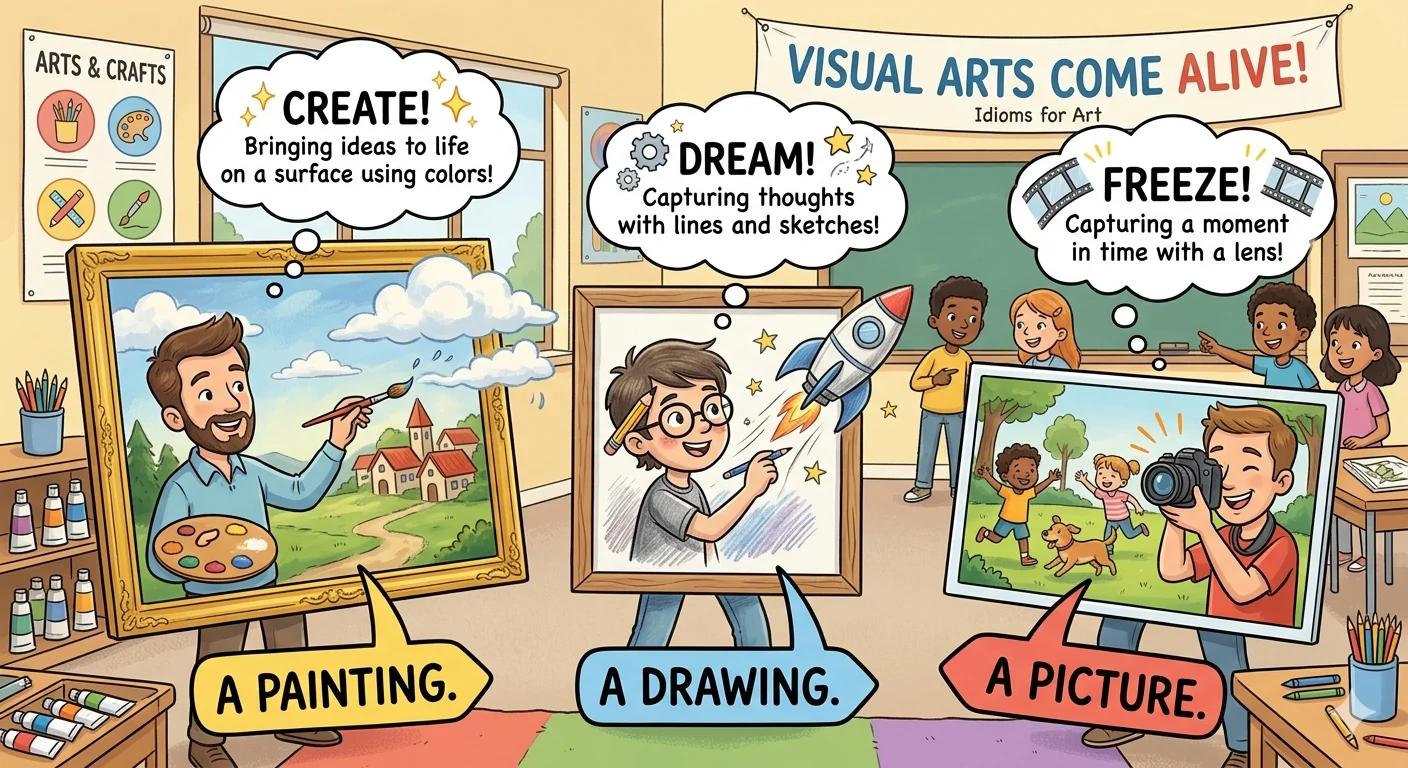
English is full of colorful expressions, and illustration idioms are perfect examples. Whether you’re writing creatively, speaking casually, or teaching English, understanding these idioms makes your language lively. Imagine trying to explain a tricky idea visually—idioms often do the “illustration” for you!
Here are 20 of the most famous illustration idioms with easy explanations, examples, and tips to use them naturally.
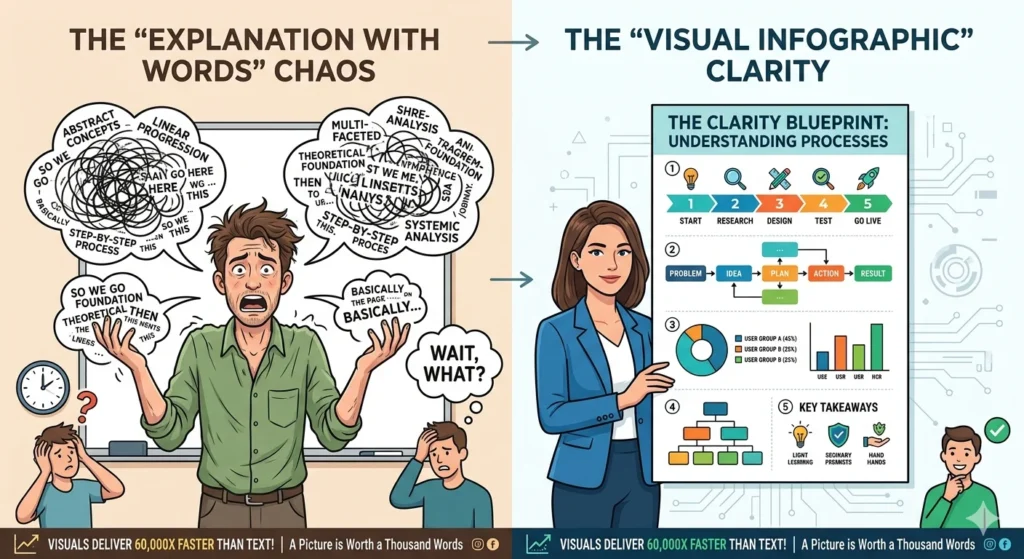
A Picture is Worth a Thousand Words
Word-by-Word Meaning
A single picture can express as much as many words.
Idiomatic Meaning
Visuals often communicate complex ideas better than verbal explanations.
Example Sentences
- The infographic was so clear; truly, a picture is worth a thousand words.
- Instead of explaining, she drew a chart—a picture is worth a thousand words.
Common Error
Saying “one picture equals a thousand words” is less natural.
Usage Note
Use in both professional presentations and casual conversation to highlight visual clarity.
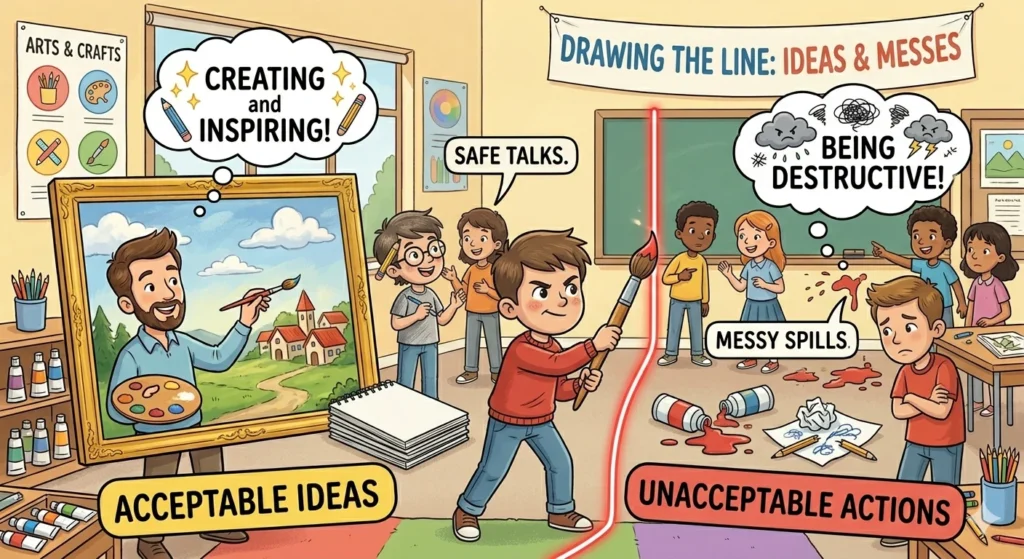
Draw the Line
Word-by-Word Meaning
Mark a line to separate areas or ideas.
Idiomatic Meaning
To set a limit on what you will accept or allow.
Example Sentences
- I like to help, but I must draw the line at lending money.
- Teachers need to draw the line when students misbehave.
Common Error
Avoid using it literally when the context is about boundaries.
Usage Note
Works well in personal boundaries and professional ethics discussions.
Paint a Picture
Word-by-Word Meaning
Use paint to create an image.
Idiomatic Meaning
Describe something in detail so someone can imagine it clearly.
Example Sentences
- She painted a picture of her hometown with vivid details.
- The lawyer painted a picture of the events during the trial.

Common Error
Avoid using with literal painting unless context is clear.
Usage Note
Ideal for storytelling, presentations, or descriptive writing.
Sketchy
Word-by-Word Meaning
Something made with rough, unfinished lines.
Idiomatic Meaning
Unclear, suspicious, or unreliable.
Example Sentences
- That deal sounds a bit sketchy to me.
- His explanation of the situation was sketchy.
Common Error
Not to confuse with literal sketches unless describing art.
Usage Note
Common in casual spoken English, especially for suspicious or uncertain situations.
Outline
Word-by-Word Meaning
Draw the edge or boundary of something.
Idiomatic Meaning
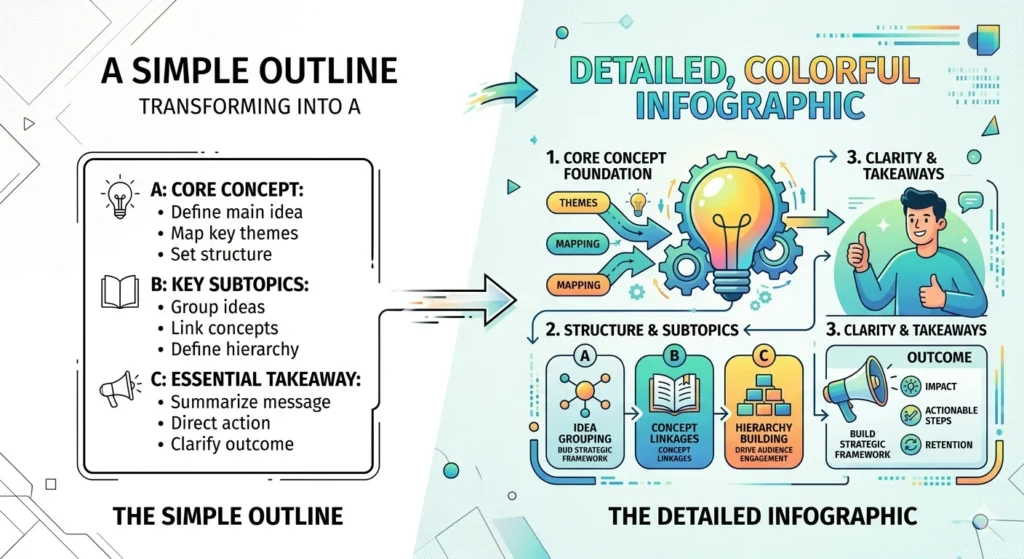
Provide a brief summary or main points of a plan or idea.
Example Sentences
- The manager outlined the project steps for the team.
- Can you outline your proposal in a few sentences?
Common Error
Avoid using it interchangeably with “detail”—outline is brief, not full explanation.
Usage Note
Frequently used in business, writing, and teaching.
In Black and White
Word-by-Word Meaning
Written or printed in black ink on white paper.
Idiomatic Meaning
Clearly written or explained, leaving no room for doubt.
Example Sentences
- The rules were stated in black and white.
- I need the agreement in black and white before signing.
Common Error
Avoid using for verbal explanations; it’s about clarity in written form.
Usage Note
Perfect for legal, business, or official documents.
A Stroke of Genius
Word-by-Word Meaning
A single, brilliant brush stroke.
Idiomatic Meaning
A sudden brilliant idea or action.
Example Sentences
- Creating that app was a stroke of genius.
- Her solution to the problem was a stroke of genius.
Common Error
Avoid using for everyday minor ideas; reserved for clever, impactful solutions.
Usage Note
Used to praise someone’s creativity or intelligence.
Color Outside the Lines
Word-by-Word Meaning
Draw beyond the boundary lines.
Idiomatic Meaning
Break rules creatively; think outside the box.
Example Sentences
- Innovative companies encourage employees to color outside the lines.
- He likes to color outside the lines when designing graphics.
Common Error
Avoid literal meaning unless teaching children to draw.
Usage Note
Great for creativity, brainstorming, and innovation contexts.
Picture-Perfect
Word-by-Word Meaning
Exactly like a perfect photograph.
Idiomatic Meaning
Flawless or ideal.
Example Sentences
- Their wedding was picture-perfect.
- The room looked picture-perfect after decorating.
Common Error
Avoid using for abstract ideas; best for visual or aesthetic perfection.
Usage Note
Common in descriptions of scenes, events, or aesthetics.
Draw a Blank
Word-by-Word Meaning
Make a blank space.
Idiomatic Meaning
Fail to remember something or think of a response.
Example Sentences
- I drew a blank during the exam.
- He drew a blank when asked about her name.
Common Error
Do not confuse with “forget” in permanent sense; it’s temporary memory lapse.
Usage Note
Frequently used in exams, interviews, or conversations.
On the Drawing Board
Word-by-Word Meaning
On a literal board for sketches.
Idiomatic Meaning
In planning or development stage.
Example Sentences
- The new project is still on the drawing board.
- Their startup is on the drawing board, not launched yet.
Common Error
Avoid using for finished or ongoing projects.
Usage Note
Often used in business and design contexts.
Behind the Scenes
Word-by-Word Meaning
At the back of a stage.
Idiomatic Meaning
Hidden work or activity that supports visible results.
Example Sentences
- Much of the film’s magic happens behind the scenes.
- Volunteers work behind the scenes to organize events.
Common Error
Do not use for publicly visible actions.
Usage Note
Works in entertainment, events, and business contexts.
Full of Color
Word-by-Word Meaning
Containing many colors.
Idiomatic Meaning
Lively, vivid, or exciting.
Example Sentences
- Her storytelling was full of color.
- The festival was full of color and joy.
Common Error
Avoid literal meaning unless describing art or visuals.
Usage Note
Use for writing, speeches, and descriptions to make them lively.
Trace Back
Word-by-Word Meaning
Follow lines back to the origin.
Idiomatic Meaning
Find the origin or source of something.
Example Sentences
- We traced back the problem to a software bug.
- Historians trace back the story to ancient times.
Common Error
Do not confuse with physical tracing unless literal.
Usage Note
Useful for research, history, or problem-solving contexts.
Masterpiece
Word-by-Word Meaning
A work made by a master.
Idiomatic Meaning
An outstanding or exceptional work.
Example Sentences
- That painting is a masterpiece.
- Her novel is a literary masterpiece.
Common Error
Avoid calling minor works a masterpiece.
Usage Note
Used for art, writing, or exceptional achievements.
In the Limelight
Word-by-Word Meaning
Standing in bright stage light.
Idiomatic Meaning
At the center of attention.
Example Sentences
- The actor was in the limelight after the awards.
- She enjoys being in the limelight at parties.
Common Error
Avoid using for hidden or background roles.
Usage Note
Good for fame, recognition, or public attention contexts.
By the Book
Word-by-Word Meaning
Following written instructions.
Idiomatic Meaning
Following rules exactly, without deviation.
Example Sentences
- The accountant did everything by the book.
- Police procedures must be done by the book.
Common Error
Do not use when improvising or being flexible.
Usage Note
Common in professional, legal, and official settings.
Fade to Black
Word-by-Word Meaning
Gradually darken to black.
Idiomatic Meaning
End suddenly, often dramatically.
Example Sentences
- The movie faded to black after the climax.
- The meeting seemed to fade to black without conclusion.
Common Error
Avoid literal use unless describing visuals.
Usage Note
Common in filmmaking, storytelling, and presentations.
Outline the Scene
Word-by-Word Meaning
Draw the main parts of a scene.
Idiomatic Meaning
Describe main points or events briefly.
Example Sentences
- The teacher outlined the scene for the play.
- Can you outline the scene before writing the story?
Common Error
Avoid giving full details when only a summary is required.
Usage Note
Ideal for storytelling, teaching, and planning.
Sketch of the Day
Word-by-Word Meaning
A quick drawing made for that day.
Idiomatic Meaning
A quick summary or highlight.
Example Sentences
- The newsletter includes a sketch of the day.
- The teacher gave a sketch of the day before the lesson.
Common Error
Avoid using for in-depth reports.
Usage Note
Works for quick summaries, highlights, and daily briefings.
FAQ Section
Q1: What are illustration idioms?
A: Expressions that use visual or drawing-related ideas to convey figurative meanings.
Q2: How can I use them in writing?
A: Include them in descriptions, storytelling, or when explaining complex ideas visually.
Q3: Are illustration idioms common in spoken English?
A: Yes, especially in informal conversations and creative contexts.
Q4: Can they be used in business writing?
A: Absolutely! Idioms like “draw the line” or “outline” fit professional settings.
Q5: How to remember these idioms?
A: Create visual associations or mini-sketches for each idiom—learning by illustration works best!
Conclusion
Learning illustration idioms makes your English expressive, fun, and easier to visualize. Start using one idiom a day in conversation or writing. Soon, your communication will feel more vivid and professional!

Adrian Wells, author at SeekIdiom, shares easy explanations of English idioms with examples to help learners expand vocabulary and speak more confidently.